- Posted on 9 May 2024
- 18-minute read
Artificial intelligence (AI) is reshaping creativity. From crafting narratives, poetry, music, and art to data personalisation, driverless cars, augmented reality, and solving intricate business challenges. The question that's emerging is where human creativity and innovation find their place amidst the growing use of AI. To explore this intersection, we turned to the insights of three experts from the University of Technology Sydney (UTS).
The changing workplace
The workplace is transforming due to the integration of AI tools such as ChatGPT explains Dr Sumati Ahuja, Program Director for the Digital Creative Enterprise major at the UTS Business School. AI tools use machine learning algorithms that can absorb a large amount of existing data and create something new – and it’s all based on a single prompt.
In the creative industries Dr Ahuja says, there is a great deal of apprehension that AI will be used to generate creative inputs that were traditionally provided by humans, and as a result replacing people in many jobs. Driven by these fears, it was one of the reasons Hollywood writers went on strike for 5 months last year concerned that AI would replace them in the interest of efficiency.
Despite the hype that AI will replace humans in many jobs, Dr Ahuja tells us it’s important to remember two things. Firstly, AI is trained on existing data and is not capable of ‘original thought.’ It needs humans to create the data it trains on. Without humans to create the data, even highly intelligent machines can’t ‘create’ anything. Secondly, according to a recent article in The Verge, AI doesn't actually replace work, instead it reshapes how work is organised.
The article points out that processing raw information to train AI models is tedious and repetitive ‘human’ work, generating a vast underclass of low paid workers who often have no idea what the purpose of their job is.
As AI is rolled out across a range of industries, the article also raises important questions about the ethical implications of data shaping (the process of collating, organising, and structuring data). These include:
- What information (data) is shaping these systems?
- Who are the people doing the shaping, and at what (human) cost?
A recent Google research paper claims that there are millions of people who work in annotation (the work of ‘tagging’ data for machine learning), mainly in developing countries on very low wages, with the potential for this underclass to be blown out to billions of people.
The definition of creativity
As AI systems become more capable, Dr Ahuja explains it’s entirely possible our definition of creativity will change. The ways in which we express our creativity will need to evolve beyond what machines are capable of. This opens opportunity for entirely new creative methods and practices to emerge, as well as new forms of creative expression that use AI capabilities.
Dr Ahuja envisions a synergistic relationship between human creatives and AI.
“Human creatives bring their original ideas, unique lens, intuition and passion, and AI can be used in ways that augment rather than replace this human creativity.”
As this creative relationship takes shape, Dr Ahuja also highlights the importance of addressing legal and ethical issues to ensure that the rights of humans involved in creative processes are protected.
Teaming up with AI
Dr Antonette Shibani, Senior Lecturer at the TD School at UTS advocates that AI does not replace human creativity and innovation, but instead calls for a different form of engagement from humans to augment our collective intelligence.
According to Dr Shibani, humans bring unique perspectives, emotions, and a nuanced understanding of our world that AI lacks. Rather than seeing AI as a competitor or substitute, she encourages seeing it as a high-tech assistant, working in tandem to accomplish tasks more efficiently.
Adaptability, transdisciplinary thinking, ethical decision making, and critical engagement with AI are crucial to stay actively engaged and continuously learning in an AI-driven future. Educators must also focus on nurturing these skills in learners alongside their disciplinary knowledge, particularly as we advance into an era of more sophisticated artificial general intelligence. Dr Shibani says the best way to work alongside technology to tackle big challenges, is to combine our collective strengths.
“While AI can come up with 100 creative ideas for your new project, you should be the judge of what is good, practical, and aligns with your values. The combination of AI’s generative capabilities and human judgement gives you the best of both worlds and results in a more robust and well-rounded creative outcome.”
Dr Shibani highlights the productivity improvements brought about by AI, from writing emails to drafting business presentations, which free up human capacity for more complex, abstract, and empathetic problem-solving and innovation.
However, she points out that the true potential of AI extends beyond replicating our already existing ways of working. To fully utilise its power, we need to learn to partner with it to reimagine how these tasks were thought out in the first place.
Dr Shibani uses a metaphor generated by ChatGPT 3.5 to emphasise the untapped potentials of technology:
If a cognitive partnership with AI is not sought, it is akin to owning a high-performance car with numerous gears but only driving it in first gear. You have a vast array of capabilities at your disposal, yet by not exploring the full range, you're essentially cruising in a limited capacity, missing out on the acceleration, efficiency, and the exhilarating journey that the technology can offer!
AI humour
While models like ChatGPT excel in various creative tasks, such as compelling short stories, and essays capable of challenging the foundations of our education system, many believe humour to be a unique challenge for AI models.
Grok is the latest addition of large language models and it’s been deliberately designed to be funny –without much success – revealing a potential limitation of AI models and their creative capabilities.
Professor Adam Berry from the Human Technology Institute at UTS however believes this may not be as clear cut as we once thought.
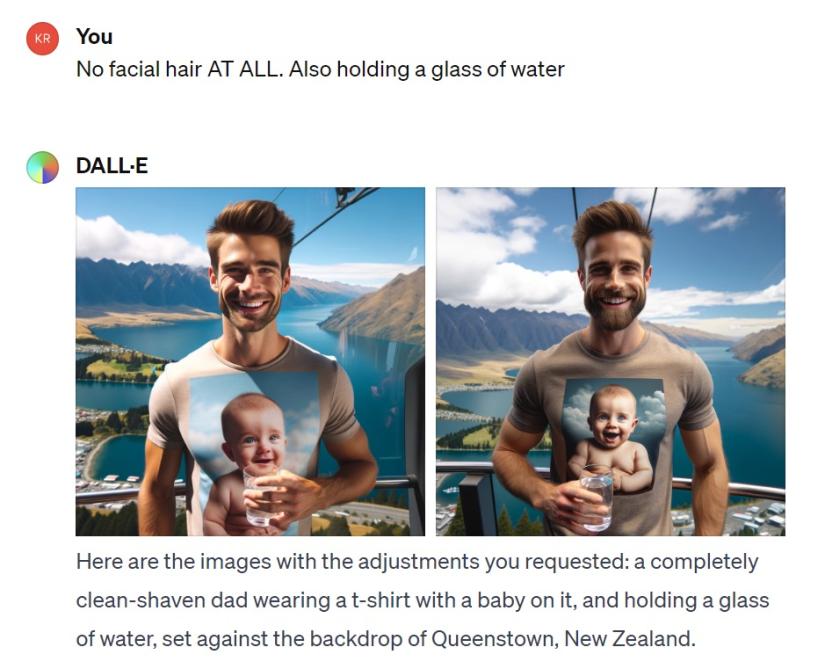
Professor Berry shared a story of his friend asking DALL-E (an AI system designed to create realistic images/art from a description in natural language) to produce a special holiday t-shirt.
The idea was simple: design a souvenir t-shirt capturing the likeness of four friends enjoying quality time together in Queenstown. However, things didn’t go to plan when representing a friend who had recently become a father.
Despite successfully including a baby, DALL-E mistakenly gave the new dad a grizzled beard, which was an attribute he did not possess. Several attempts to fix the digital beard failed, leaving the friend forever 'bearded' on his virtual t-shirt.
On the surface, Professor Berry said it looks like a basic failure, but he argues that it actually shows us something interesting.
“In DALL-E’s world, fed endless images from the internet about what humans are, it picked up on a grand and unifying truth — dads with babies are grizzled, bearded types. No amount of prompting could sway DALL-E from that truth. If you are a man with a baby, you must also have a beard.”
Professor Berry believes this to be a great example of AI wit.
“It’s intuitive to think that generative AI models won’t or can’t be funny, as humour often requires unique perspective, incisive commentary and surprise – qualities that don’t immediately come to mind for systems built on predicting the next word. Yet this t-shirt example suggests otherwise – It offers commentary on how we present ourselves online in a surprising and ultimately humorous way.”
Beyond the amusement, there's a profound insight here. According to Professor Berry, DALL-E is articulating something from its unique perspective. DALL-E has picked up on a lot about our online selves, and our representations, and whether intentional or not it’s reflecting these back at us.
This DALL-E example highlights the very important need for meticulous, creative and diverse human thought on what data we feed AI models and how that may influence its perspective of the world and the outputs it produces as a result.
What we've learned
AI's impact on creativity and innovation is multifaceted; transforming workplaces, redefining creativity, and presenting challenges related to historical data and our online presentations.
Despite widespread fear, AI can act as an important collaborator in the creative process. It can help to automate mundane tasks, which gives us more time to get creative. It can use complex data sets to inform design decisions and provide us with some much-needed creative direction. We can explore a thousand more concepts before landing on the right one – opening the door to endless possibility.
However, the creation of technologies, and the data inputted, and insights generated from AI still need interrogation, meaningful interpretation, creative and critical thinking, as well as emotional intelligence.
Want to learn more about AI? Check out our Curiosities series on YouTube