• Posted on 27 May 2024
  • 2-minute read

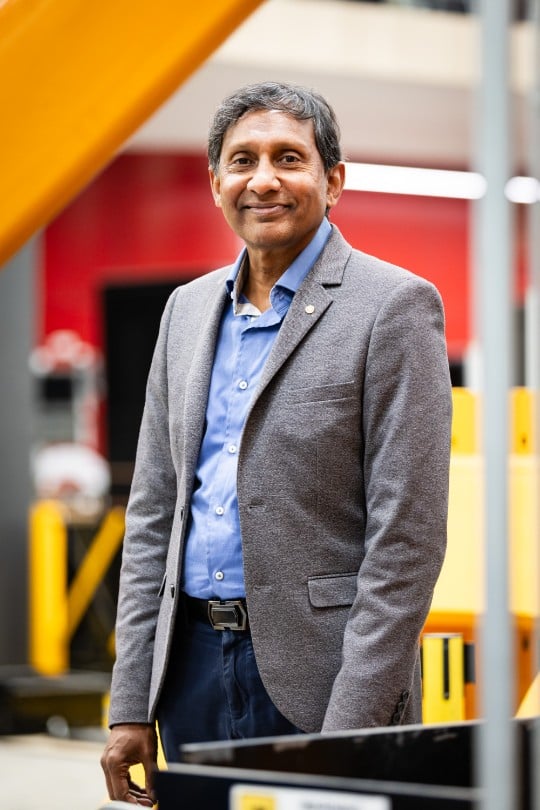
Distinguished Professor Buddhima Indraratna has been awarded the prestigious 2024 International Civil Engineer award by the Jose Entrecanales Ibarra Foundation in Madrid, Spain.

Distinguished Professor Buddhima Indraratna, Director of the Transport Research Centre (TRC) at the University of Technology Sydney (UTS), was honoured with the prestigious José Entrecanales Ibarra Foundation’s International Civil Engineer Award for 2024.

Considered the Nobel equivalent in the field of civil engineering, the award was presented by the Vice-President of Spain, her excellency Teresa Ribera, during a formal ceremony in Madrid.

The Jose Entrecanales Ibarra Foundation’s event for Civil Engineering awards for (a) 2024 International Civil Engineer and (b) most Impactful Civil Engineering Project, was attended by nearly 400 people from industry and academia. The guests of honour included the Vice-President of Spain (Teresa Ribera), the Australian Ambassador to Spain (Sophie McIntyre), chancellors of universities and CEOs of multinational companies. 

Professor Indraratna is the first Australian to receive this prestigious accolade, which is awarded every 3–4 years. Since its inception in the late 1990s, the past five winners were structural engineers (USA and Europe) and a water resources engineer from Japan.

Selection panel members represented various major cities and institutions from all continents, including Boston (MIT), Madrid, Paris, Sydney, Shanghai, Cairo and Sao Paolo, plus representatives from leading multinational civil engineering companies.

The Jose Entrecanales Ibarra Award from Spain for Professor Indraratna is a remarkable international recognition, honouring his eminent contributions to the field of civil engineering with global impact, especially in advancing transportation infrastructure through geotechnical expertise.
Distinguished Professor Buddhima Indraratna video thumbnail

Distinguished Professor Buddhima Indraratna – José Entrecanales Ibarra Civil Engineering Award

Distinguished Professor Buddhima Indraratna – José Entrecanales Ibarra Civil Engineering Award transcript

[Music]

Professor Buddhima Indraratna is a distinguished professor at University of Technology Sydney. He is very well known for his research and for his publications. He's also a very influential engineer. He's also a top educator – he has supervised more than 70 PhD students to completion. A large significant record to break. I was very excited to learn the news my colleague Buddhima was the recipient of the award. His work is recognised internationally. This certificate, what he does, excellent in the world.

My name is Buddhima Indraratna. I was born in Sri Lanka. From the time I was a little child, I I remember playing with all kinds of engineering type toys. I used to play with cranes and trains and buildings, Lego, so this was quite obvious that I had that passion from the time I was a kid. As a teenager, I left for United Kingdom for higher studies, entered Imperial college and did my first degree in civil engineering, and subsequently completed a master's degree in soil mechanics where I became very interested in geotechnics. 

And then for my PhD, I went to Canada, and then from there I went to Southeast Asia to Thailand where I was exposed to a completely different type of geotechnical conditions, and then in the early 1990s I immigrated to Australia, so I have practically travelled most of the continents. And what this has given me is an exposure to different types of problems, and also the different ways how different communities take these challenges.

So one of my main research areas is to focus on how to use waste materials into the construction of roads and railways, and we have done that very successfully.

I believe Australia and other countries have to look for the future in a more environmental and climate change point of view. The world is such that we got to save the planet for the next generation. We have to look at the amount of waste that different countries produce. We have to be mindful of the perspectives of circular economy. Can we recycle this waste? Can we use this in infrastructure?

We have looked at a massive amount amount of rubber ties that are discarded every year in Australia. In fact it's more than two times our population. We discard more than 40 million rubber tyres every year. So we came out with this idea of putting the rubber tyres into the track, for example in railways, filling these rubber tyres with waste materials and then building the railway tracks on these rubber tyres. So this is an idea like a shock absorbing system, so as a result if you build a railway track on these rubber tyres, then you will eliminate to a large extent the vibrations and the noise. So this has now been well accepted in industry, we have got Sydney Trains to do these trials in parts of Western Sydney, and we have been very successful there. And now these are these are patented technology, and now other countries like China and India are also looking at using this technology.

And this track for the very first time in the world is now constructed using waste materials.

But what is more important will be the feedback from the users. So that feedback is important. Because it's equally important as the data that we scientifically measure and analyse.

So this pressure, this is the excess pore pressure or the total pore pressure?

The total one.

Total.

This one is the pore pressure, right?

So for instance, we now have 25 to 30 years of data that we have collected from railway tracks. Suddenly we have taken this data from hard discs that have been saved, and now the students are analysing data that was taken 20, 25 years ago and we have a better understanding now why certain structures failed, which should have been stable according to the theory, but now we understand why they failed, because certain variabilities in the ground were not captured through classical solutions in the past. So this is why I'm emphasising the importance of artificial intelligent concepts, the development of computer engineering – especially creating digital twins.

When computer engineers develop digital twins, they don't have a fundamental idea of soil properties or geotechnical conditions. But if civil engineers can understand a bit more of the concepts of digital twins in a computer engineering point of view, then both teams can come together and strengthen what the digital twins actually means. So it is very important that infrastructure for the future must be a multidisiplinary field. It's not just civil engineering, it is a value added civil engineering that is taking the knowledge from the other fields that are evolving at this stage.

Are we calling, then, for a civil engineering revolution?

Using the information from the the other field, I would practically call it a transformation of the civil engineering thinking.

Several times I have been invited in the past by foreign governments, countries like Sri Lanka and Thailand, to come and assist in the rehabilitation of certain structures which have been affected or damaged considerably by natural hazards.

In Sri Lanka in early 2005 following the disastrous catastrophic 2004 Boxing Day tsunami that affected Sri Lanka and southern part of the Indian subcontinent, that was a time where the population was completely displaced. Factories were closed. And when you have to rehabilitate infrastructure with very limited resources, with very limited availability of construction materials, that is the time the research knowledge comes into play. So when I went to Sri Lanka, when I realised the amount of Destruction, I had to use the best experience I had through my research knowledge. Even using materials that are coming from demolish charts, concrete particles, bricks that are available. How we can use use this kind of material to rebuild the foundations and use this material to reconstruct roads and railways. So that experience was very important because I have already done research in these areas. We were able to make a multidisiplinary crew, including geologists, civil engineers, mechanical engineers and then putting our minds together and rebuilding these railway tracks and roads within a period of 4 to 5 weeks.

I never had plans to become an academic. That came very later. I was always thinking of myself as a practising engineer. But somehow the opportunity arose after my PhD that I was going towards the academic area because I wanted to do something new, I wanted to contribute something novel into the field of civil engineering, and I thought that that could only be possible if I became an academic. But doing my research with a lot of applications to practical situations.

The professional careers in any field, not just engineering, has a lot to do about understanding the people who work with you. And that comes through the appreciation of different cultures, diversity and the appreciation for different backgrounds and training. We have students and staff coming from many different countries and they have different backgrounds, and also what I've understood is that the way that different people from different upbringings and different backgrounds, they think of challenges and how they deal with times in quite different ways.

Share

Featured researcher

Buddhima Indraratna

Director, Transport Research Centre, Faculty of Engineering & Information Technology
News

UTS Transport Research Centre received prestigious international engineering award

The UTS Transport Research Centre (TRC) team has been honoured with the 2026 Donald R. Stanley Award by the Canadian Society for Civil Engineering (CSCE).

News

UTS Transport Research Centre celebrates doctoral student completions

The UTS Graduation Ceremony this month marked a proud milestone for the UTS Transport Research Centre and its academic team.

News

Recycled tyre tech boosts railway resilience and cuts waste

New research has shown that a world-first system of rubber shock absorbers made from recycled tyres can significantly protect railway tracks from damage,...

News

New modelling tools to put high-speed rail on the fast track

UTS Distinguished Professor Daichao Sheng will use a prestigious national fellowship to build more accurate modelling for high-speed rail in Australia.