

- Posted on 29 Apr 2024
- 5-minute read
UN Women / Flickr

Wanning Sun, Deputy Director, UTS:ACRI; Professor of Media and Communication, Faculty of Arts and Social Sciences, UTS
Note: This article appeared in Crikey on April 29 2024.
Former foreign minister Bob Carr recently described AUKUS as ‘fragrant, methane-wrapped bullshit’. This remark — tailor-made for the headlines — was covered by media outlets on both sides of the Tasman Sea.
The one-day livestreamed symposium, ‘AUKUS: Which way for New Zealand’, was held late last week in New Zealand’s Parliament. It was organised by the nation’s Labour Party, with the country’s Opposition Leader Chris Hipkins, among others, in the audience.
The timing and title of the symposium is indeed apt. New Zealand politics finds itself polarised, having to decide whether to join pillar two of the AUKUS pact, or remain independent. The centre-right National Party, which displaced Labour from government in October 2023, is keen to join.
One of Carr’s co-panellists was the former NZ Labour prime minister Helen Clark, whose views on AUKUS and New Zealand’s possible involvement did not receive much attention in Australia. According to Clark, AUKUS is shaping up to be one of the key points of difference between her party and the government.
Clark was clear about why she opposes New Zealand joining the second pillar of AUKUS. Rather than becoming a ‘cog’ in the AUKUS machine, Clark sees an ‘alternative path’ in which ‘New Zealand keeps its head while all around are losing theirs’. In her view, New Zealand should maintain its long-standing independent foreign policy and its nuclear-free record.
Noting the growing tension between the US and China, she argues that New Zealand, along with its Pacific neighbours, should be a voice for de-escalation. In her view, as a small liberal democracy, New Zealand has successfully navigated a complex relationship with China, and joining AUKUS would take away that ability.
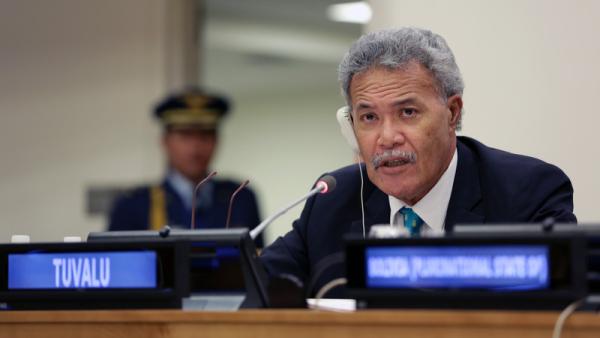
While Carr clearly won the most colourful speech prize, the third speaker, Enele Sopoaga, Tuvalu’s former prime minister, delivered an equally devastating critique of AUKUS — something that’s rarely heard by the Australian public.
Sopoaga was prime minister of Tuvalu from 2013 to 2019. Speaking not on behalf of his nation’s current government but as a representative of the Pacific Elders’ Voice — a group of former Pacific leaders — Sopoaga argued that the countries involved in the AUKUS pact had failed to consult Pacific nations. Quoting an AUKUS statement which said the pact was about ‘expanding our individual and collective undersea presence in the Indo-Pacific’ and that it ‘contributes to global security and stability’, Sopoaga asked, ‘Who is the ‘our’ in these statements?’
‘This is not our agreement,’ he said. ‘It is theirs.’
Sopoaga was clearly disturbed by the prospect of nuclear-powered submarines ‘cruising through the waters of the Pacific Island nations without any consultation whatsoever’.
As the former leader of Tuvalu, one of the numerous low-lying Pacific nations that are most vulnerable to rising sea levels, Sopoaga argued that climate change, not war, is the ‘single greatest threat to the livelihoods, security and well-being of the peoples of the Pacific’.
Sopoaga believes AUKUS shows a ‘contemptuous disregard for Pacific regionalism’, stating that nuclear-powered submarines could only inflame regional tensions and make the region less secure and stable.
He also couched his critique in a historical context, reminding the audience of the Pacific having been a ‘dumping ground’ for nuclear wastes by the US, the UK and France in the past. For this reason, allowing nuclear-powered submarines to travel through the region shows a ‘shameful disregard for the long and tragic history that the Pacific has suffered from the detonation of nuclear weapons’.
Sopoaga views AUKUS through the lens of the future as well as the past. He referred to the Australia-Tuvalu Falepili Union, a new agreement between Australia and Tuvalu, which will create a special visa pathway for Tuvalu’s residents to escape the threat of climate change. In return, Tuvalu cannot enter into any security pact with China without Canberra’s approval. He said:
For a small migration entitlement, Tuvalu was being asked to hand over its sovereignty to Australia. It basically said that before Tuvalu entered into any security agreement it has to get Australias approval first. This is neo-colonialism at its worst.
Sopoaga viewed this deal as an act of ‘shameful bullying’.
‘In all my years of politics I have never seen anything so brazen and disrespectful,’ he said.
His view is clearly at odds with Kausea Natano, Tuvalu’s immediate past prime minister, who is known for his pro-Taiwan stance, and who was responsible for signing the deal with Australia.
Sopoaga is also clearly in disagreement with Anthony Albanese, who describes the agreement with Tuvalu as ‘the most significant agreement between Australia and a Pacific Island nation ever’,
Speaking with pathos, Sopoaga clearly did not mince words. His grievances against Australia over AUKUS are myriad and strongly worded: neo-colonialism, a failure to consult with Pacific nations, a tendency to see Pacific nations solely through the prism of security, and a disregard for Pacific nations peoples’ sovereignty, agency and livelihood. The extent to which his sentiments resonate with people and governments across the Pacific region, and whether these judgments are fairly based, is open to debate. But his views warrant airing.
The fact that our media did not think it worthwhile to give voice to this Pacific leader raises doubts about whether we in Australia believe that the less powerful nations in what Foreign Minister Penny Wong calls ‘our Pacific family’ have equal power in making decisions that affect everyone in the region. ‘Family’ is a warm and fuzzy concept. But few parents — or children — are likely to agree with you if you say that power relations do not exist within families.
Author
Professor Wanning Sun is Deputy Director at UTS:ACRI and a Professor of Media and Communication in the Faculty of Arts and Social Sciences at UTS.