


- Posted on 30 Apr 2024
A prestigious award
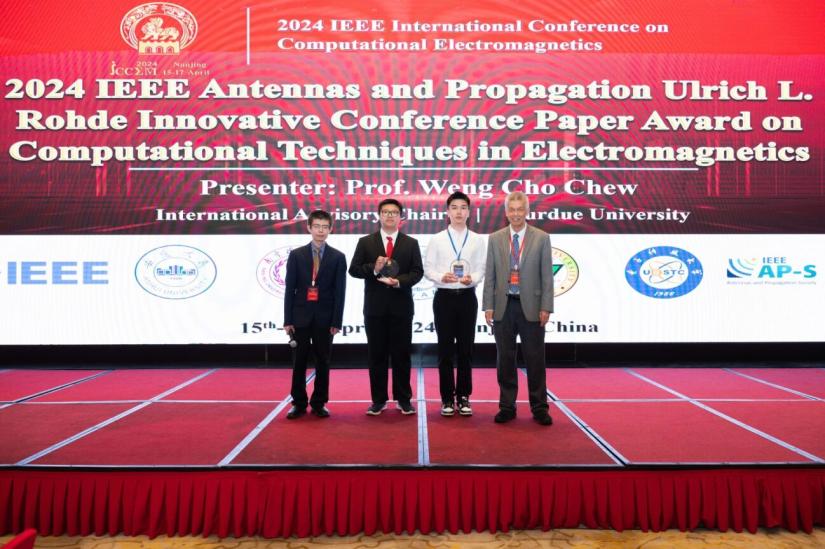
Congratulations to GBDTC PhD student Yuenian Chen on winning one of the 2024 IEEE Antennas and Propagation Ulrich L. Rohde Innovative Conference Paper Awards on Computational Techniques in Electromagnetics!
This award recognises the two best innovative conference papers presented at an annual IEEE AP-S technically sponsored meeting on computational techniques in electromagnetics.
Yuenian received this award at the 2024 IEEE International Conference on Computational Electromagnetics (ICCEM) held in Nanjing, China in April 2024 for the paper titled: 'A Four-Port Shared-Aperture In-Band Full-Duplex Antenna Array Based on Modes Combination Method'.
Paper abstract
This paper presents the development of a four-port in-band full-duplex (IBFD) antenna array system featuring a shared radiation aperture, utilizing a combination of common-mode (CM) and differential-mode (DM).
The IBFD antenna system comprises two subarrays, with simultaneous excitation of any of the four input ports activating one subarray in CM and the other in DM. Incorporating both CM and DM in both the xoz and yoz planes results in identical radiation patterns when any of the four ports are stimulated.
The proposed method is different with all existing method. It enables full aperture excitation in any of the four modes, markedly increasing gain without compromising beamwidth. Besides, it is less sensitive to the imbalances of the feeding components.
To validate the proposed method, the IBFD antenna system is designed, fabricated, and measured. Experimental results confirm the effectiveness of the approach, showcasing isolation exceeding 38 dB between any two ports within the bandwidth of 3.3 – 3.8 GHz (14.1%).
Additionally, each port of the system exhibits similar and broadside radiation patterns, underscoring the significant potential of this approach for IBFD systems in 5G sub-6 GHz applications.