

- Posted on 15 Mar 2024
- 48-minute read
Heart-warming, heart breaking and hilarious, this discussion celebrates the roots and routes which we all traverse.
In Australia alone, we have over 300 languages but as a society we have a monolingual mindset. Even if we have a multiplicity of languages, English holds a hegemonic place in our daily lives.
We need to support the revival and survival of languages, actively work against language loss, and hear from those with lived experiences with preserving their mother tongues.
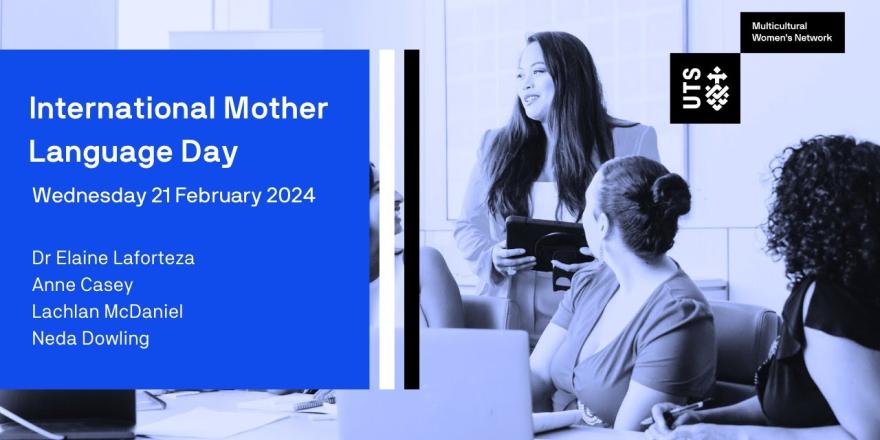
In this session, Lachlan McDaniel, Anne Casey, Neda Dowling, and Dr Elaine Laforteza shared their experiences with a mother language that differs to the dominant ways of hearing, speaking, and writing in Australia.
If you are interested in hearing about future events please contact mwn@uts.edu.au.
Languages encapsulate concepts, ideas, and worldviews thats a large reason why during colonisation we see the attempt of the eradication of languages. Retaining and teaching these languages teaches different world views and can have a very significant impact on people Lachlan McDaniel
I grew up fluent in Irish and it was so culturally important to us. For me its about reclaiming the voices of my grandparents who suffered deep political violence. Its both deeply personal but also a political act to keep this language alive. Anne Casey
When a language hasnt been spoken for me, close to 10 years you tend to lose a part of that identity. You not only lose the words, but you also lose that identity. Neda Dowling
International Mother Language Day is a joyful day because we are talking about resistance, continuity, and paying homage to our heritage. Dr Elaine Laforteza
Speakers
Lachlan McDaniel belongs to the Galari Clan of the Wiradjuri Nation and is learning the Wiradjuri language. Lachlan’s PhD explores the significance of Wiradjuri cultural revitalisation, including how the revitalisation of the Wiradjuri language impacts the socio-political status of the Wiradjuri people in Australia. It also explores the significance of Wiradjuri cultural revitalisation on Wiradjuri aspirations for self-determination.
Anne Casey has worked for 30 years as a journalist, media communications director and legal author. She is also an internationally award-winning poet. Anne's work is widely published, ranking in The Irish Times' Most-Read and winning awards including the American Writers Review Prize and the Henry Lawson Prize. Anne’s doctoral work at UTS explores decolonising lost histories through poetics of resistance.
Neda Dowling is an advocate for social justice and equality and is passionate about addressing the challenges faced by asylum seekers and refugees, while promoting inclusivity for the LGBTQIA+ community. Neda works at the UTS Human Technology Institute, facilitating research and collaboration to bridge the gap between technology and humanitarian efforts for a human-centred world.
Dr Elaine Laforteza is the Equity and Diversity Project Officer (Cultural Diversity) at UTS. She has a PhD in Cultural Studies and previously held academic positions in various universities in Australia. Elaine’s work has been published in peer-reviewed academic journals and community media, and she authored the book The Somatechnics of Whiteness and Race. Elaine hosts SBS’s award-winning podcast, My Bilingual Family, and is also an emerging playwright.