

- Posted on 27 Feb 2024
- 7-minute read
Office of the President, Republic of China (Taiwan) / Flickr

Corey Lee Bell, Project and Research Officer, Australia-China Relations Institute, University of Technology Sydney

Elena Collinson, Senior Project and Research Officer, Australia-China Relations Institute, University of Technology Sydney
Note: This article appeared in AustralianOutlook on February 27 2024.
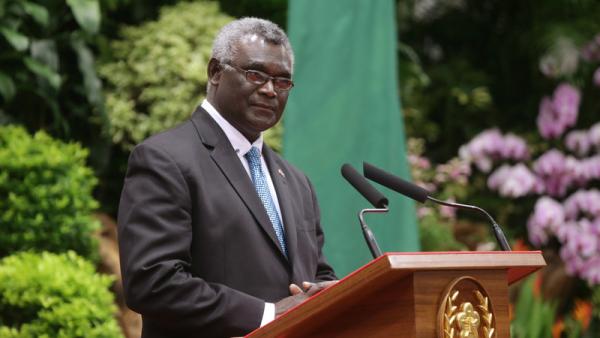
Last week, Solomon Islands Governor General David Vunagi formally announced the nation’s 2024 joint election date, with voters set to go to the polls on April 17. The outcome will be closely watched by Canberra as it continues to push against Beijing’s growing influence in the Pacific Islands region. While elections in the Solomon Islands do not lend themselves to easy predictions, some observers have noted the possibility of incumbent Prime Minister Manasseh Sogavare becoming the first political leader in the nation’s history to serve successive terms.
During his time in office Sogavare has presided over a pivot towards China that saw Honiara end its decades-long diplomatic recognition of Taiwan in 2019 and sign a secretive security pact with Beijing in 2022, followed by a policing deal in 2023. While Sogavare has sought to reassure Australia and its partners, including the US, on the nature of its security partnership with China, he has also been critical of their concerns, describing them as ‘hysterical’ and hypocritical, as ‘unneighbourly,’ and as constituting ‘foreign interference.’
What might a Sogavare victory mean, then, for Australia’s desire to remain Honiara’s ‘security and development partner of choice‘?
In a statement setting out its election platform, Sogavare’s political coalition has pledged to ‘strengthen (the) relationship with China through a ‘look north’ foreign policy, while nurturing ties with other traditional partners such as Australia.’ Broadly speaking, this reflects the reality of his government’s recent, relatively balanced approach to engaging with the two nations. The specific reference to ‘looking north,’ however, merits closer examination.
The slogan ‘look north’ has a long history in Melanesia, having been formerly used by political leaders in Papua New Guinea (PNG) in the early to mid-1990s, and Fiji in 2006. In the former case, it came at a difficult time for Australia-PNG relations, in which Australia’s Department of Foreign Affairs and Trade assessed the then-Wingti government as ‘nationalistic and reformist,’ and ‘happy to see Australian influence diluted, especially in the economy’ on account of a belief ‘that in some areas we are holding PNG back economically.’ The latter came in the wake of a coup in Fiji that dramatically worsened Suva’s ties with Australia, prompting Canberra to place sanctions on the new regime.
Outwardly, ‘look north’ in its earlier incarnations described aspirations to tap into the explosive economic growth of the Asian region – including but not exclusive to China – to increase trade and investment. Less officially, it has been associated with strategies to reduce aid reliance on Australia and advance economic and foreign policy self-determination. The call to ‘look north’ reflects the problem that Canberra’s ‘aid game’ has reached a bottleneck. The hard reality is that in terms of results, decades of significant Australian assistance has at best delivered modest economic gains, while the region has become the world’s most aid dependent.
This has been most notable in the years leading up to the Solomon Islands’ diplomatic pivot towards China. In the half decade immediately prior to the pandemic, many Pacific Island economies, the Solomon Islands among them, shrank or went nowhere in terms of gross GDP, and bucked the trend of developing countries improving in terms of ease of doing business – impeding their pathway towards improved economic self-determination. While some recovered from the disastrous impact of the pandemic, 2022 – the year in which the Solomon Islands-China security pact was signed – saw the Solomon Islands’ GDP per capita figures fall below those of more than half a decade earlier, widening the gap between the nation and many of its wealthier neighbours, including PNG, Fiji, and Vanuatu.
The Solomon Islands’ desire to transition from ‘aid to trade’ and look beyond Australia makes sense in this context. But such a shift throws into starker relief for Canberra the unquestioned dominance of China as its major export destination, and a trading partner more generally.
According to a World Trade Organisation report, China took a 57 percent share of Solomon Islands’ exports in 2020, and, according to OEC data, just short of 60 percent in 2021. By comparison, while the former does not put Australia in the top five export destinations, the latter sees it squeeze into fifth place at 2.72 percent. With trade being of such vital importance to the Solomon Islands economic transformation agenda, a more comprehensive mutual security partnership aimed at protecting it could become an increasingly tempting proposition for a relatively Western-sceptical administration in Honiara.
Sogavare’s relative shift from ‘aid to trade,’ and from ‘south to north,’ as such reflects broader and longer running challenges for Australia’s Pacific Island diplomacy. But it also presents Canberra with an opportunity to strengthen relations.
It would be beneficial for Canberra to continue to increase its focus on the expansion of business and trade ties, which had been the subject of a parliamentary Joint Committee on Foreign Affairs, Defence and Trade report in September 2021. It could do more to incentivise Australian businesses to engage in the region – a broad aim outlined in the Australian government’s new International Development Policy – which it should seek to tie with Australia’s infrastructure and development assistance. The aim for doing so should be to broaden links and hasten economic improvements by better aligning industry assistance priorities with the immediate needs of viable local and Australian-partnered enterprises. While such a proposal is not without barriers and impediments, not least the requirement of private sector buy-in, and would still require oversight, it could help address the weaknesses of the former, bureaucratically conservative ‘build it and they will come’ model.
Moreover, Australia could encourage Honiara to ‘look north’ not just to China, but beyond to leverage the cooperation of its allies and partners in order to increase trade and investment diversification. To an extent, groundwork for this is already being laid. The traditional division between ‘spheres of influence’ in Melanesia, Polynesia, and Micronesia – associated with the leadership of Australia, New Zealand, and the US respectively – has in recent years been eroded by American efforts to strengthen partnerships with Melanesian, Papua New Guinea, and Polynesian Tonga. Japan has also been stepping up its aid programs in the Pacific Islands region while its trade with Papua New Guinea has grown substantially. Japan and countries like Korea also offer industrial complementarities, established ASEAN economic links, and experience in economic and aid diplomacy. Working to bring in ASEAN partners such as Indonesia, which has a shared interest in the security of neighbouring nations such as Papua New Guinea and Timor-Leste, could further strengthen this project.
The Labor government’s refinement of Australia’s Pacific strategy, including through more inclusive, less securitised rhetoric, increased engagement through mutual high-level visits, and the implementation of new migration pathways, among others, has been a welcome development. But there is scope for improvement in terms of Australia’s approach to relations with its Pacific neighbours. A Sogavare victory may indirectly contribute to nudging this along.
Authors
Dr Corey Lee Bell is a Project and Research Officer at the Australia-China Relations Institute, University of Technology Sydney.
Elena Collinson is head of analysis at the Australia-China Relations Institute, University of Technology Sydney.