

• Posted on 28 Feb 2024
  • 15-minute read

We all understand the importance of preventing overfishing for sustainability – but our research shows that considering the social impacts of decisions about fisheries management is also crucial.

landscape with lake and canoe
Photo by: Impress Photography

Harry Mitchelson remembers when his father used to fish the waters around Lakes Entrance in Victoria. He would catch so many fish that he could not possibly sell even a quarter of what he caught; he would throw most of it back into the sea.

“He had to catch every fish that swam in the ocean. He was driven by, if there's a fish there, he had to catch it,” Harry, a fourth-generation fisher, told us as part of our research into the economic and social contributions of professional fisheries and aquaculture in Victoria.

The sea is in Harry’s blood. Unlike his father, he understands the need not to overfish and to protect precious stocks. 
But, like the hundreds of other fisher families providing fresh Australian seafood in Victoria and NSW, Harry’s way of living is under threat.

Competition for waterfront real estate and multiple demands on diminishing fish stocks are increasingly eroding the rights of owner-operator fishing businesses like Harry’s.
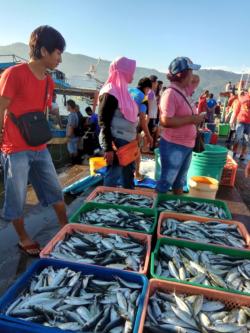
People with fish in crates

Areas set aside for recreational fishing are restricting fishing grounds for commercial fishing. Meanwhile, government decisions often prioritise the sustainability of fish stocks over the livelihoods of those who live off the sea, rather than treating sustainability in fisheries as having ecological, social and economic dimensions of equal weight.

Unlike farming, which uses private property land, our waterways are a public resource and fishing rights are administered by governments. Decisions on how much can be fished and how the catch is distributed are almost always made to protect fish stocks. Socioeconomic objectives are usually left as high-level goals, and not incorporated in an evidence-based manner into these decisions.

Our research is providing crucial insights into how the fishing and aquaculture industries contribute to the wellbeing of regional communities in Australia and internationally. It has highlighted the vital role of fishing for some regional economies, for economic diversity and resilience, for food supply, synergies with tourism and recreation activities, environmental knowledge, stewardship and the social fabric of communities.

In Australia, overfishing up to the 1980s meant restrictions on commercial fishing were necessary. However, some of the more recent restrictions on commercial fishing have been more in response to lobbying from recreational fishing groups, or to restructure commercial fishing away from smaller operations towards larger more profitable operations. All this can have serious consequences for families like Harry’s, reducing their ability to earn a living. 

Overseas, in countries we have studied including the Philippines and Indonesia, changes to policy that impact fishing can pose a serious threat to food security and livelihoods of the huge numbers of coastal communities on the many thousands of islands making up each of these countries.

We have recently published a groundbreaking paper on this issue that argues sustainable fishing should be about more than just environmental protection. 

While, of course, the ecological sustainability of fisheries is a necessity, we argue for fisheries policy tools that treat sustainability as also having social and economic dimensions. 

We propose a more holistic way of managing fish supplies, by integrating social factors into the heart of fisheries management procedures - specifically ‘harvest control rules’ (HCRs).
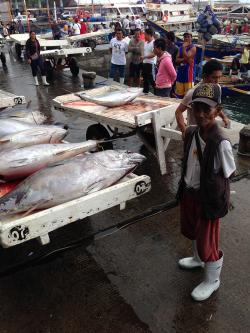
Fish market in the Philippines

HCRs are pre-agreed guidelines that determine what to do when catches hit a certain limit – usually based on modelling of fish stocks. They are used to enforce objectives in management plans and policies aimed at regulating fishing to maintain or rebuild fish stocks, and sometimes to protect wider ecosystem structures and processes.

There have been calls to integrate social and economic objectives with biological ones in fisheries policy for decades, but fisheries policy still usually focuses on fish stocks, with much less attention to how well fisheries are performing socially. 

We propose the idea of social HCRs, which also include one or two social or economic reference points, such as employment or food security. 

Social HCRs, along with broader reforms to make social and economic fisheries objectives operational and evaluate their outcomes with evidence, could ensure that policy decisions also consider relevant social considerations, such as fisher income, employment and livelihoods, quality of life, preserving communities and cultural traditions, maintaining recreational fishing access, ensuring food supply, and managing resource use.

There are multiple benefits from viewing fisheries management through a social or economic lens. It would ensure policies better align with socioeconomic objectives, and can lead to a clearer understanding of impacts on communities to open the way for possible compensation or, in some cases, allowing fishing to continue for a while.

In situations where there is over-fishing, it may seem counterintuitive that we’re proposing commercial fishing should be allowed beyond what is biologically recommended.

But the reality is that overfishing is already often allowed for social reasons – it’s just that the policy processes around these decisions are opaque. Introducing social HCRs would allow for more transparency and accountability in achieving social objectives through fishing. 

Over the long term, we hope that including social considerations into HCRs would help move fisheries management beyond the assumption that biologically sustainable fisheries will bring general benefits to society, and instead explicitly recognise the benefits and losses for different groups within communities that are inherent in fish management strategies.

This would help us to manage our fisheries resources to contribute to the wellbeing of communities and society – and to the livelihoods of fisher families like Harry’s – with preventing overfishing as a part of, but not the only, goal.
Qu0WwYn-F3I

Descriptive transcript

I'm pretty proud to be part of a fishing family. It's a strong heritage. We all come together and we've all got that one thing in common. My great-grandparents fished on this boat, actually, before my dad did. I do feel like fishing is in my blood.

When we have customers sitting here in the restaurant and they see someone in a chef's jacket walking down the wharf to get our fish, they're like, "What? How can this be so fresh?" It's something that you don't see anywhere, and that's what we have to preserve. That's what's so special about here, because it's real.

If I could get out of school five minutes earlier to catch the boat before it left, I'd be there. I remember one time as a kid, I busted my knee up pretty bad and I couldn't walk on it. Mum said to me, "If you can't bend it, you're not going to sea." I bent my leg, I had tears rolling down my face, but I bent my leg. And I still didn't get to go to sea.

My father was different to me. He had to catch every fish that swam in the ocean. He was driven by, if there's a fish there, he had to catch it. They used to throw so much fish away in the old days because they couldn't handle them. Instead of going and getting 50 boxes of trout, he'd go and get 250, and then they'd lose 200 and sell 50. That's always stuck with me, that he had to catch every fish in the ocean, and I didn't want to be like that.

When you talk Victorian seafood, you talk local, niche markets. So a lot of Melbourne people get fresh whiting, fresh rock flathead, fresh trevally, and that's our market. It's not wholesale, freeze them and send them overseas like the other states. We're a niche, fresh, 'fresh is best' market.

We're trying to create a little bit of Melbourne in Lakes Entrance. So the style and the elegance of Melbourne dining, but we want to be 100% Lakes Entrance and Victorian seafood. We catch squid, prawns, octopus, whiting, flathead, duckfish, gurnard, monkfish, scallops—you name it, we catch it here. That's what makes it so unique and so exciting to be a chef here, because you have that wide variety of seafood. You never get bored.

It's just so real to me because my late husband was a fisherman. Him catching the fish, me cooking the fish—it's a real love thing for me. Even though he's passed away now, it's still a way that I can connect with him. It's just a way to honour what we did together.

Literally, I've been up the wharf this morning. It's 20 steps to a boat that I get my prawns from. It couldn't be any fresher. The boats are small. We don't catch a thousand tonnes a year. We only catch what we can sell, and we sell it easily.

The seafood industry to Lakes, I reckon it's the heart of the town. When the tourists come, some of the first things they see are obviously the fishing boats, and it's not hard to tell what Lakes Entrance was built on.

The original fisherman in the family was my grandfather's grandfather. So my fishing heritage goes back six generations. My great-grandfather's father, grandfather, as well as their wives—they were all incorporated into it. Basically, all the fishers, what made them good was the effort they put in, the skills they learnt, which were passed down from generation to generation.

When the cicadas come, the tuna come. You'll be sitting at home and you'll hear a cicada in the bush, and you'll know that the tuna is just about to arrive. On a hard easterly, you'll get a low tide. On a hard westerly, you'll get a high tide. And there are a hundred different combinations in the middle. On the other side of the lake, there are trees, and when there's a south-west change coming, they curl their leaves up and close them. So you go out in the morning, and if you can see a sea of silver, you know it's going to be bad weather. If it's all green and lush, you know it's going to be good weather, because they won't open their leaves if it's going to be rainy and windy. Just things like that you pick up over time.

Little Soda is an old lake fishing boat that we bought off one of Mick's cousins, and we use it to go foraging. Normally what happens is that we might have a big day in the kitchen and we look around the dining room and there's only a couple of tables left, and we think we might have enough time in between lunch and dinner to go out in the boat and forage a few things for dinner. We'll go to a place we haven't been for a while because you need to manage your patches, pick a few things, and hopefully the tide's going all right so that we're not late back for dinner, because we do open at five, and sometimes we've got back at about quarter to five.

The whole town was based on fishing. It's an industry that's really embracing, so a lot of the young blokes just start work on fishing boats even now. The co-op started about 1958, I think. A group of fishermen got together and decided it was a good idea to put it all together, so that's where it all started, and a lot of the buildings you see today are still remnants of the past from there. The fishing is what keeps the community alive. Tourism is really good for a certain part of the year, but for the vast majority of the year it's the commercial fishing that keeps the town going.

I've been coming here since I was young. I practically come weekly, years and years. Most are straight off the boats here, so you can't get any better than that. Well, I suppose it's what keeps this area going. If we didn't have that, Lakes would be a lot different. I'd say most people who live in Lakes Entrance come to buy their fish either from here or straight from the trawlers. Some days you'll come in and you'll have a stretch of people all the way to the car park, and you know that what you did last night is actually going to mean something. Apart from that, we sell to the Melbourne market.

Good morning, I'm Barbara Konstas from the Melbourne Seafood Centre. So what happens here is fish come into the ports, gets transported in through the trucking system, and gets unloaded here. At 5am we open to the buyers. Dad's not well at the moment—he's fighting cancer. He's very tired after treatment, and it just happened to be Christmas Eve; he just could not get out of bed. He couldn't come in and do it, so it was left for me to come in and do. Well, it's in my blood now. It's nearly 100 years in the family, and everyone here just makes it so much easier and makes it worthwhile getting up so early.

To get up at sometimes 11pm to come into this centre to unload fish, you've got to love the product and you've got to love what you're doing. It's just been in the family for so long—it's life now. I don't know any different when it comes to working in a family business. I've just watched Dad, followed in his footsteps. He did the same with his Dad, and then his Dad did the same with his. He's just been up at the crack of dawn for like 48 years. He's worked really hard to put a roof over everybody's heads, and he's the hardest working man I know. So trying to follow in his footsteps—hard, but I try.

Thank you, thank you.

Hi Jess, how are you? Looking good, how are you? These look amazing. Two kilos please.

I think cooking seafood, once you know or you've had a little lesson of how to do it, it's quite easy. I think we tend to go out and want to buy the big fillet of fish. For me, buying a prawn or buying mussels or sardines—they're far easier. Not only are they better for you, but they're far easier to cook. My mother, when she was in Sicily, was up in the mountains, so she never really actually had fresh fish. When she got married, she went to Catania, which is the second capital of Sicily, and all of a sudden she had access to the most amazing fish all over the world. One of her friends taught her how to do the stuffed sardines. We've had those sardines as long as I can remember in our family. So from someone who had no idea how to cook fish, she ended up cooking a lot of fish, and she had an abundance of seafood all around her in Catania, where I grew up until I was seven.

So give it a go. Just go out and ask your fishmonger, "How do I cook these?" And it's usually the cheaper seafood that is easier to cook.

Can you imagine, you get up at five o'clock in the morning and you go out in the ocean and you're just free. You're free. It's just you and the ocean and it's just magic. I couldn't imagine being anything else apart from a fisherman. I watched my grandfather fishing. I used to fish with my dad, my uncle. When I was younger, that's all I ever wanted to be. When we get out that entrance, you just feel like that's where you're meant to be. You're out there with nature. Every day's different. The bad days are really bad, but they make the good days good.

And I see my kids every day. All of them. I see everyone every day. So I've got three sons, two older ones and one younger one. The two older ones, when they're both out on the boat, the mood's quite light. They like to joke around a bit. It's a bonding experience that a lot of people don't get to have, and I'm lucky to have it.

It's really lovely to see her buzzing around and looking after customers and sharing the love—sharing the love of the town, sharing this new passion that we have for foraging of the coastal herbs and the seaweed. It just connects us together to each other. I like to think I've given her the knowledge that she can explain to the customers and just share the love of what we do. I think that's really important—that you know where everything comes from.

Professor Kate Barclay is a social scientist researching the social aspects of fisheries, at a time when industry and government are increasingly recognising the importance of human dimensions in sustainable fisheries. She is Director of the Climate, Society and Environment Research Centre (C-SERC).

Byline: Professor Kate Barclay

Share