

• Posted on 2 Aug 2023
  • 69-minute read

In the May 2023 budget, Treasurer Jim Chalmers announced an important change to the welfare payment for single parents: recipients could stay on it until their youngest child turned 14, up from the previous cut-off at 8 years old.

The campaign that took place leading up to the budget is a success story of how lived experience, independent research, media attention, and a government-backed task force combined to reform a harmful policy.

It’s a powerful case study for anyone wanting to change bad laws.

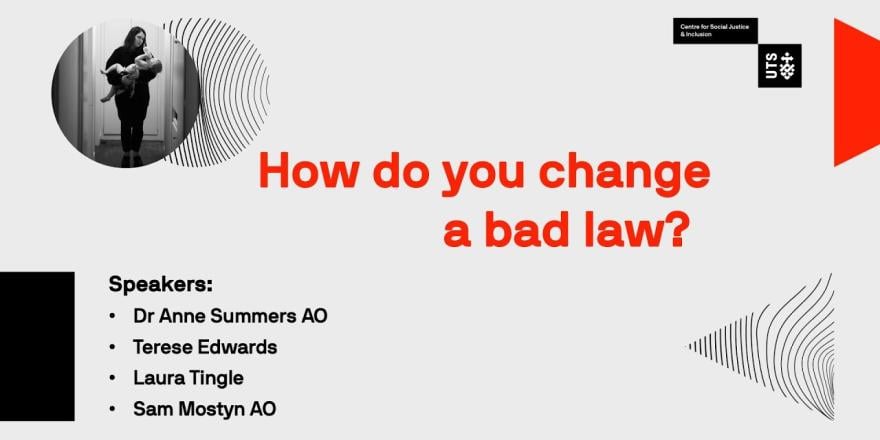
Terese Edwards, Anne Summers, Laura Tingle, Sam Mostyn, and Verity Firth sat down to discuss how researchers, activists, policymakers, and the community sector can join forces to make a real difference and navigate complex politics to advocate for – and achieve – reform.
597yx3948UI

Descriptive transcript

Good evening, everybody. My name is Carl Rhodes. I'm the Dean of UTS Business School. I'd like to begin by acknowledging that we're meeting today here on the land of the Gadigal people of the Eora Nation and pay respects to their ancestors and Elders, also acknowledging these as the first peoples of this land.

Of course, the acknowledgment takes on a special meaning this year, the year of the Voice referendum. I don't know if you're aware that next week, on the 4th of August, it will be National Aboriginal and Torres Strait Islander Children's Day, a commemoration that began as a protest in 1988, the year of the bicentenary of white Australia. During the time of the Stolen Generation, Indigenous children whose birthdays were undocumented and unknown were given the 4th of August as a national birthday for all of these children, and this is why this day was there.

Other things that have happened around this time in history: a couple of weeks later, on the 17th of August 2007, is the anniversary of the legislation that allowed the Northern Territory Intervention under John Howard's rule, suspending the UN Racial Discrimination Act in taking that move.

I think it's fairly clear from just two examples of history around this time that false white heroics have failed Indigenous Australia and it's time now, I think, at a very minimum for a Voice to prevent atrocities happening again. Vote wisely, Australia.

I would also like to welcome you here to UTS and specifically to UTS Business School, the building we're in now, where we work. We're very proud to be hosting this event, specifically looking at the activism and advocacy that led to the change in the welfare payments to single mothers earlier this year, effectively a series of actions that materially improved the lives of women and children around the country, but also I think today you'll be enjoying a discussion generally about how researchers, activists, policymakers and the community can work together to achieve meaningful reform. This is democracy in action.

Now, some of you who haven't been here before might be wondering why on earth are we having this event in a Business School? Why would a Business School be interested in such things? We have a pretty bad rap in business schools. We've earnt it, by the way. It's well deserved. But here at UTS Business School, as a group of scholars and teachers in business and economics, nothing could be more important to us than how business activity, economic policy and economic management can and should support justice and progress. We aspire to be a different type of business school. We aspire to be a socially committed business school focused on developing and sharing knowledge for an innovative, sustainable and prosperous economy in a fairer world.

Now, when Anne Summers joined the school last year as Professor of Domestic and Family Violence, it was a big step for us in helping become that very Business School who we aspire to be. The value and impact of Anne's research is second to none, quite amazing really, and serves as an exemplar and role model for what research can and should do in improving the lives of real people. It also serves as a role model for the fundamentally democratic role that universities have in contributing to social and economic justice and progress. In an era where so many people think of universities as corporations and think of the higher education sector as an export industry, Anne reminds us that we are and can be so much more than that.

So I would like to introduce you to your host and MC for this evening, the Honourable Verity Firth. For the few of you who may not know, Verity is Pro Vice-Chancellor of Social Justice and Inclusion at UTS and she leads the university's commitment to social justice and inclusion, ensuring that commitment is embedded across all of the university's initiatives and activities. Verity has had a long career working at the highest levels of government, including being Minister for Education and Training in New South Wales as well as New South Wales Minister for Women. Enough from me, Verity, over to you.

Thank you. Oh, it's nice and loud. Thank you very much, Carl, and thank you to all of you for being here tonight. This evening's discussion, I also want to acknowledge of course that we're on the land of the Gadigal people and pay respect to Elders past and present.

This evening we really are here to celebrate a really big victory for women who have been campaigning close to decades for more economic justice in this country, particularly single-parent women. But we also wanted to do it as a bit of an anatomy of a campaign because there's something really interesting about how this change was achieved in the Budget this year and there was a whole lot of serendipitous moments and almost organic actors that emerged in the process and we wanted to dig deep into that as well and hopefully learn a bit from what we think is a pretty interesting case study of social change.

Before we launch in on that and I can introduce my very illustrious panel, we're very excited to have them here tonight, I have a couple of pieces of housekeeping. Firstly, we're live captioning the talk, so you can have a look on the screen over there. We're recording this session and we will share the recording with you next week, so please feel free to share it widely. We had many, many people register for this event so that they could receive the recording. ABC Radio National are also interested in broadcasting this event, so when there is a Q&A session later, be aware you are being recorded and potentially being played to a national audience, so perhaps keep that in mind as you ask your questions. There will be a time for questions, so start thinking about what you want to ask, but keep your questions to the point and hopefully with a question mark at the end.

A little over three months ago, Treasurer Jim Chalmers delivered the Budget and announced an important change to the welfare payment for single parents. The Government announced that recipients of the Parenting Payment Single would be eligible to continue to receive it until the youngest child turns 14, which was up from 8. The campaign to change that policy was driven by tireless advocacy over many, many years, particularly by some of the people on this panel, alongside many others from grassroots organisations through to philanthropic bodies through to parliamentarians.

At the heart of the reform was a desire to prevent thousands of single mothers and their children from falling into poverty. The result, as I said before, is a great case study of effective advocacy and an organic alliance that emerged, including people with lived experience of single parenthood, activists and advocacy groups, academic researchers, philanthropic organisations, a government-backed taskforce that was set up explicitly to address women's economic participation and, of course, a media who was prepared to tell the stories.

So tonight that's what we're going to be looking at. We'll be talking to some of the key participants and seeing what can be learnt from the success of this campaign.

So I'm now going to tell you who we've got here with us tonight. First is Terese Edwards. Terese is CEO of the National Council of Single Mothers and their Children. She focuses on changing the dialogue on single mothers and making sure women's strengths, voices and respect are central to policy decisions. She assists women in navigating complex systems to gain the information that best supports and protects their families. Welcome, Terese.

Anne Summers is a journalist, commentator and best-selling author. She is currently a Professor of Domestic and Family Violence here at UTS Business School, where she conducts innovative data-based research into domestic violence in Australia. Her 2022 report, The Choice: Violence or Poverty, influenced the Federal Government to make changes to the payment system for single mothers. Welcome, Anne.

Sam Mostyn is the Chair of the Women's Economic Equality Taskforce, an independent group of eminent women established to provide advice to the Australian Government to support the advancement of women's economic equality and achieve gender equality. Sam has extensive experience in governance roles across business, sport, the arts, policy, diversity, Indigenous and women's affairs and the not-for-profit sectors. Welcome, Sam.

And last but not least, Laura Tingle. Laura Tingle has reported on Australian politics for more than 40 years. She has worked for the ABC since 2018 and previously held senior positions in print media, including more than a decade as Political Editor of the Australian Financial Review. She is the Chief Political Correspondent for the 7.30 Report and has written four Quarterly Essays, won two Walkley Awards and is President of the National Press Club of Australia. Welcome, Laura.

So my first question is around the focus of the event really: how do we change bad policies and laws? So what I thought I might do is ask each of you to give me a bit of information on your background and what drove your involvement in the campaign to change the single parent payment. For Laura, I thought it would be interesting to see why you were so keen to report on the issue. But we might start with you, Terese. Tell us a little bit about yourself and what drove your desire to work on this campaign.

Sure. So first of all, thank you so much for the opportunity and I flew in this morning from the Kaurna lands and I do tread carefully and with respect because I know it's not my lands, it's never been ceded. So you will see me without papers because my story fits within my heart and my soul. So I think what has driven me the most is I am the person who answers the phone, who responds to the emails, and mostly in 2023, it's private messages over the Facebook page.

So there was the people who intuitively understand the financial ramifications of what that meant. And for a long time we've spoken in the framework of dollars and cents. What is less probably known is the respect, the way women see themselves and the way that they want to be seen. So most commonly I would get a phone call from a woman who would say, "I'm not like another single mum." And when we worked that through, what she was trying to say in a way that was buying into that really brutal neoliberal framework is that, "I am amazing. I have stepped away from a really difficult situation and I've done that with absolute limited resources and I'm determined and fearless to carve out a life and to not let this be a mark on myself or my intergenerational role that I have as an absolute matriarch." So that is what has driven me.

What has really, really bugged me and has been equally burning is I think most of us in this room—and I'd like to actually see that there are many hands on that banner, that one that worked towards success—and it's a really important question because if you understand the history, you will then understand how important people have been in coming along and sharing that load, that load sometimes that felt a bit overwhelming.

So what also kept me going was a belief, this burning belief, that at one point in time we are going to have a moment and it's going to rain down with hope and with justice and we're going to just wash out the shittiness that has been part of the last two decades.

So if I can quickly just say that we've got people in the room who have been part of a bus that went from Sydney to Parliament House full of single mums, that we had—I co-produced a documentary in 2014 that I actually thought, in all fairness, Verity, that we'd stopped the crap before it even happened, we'd done enough. I was the author of the first report that the United Nations had investigated on the treatment of women in this country.

So they were the things that sort of kept me going, but also I think deeply and personally I wanted to square up the ledger and I was really spurred on between never, never dropping the ball, always wanting to fix that. There was such an opportunity when I got announced onto the Women's Economic Equality Taskforce, my hand had been shown. We knew what I was going to try and do.

But I do want to share one particular moment. It was a very recent moment and it stays with me a lot. So on the 23rd of March, because we have no money—I have to work really hard and sometimes I don't get to events because I can't afford the flights, so we're not a well-heeled organisation by any stretch of the imagination and there's a whole lot of smoke and mirrors going on. But on the 23rd of March, because of some philanthropic support that we got, I actually got to fly in five women who live in poverty to be in the halls of Parliament, where they always should be. We were doing an early morning event and the night before we went out for dinner and it was just one of those loosely arranged events, and there were other people in the room who were part of it, but there was also Anne and Sam and some great folk from Swinburne and Toni Wren was there. There was just this moment where I actually got up and left and I sat back and I thought, no one in this restaurant would be able to pick out who was in poverty and who wasn't. If I can ever talk about what makes a successful campaign, it is that spirit of equity. So that was at the heart of that.

For reasons that I don't know why, I was the driver of the car. I got lost coming here, so we had lots of time chatting. But we got back and the women who were part of the event, they were so ready to go the next day. They were so ready, they were up and ready to speak their truth because they just sat at the table and that was one of the times where that stress, that stress that keeps you awake at night, that runs the shower so the kids don't hear you crying, that stress, that belief, that mark that says you have failed, that was not present that night. So they're the things that I take away and why I think it was such a successful campaign. So we had truth, we had respect, and we had determination in spades.

Wonderful. Thank you. Anne, talk to us a little bit about what drove you to get involved and what role you played.

I guess the role was somewhat unexpected, but I was appointed an inaugural Fellow by the Paul Ramsey Foundation a year or so ago and given some money to do some research. I was attached to UTS while I did that research and I decided that within the domestic violence area, I wanted to look at single mothers because I'd seen a figure in the personal safety survey that suggested that single mothers experience violence at a higher rate than other women. I thought, where are all the papers and books and discussions about this? I hadn't read anything, so it looked like a promising area of research and one that, because of my deep sense of justice and fairness, attracted me. I'm not a single mother myself, but I feel very strongly about the way in which single mothers in this country have been treated, particularly in the last 20 years, and the way they've been demonised and treated so appallingly, not just financially but culturally.

I began this research and it turned out that the information I wanted didn't exist in the public domain, so I had to go to the ABS and they said, "We've got it, it's all down there in the microdata, we'll do a customised study." The customised study produced this absolutely unspeakably sensational data which showed an extraordinarily high rate: 60% of single mothers have experienced domestic violence. Moreover, the majority of single mothers were single mothers because they had left violent relationships. So that was the first finding. That was sensational enough. The other thing that it showed that I hadn't actually gone looking for, but once the data was there you couldn't ignore, was that 50% of those single mothers, and that included those who'd experienced violence, were subsisting on government benefits. Then I looked at the level of government benefits and how the welfare system has changed over the years and how single mothers are actually living in poverty.

So the conclusion is inescapable that there were 275,000 women in Australia then—this is 2016, and I imagine still today—275,000 women living in violent relationships. Many of them have tried to leave or have left and gone back. Many others have wanted to leave, but do not leave because they have nowhere to go and they have no money. What it boils down to is they know what happens to women who leave because if you don't have a job or if you don't have family resources and you're forced to live on government benefits, you are going to be living in poverty. So women are forced to make this choice between violence and poverty and that finding was so stark and no one had presented it that way before that the conclusion from that was inescapable.

And so my report became a plea to the Government to say, "Okay, the Government can't end domestic violence overnight, but it can end single mother poverty." So changing this terrible change of law that Julia Gillard had brought in in 2012 and came into effect in 2013—10 years ago—changing that law became, if you like, the lightning bolt, the linchpin, it became the symbol and the reality of what you had to do to not only improve the financial lives of a vast number of single women, but also as a Government to signal that you were going to end this regime of treating women with contempt.

One of the things that I'm very, very gratified by is that the report, which was published on the 7th of July last year—today is the 28th of July—so it's all happened within a year. It's been very quick for government. One of the things that has really gratified me is the extent to which that report, which was never formally published—we have a little published version of it now that we use internally, but it was only ever online. So you had to go and download it. I was amazed at how much it was downloaded—5,500 people from Paul Ramsey and another 600 from UTS and it's been published in a few journals. But what amazed me was the number of government ministers who'd read it. Anthony Albanese, the Prime Minister, when I ran into him at the launch of the women's budget statement in Canberra in November or October, said to me, "I've read it cover to cover," and that was very gratifying.

I knew then, plus conversations I was having with Sam—I hadn't at that stage met Terese but knew about her work of course—I knew then that we had a campaign in the making and that what lay ahead of us was how to make sure we won. Our first, very impertinent, if you like, demand was, "Change it now, October Budget, please, Government," and we got a big eye roll on that. "Okay, we'll settle for May." And that's what happened.

And I'm sure everyone in this room has read the report, but gosh it's a good read. I think one of the reasons why so many politicians did read it was it also read very beautifully, so it was an easy read as well as an extremely powerful one, and of course that data had never really been properly discovered and analysed before.

So I think what's so interesting about this case study is that at the same time that this was going on there was also this creation of the Women's Economic Taskforce, and I want to talk to you, Sam, about your motivations, but also the role you played.

Thank you. I'm just struck listening to Terese and Anne, and will be with Laura, that sometimes you get very, very lucky about high quality people who deeply care about an injustice and find a way to use either friendship or respect for one another to put egos aside and just do something. This is a story of a group of predominantly women who just decided separately and then collectively to do something for all the reasons you've heard.

I thought I'd start by saying the report that Terese brought us all to Canberra with her wonderful single mothers on that very early morning was to put a report to the Parliament on financial abuse and the weaponisation of child support in Australia. I felt it was such an important morning I got all the women actors in that day to sign it for me because I like to keep an artefact of moments and this was one of those moments when Terese spoke, the women themselves spoke and then Anne spoke very powerfully and delivered one of the great lines we might talk about in a little bit that might have got Laura interested as well. But there've been moments in this time together, separately and together, where we just could feel the momentum was in place and we had to get as many voices, very diverse voices, telling the same story so that there was an overwhelming sense there was no longer a chance to say no to the push.

So I think the thing I found fascinating was, a bit like the introduction to tonight as to the fact we're in a business school, I was the President of Chief Executive Women, which once upon a time had been regarded as a kind of elite white women's business group that in the two years during COVID a group of us decided it was time to really lift the sights of this powerful group of women who held incredible positions across not just the business community but around not-for-profits, universities, states—they were a remarkable group of women, about 1,000—but the organisation never turned its mind to policy for women generally. It had been typically doing work on the role of women and leadership, the data on the gender pay gap, how many people are on boards, it had been very much focused on that more narrow progress, and with the support of all members, we decided to branch out into what would be the policies that would be wonderful for women in this country and we were encouraged to do that at the time. The New South Wales Government had a Treasurer in Matt Kean who was very determined to do something—doing renewable energy, but as Treasurer he wanted to do something around the economic participation of women in New South Wales.

So I was fortunate, having given a speech at the Press Club around what Chief Executive Women believed was a course for major reform, including things like paid parental leave and lifting the pay rates for childcare workers, those kinds of things, Matt reached out to me and said would I chair an economic advisory committee for women in New South Wales, which I did, and was joined by a small group of amazing women from across New South Wales and we delivered a report that led to a $5 billion commitment from the New South Wales Government into a childcare fund now held by the Education Department to guarantee early education care and money for childcare workers in New South Wales.

So by the time we're heading towards a federal election and the Prime Minister had put at the front of his campaigning his own story of being a child, a son of a single mother, and had told that story many, many times and actually told that story again on the night that he declared victory. As part of that speech he thanked his mother and said he was going to make sure in his time there'd be no door left unopened for those who suffered any form of disadvantage. He was specifically, I think, pointing to the communities he'd grown up around and particularly women.

When I heard it, I thought there's the moment, there's a Prime Minister who's won an election, I think because in part of women. The role of the women Independents can't be underestimated. So a number of those women Independents campaigned not just on climate change and integrity, but rights for women and economic justice for women and so there was this growing sense of a broader coalition coming into the Parliament, the highest ever levels of women in the Cabinet and numbers of women in the Parliament all of a sudden to start talking about the issues that affected women's economic participation and fairness and decency. You recall at that time there was a march for justice, we were dealing with the horrendous issues of violence against younger women, women were stepping up, young women, Brittany Higgins and Grace Tame, Chanel Contos, out there showing campaigning could work. They were getting reform on consent, they were restating, I think, the rights of women and the marches began.

Despite there being, I think, a degree of cynicism about those marches, it was speaking for something that was, I think, grounded in Terese's view of women having had enough, women speaking for other women and demanding something of our governments because with a sense that the data, particularly the data that was to come from Anne about this profound amount of violence and so many women making a choice about staying in violence or entering poverty. And so all these things were coming together in a way that you could feel community expectations, women and particularly women all up and down the economic environment plus a political change, which meant, I think, that we could actually imagine something happening.

Then Katy Gallagher was appointed Minister for Women and Finance and Minister for the APS, so that combination of tasks, and I think her early discussions together with the Treasurer and the Prime Minister set a course to say we've actually got a big job to do on women's economic uplift, women's safety, and because she's Minister for Finance and a key player in the expenditure review committee of cabinet, suddenly women's issues in the most important rooms of the Cabinet, not just at the Cabinet table, but inside the expenditure review committee.

So it was then that Katy appointed or said she wanted a Women's Economic Equality Taskforce and asked me if I'd chair it and she chose the members of that taskforce, 13 of us. So there'd been five of us in New South Wales, for the Commonwealth 13, and Terese was appointed and had already been seen by the Government as playing an incredible role in that group.

We'll talk more about what we did, but I'll leave you with just an insider's reflection on the first meeting of the taskforce because the taskforce has members as broad as the Chief Executive of the ACTU, so the President of the ACTU, Michelle O'Neill; Jennifer Westacott, the Chief Executive of the Business Council of Australia; Terese; we had Danielle Wood, the economist who opened the Jobs and Skills Summit with that cracking speech about how important the economic value of women in this country is and set the tone for the Jobs and Skills Summit; and Jenny Macklin, a former Education Minister, very important minister in previous governments—13 of these women together asked to produce reports to the Government on how we would increase economic participation of women, but also look to the intersecting forms of disadvantage, particularly housing, violence, superannuation balances, the kinds of things you'd expect us to look at.

But in the first meeting when we were convened and the Minister sat with us, she opened it by saying, "I've appointed you to be totally independent, I don't want to tell you what to do or how to do it and I want you to be bold." When she left the room, we had a wonderful conversation and Terese spoke first and made the request of the panel and said could we commit as a group to starting our work by first looking at the urgent priorities for women who suffer the most disadvantage in this country today, could we agree on that because if we could agree on that, that's where we'll start, but you'll get the head of the Business Council of Australia and Chief Economist for the Grattan Institute agreeing to that along with everybody else, we start there and we work up there and we'll get to pay gaps, we'll get to paid parental leave, but we'll start with most disadvantaged and that's what we agreed.

I think in that moment, Terese, to have everyone around that table say that's what we'll do and that is what we did. We preferenced everything to do with most disadvantage and started with Anne's report and we started to look at single mothers particularly, but also women fleeing violence, older women with homelessness issues, no superannuation balances, in poverty—they were the women we wanted to care about first and we were able to go to the October Budget with a series of asks of government, particularly around single mothers.

We didn't get that on the October Budget. We got paid parental leave I think from the Minister, but we went again for the May Budget and the Minister asked us to give an urgent set of budget recommendations. We gave them six, which the primary one was the reinstatement of the sole parent payment and we wanted it returned to age 16. We got to 14, and we will talk about that a bit later, but that got up in the Budget. So our first report, which was really a series of urgent reforms for women we cared about most, most of them were met by the Government.

I like to think when you look at the Budget statement, I carry the women's Budget statement wherever I go, it's another artefact, not just signed by the Minister for Women, it's signed by the Treasurer and the Prime Minister. So the statements in here I go back and say are accountable by the Prime Minister, the Treasurer and Katy, the Minister for Women, and make very big, bold statements about where this government is heading in future budgets and in future policy making and we started with the women that were honoured finally in the Budget and we will deliver our final report to the Minister in the next couple of weeks that looks down the track at the next range of reforms we think are necessary for the economic and social justice reforms for women across the country.

All these things were at play. There's things that happened at these meetings that became, I think, interesting from a journalistic and media point of view, but we were all operating and making calls. I sent many copies of certain pages of Anne's report to the Prime Minister and sort of indicated, as he did, there were conversations with the Treasurer, conversations with the Minister for Social Services. We didn't leave any possible option open, we went down every path, and we knew that we had everyone behind us and a series of women speaking out in the community at different levels on every aspect of this in their own right, turning up on radio, television. So the story was emerging that there had to be a response.

That's a perfect point at which to come to Laura because often these things can happen behind the scenes, all these busy people lobbying, etc., but when does it become a story and what made you interested to start reporting on this issue?

Well, if I take one step back, I'm sort of fascinated by how you overturn a paradigm in politics in particular or in economic theory or whatever it is. If you think about it, basically bashing up single mothers was something that went back and was a very fashionable thing to do in the sort of Costello era—all those women who were having babies just so they could get welfare—and the same modus operandi was at work more recently with all the victims of Robodebt.

For a lot of this period I was working at the Financial Review and so there was basically two models. You were actually either, in the media, a bleeding heart or you were on board, and I think that was certainly the sort of division that I was facing at the Financial Review. Of course, media is now deeply divided between News Corp, which is against everything everybody else is against, and the rest of us. But I think generationally—a lot of my younger colleagues don't remember an era where you had a debate about this stuff. It was just the way it was.

So when this debate came along, sure there'd been a change of government, sure there were all these people, ministers, who'd had lived experience of growing up in single parent households, all those things, but what was, I thought, really potent to me was that if you think about a day-to-day way that on 7.30 we would cover the issue of single parents—and I know this happened and I think Terese was probably involved in a couple of these stories—you'd go, "Oh, single parents, single mothers, they're doing it really tough," introduce case study, here's single mum X and her two kids, lots of shots of them getting ready for school, making their lunches, all that sort of stuff, a couple of people sa

If you are interested in hearing about future events, please contact events.socialjustice@uts.edu.au

This absolutely unspeakably sensational data showed that an extraordinary high rate of 60% of single mothers have experienced domestic violence, moreover, that the majority of single mothers were single mothers because they had left violent relationships. Dr Anne Summers AO

Basically, bashing up single mothers was something that went back, you know, and was a very fashionable thing to do in the Costello era, all those women who were having babies just so they could get welfare, and the same modus operandi was at work more recently with all the victims of Robodebt. Laura Tingle

What I would particularly like to see happen is that we seize this moment because not only did we change the Parenting Payment Single, we did slay the beast known as Parents Next and that was such a nasty, mean thing, but what I think can happen is for women to be able to capture their own portrait and write their own slate of who they are and what they want and their voices to be heard. Terese Edwards

We're dealing with gendered norms that persist no matter what we've talked about tonight. We're probably one of the most gendered normed countries in the world. We have a view about who does care, who gets to earn, who gets to be wealthy. They're tropes, they're very, very damaging and they hold us back. Sam Mostyn AO

Speakers

Terese Edwards is the CEO of the National Council of Single Mothers and their Children. She focuses on changing the dialogue on single mothers, and making sure women's strengths, voices, and respect are central to policy decisions. She assists women in navigating complex systems to gain the information that best supports and protects their families.

Dr Anne Summers AO is a journalist, commentator, and best-selling author. Anne is currently Professor of Domestic and Family Violence at UTS Business School, where she conducts innovative data-based research into domestic violence in Australia. Her 2022 report, The Choice: Violence or Poverty, influenced the federal government to make changes to the payment system for single mothers. 

Laura Tingle has reported on Australian politics for more than 40 years. She has worked for the Australian Broadcasting Corporation since 2018, and previously held senior positions in print media, including more than a decade as political editor of the Australian Financial Review. She is the chief political correspondent for 7.30. Laura has written four Quarterly Essays, won two Walkley Awards, and is President of the National Press Club of Australia.

Sam Mostyn AO is the Chair of the Women's Economic Equality Taskforce, a key player in prioritising and recommending policy change to the Federal Government. 

Share