

• Posted on 27 Jun 2023
  • 40-minute read

1 in 6 people in Australia have disability. While all our laws and policies affect people with disability, they are almost never designed with their varied needs at their core.

But what would it look like for us as a society if the rights of people with disability were embedded into our laws and policies through an Australian Charter of Human Rights & Freedoms?  

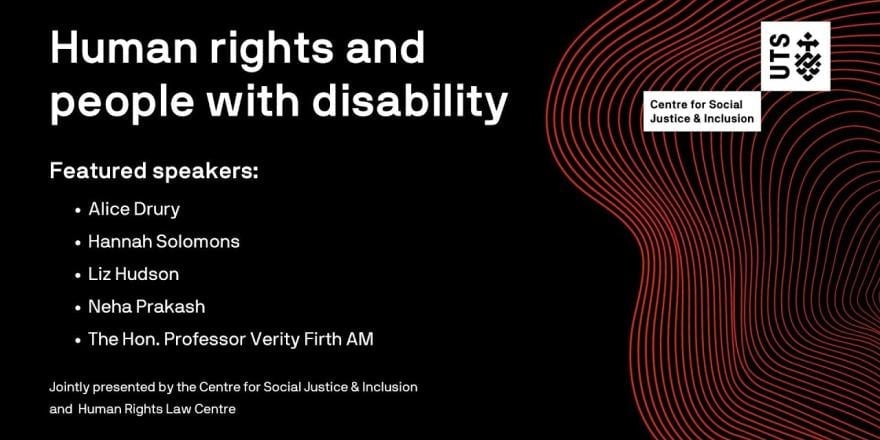
Alice Drury, Hannah Solomons, Liz Hudson and Neha Prakash joined Verity Firth to discuss how a National Charter of Human Rights can make a difference for people with disability, and the lives of all Australians.
t5EJBlpRA8M

Descriptive transcript

Before I begin, I'd like to acknowledge, at least for those of us in Australia, we are all on the traditional lands of First Nations peoples, and this land was never ceded. Today, I am at UTS. I have a fake background, but I am actually at UTS, so I'm on the land of the Gadigal people of the Eora Nation. I want to pay particular respect to them as the nation of first contact, as the nation who resisted colonisation and invasion, and as the nation that continues to hold the knowledge about the land on which this university is built.

My name is Verity Firth, I'm the Pro Vice-Chancellor of Social Justice and Inclusion here at UTS, and it's my real pleasure to be co-hosting today's event with the Human Rights Law Centre. We're joined by a great line-up of speakers: Alice Drury, Hannah Solomons, Liz Hudson, Neha Prakash, and Tenille Lamb. Actually, I don't know if Tenille is online—she was, but she's unfortunately an apology. But everyone else will be discussing human rights and people with disability. I'll introduce you to each of our panellists in just a moment.

In Australia, one in six people, or about 4.4 million people, have a disability. We have a Disability Discrimination Act, which aims as far as possible to eliminate discrimination against a person with disability in public life, and to ensure, as far as practicable, that persons with disabilities have the same rights to equality before the law as the rest of the community. While all our laws and policies affect people with disability, they are seldom designed with their varied needs at their core. Could a Charter of Human Rights be a better model for upholding the rights of people with disability? Human rights charters in our states and overseas have helped prevent human rights violations and provide a powerful tool for challenging injustices. I'm looking forward to hearing from each of today's panellists about how we can centre the human rights of people with disability in law and in policy.

It's my pleasure to welcome each of them here now, and I'll give you a little description of each of their expertise as I do so.

Alice Drury is the Acting Legal Director of the Human Rights Law Centre. Alice works on systemic and emerging threats to Australian democracy, such as getting big money out of politics and putting an end to mass surveillance. Previously, Alice was the Legal Director of GetUp and has first-hand experience in responding to government interference with civil society, having defended the high-profile activist organisation at a time of significant government pressure. Welcome, Alice.

Hannah Solomons is a PhD candidate at the UTS Faculty of Law with lived experience of disability. The focus of her research is how making disabled people the exception to the rule all the time affects the rule of law. She's also the head of Disability Pride Sydney, is passionate about the rights of disabled people and considers the current state of affairs a human rights crisis on our doorstep. Welcome, Hannah.

Liz Hudson is Policy and Research Manager for Children and Young People with Disability Australia. She has extensive experience with the disability, community service and mental health sectors. She completed her PhD at RMIT on the experiences of people with psychosocial disability during transition to the National Disability Insurance Scheme. Welcome, Liz.

And last but not least, Neha Prakash joined the National Ethnic Disability Alliance to lead a program focused on improving refugees’ and humanitarian entrants’ access to the National Disability Insurance Scheme. She is currently the Director of Strategy and Partnerships at the National Ethnic Disability Alliance. Her previous work experience includes working as a settlement officer, leading legal literacy programs and advocating for the rights of migrants and refugees. Welcome, Neha.

Well, so to the questions, this one is to all of you. We have protections in the law. We know that we have that already, like the Disability Discrimination Act, that aims to assure equality. Are these protections working? And if not, what are some of the big challenges faced by people with disability? And we might start with you, Alice, as our co-host of the event today.

Alice Drury: Sure, many thanks, Verity. The Disability Discrimination Act is really centred around issues that individuals might have when they face discrimination on the basis of having a disability. For instance, it often comes up in the situation of employment, and you're really looking at situations where people are treated in less favourable terms—that's the legalistic phrase for it. The difficulty with the Disability Discrimination Act is there are gaps. There are situations in which people are just not covered. So one example, for instance, is where an employer may not accept that an employee has a disability to begin with. And in such a situation, the courts have actually found, well, if you don't believe that somebody has a disability, you can't discriminate against them on the basis of that disability. And it follows that they don't actually have a claim under the Disability Discrimination Act. So it's one example of the sorts of gaps that people experience under the current regime.

Verity Firth: Liz, do you have issues around that that you can raise?

Liz Hudson: Yes, thanks, Verity. While the Disability Discrimination Act operates across Australia and it's applicable in all states and territories, it really is failing to implement Australia's obligations under the United Nations Convention on the Rights of People with Disability. As the representative organisation for children and young people with disability, we're really interested in the education sector. Australia's education is fragmented across states and territories, each operating their own system with different policies, practices and legislation. In relation to education, neither the Disability Discrimination Act nor its subordinate legislation, the Disability Standards for Education, expressly mention a right to inclusive education as recognised under the Convention on the Rights of People with Disability. We see this as a limitation, and the Disability Discrimination Act has largely been ineffective to prevent that kind of widespread gatekeeping in our Australian education systems. There might be the formal or informal denial of access to or discouragement of students with disability attending mainstream schools. That's the biggest concern, I guess, is around the education. But we also believe that human rights protections for children and young people with disability are needed in many areas across education, employment, the justice system, out-of-home care and the National Disability Insurance Scheme.

Verity Firth: So it's an issue, presumably, the Act just simply doesn't cover the scope of what people with disability are facing.

Liz Hudson: Exactly, especially around inclusive education and the right to inclusive education.

Verity Firth: Yeah, that's a good point. Neha?

Neha Prakash: Thank you, Verity. And just adding to Alice's point earlier, I think there are some gaps and loopholes in the Act which doesn't cover everyone. For example, what NEDA always looks into mainly is the Disability Discrimination Act provides an exemption for certain provisions in the Migration Act and migration regulations. So people with disability and their families often run the risk of having their visas cancelled or applications refused because they are unable to meet the health requirement in the Act and the regulation. Now, Australia has very strict health requirements in law and in policy, and these are not consistent with equal protection and obligations under Article 5 and Article 18 of the United Nations Convention on the Rights of Persons with Disability. So Article 5 looks at equality and non-discrimination, and Article 18 looks at liberty of movement and nationality. There are a lot of gaps and loopholes in the Act, and even if it exists, if there's no mechanism to actually see it through, it's not the best.

Verity Firth: So Hannah, just coming to you, what do you think of the Disability Discrimination Act? Does it ensure equality? What are some of the challenges that people face who have disability?

Hannah Solomons: No. That's the short answer to that. I was discussing this with my disabled colleagues and there was a general reaction along the same lines. I'd actually go so far as to say that the law, as it currently stands, can actually have an obfuscatory effect, a deceptive effect, where you're in an advocacy situation and someone will say, "Well, we follow the requirements of the letter of the law," or you'll complain that something's going wrong systemically. And the response I've had from politicians will be, "Well, you know, it's illegal to discriminate against disabled people." And I'm like, "Yeah, I do, actually." And what happens is when you pass a law, you create this illusion of legitimacy and that everything is as it should be, when actually bringing a claim under the Disability Discrimination Act is nigh impossible for your average person with a disability. Graeme Innes, the Disability Discrimination Commissioner, had to mortgage his house in order to get a $10,000 compensation payout. So, I would say, in short, no.

Verity Firth: That's really interesting. Staying with you now, Hannah, I want to talk to you a bit about your research. So, your research focuses on making people with disability the exception to the rule. The fact that we make them the exception to the rule all the time actually affects the rule of law. So, can you share some of your key findings and talk us through your research?

Hannah Solomons: Yeah, sure. So, often the law will kind of frame this issue as something we can't handle. It's too difficult for the law to get involved in. So, often when they make a law, they'll make a law assuming people don't have a disability and then put in little exceptions to try and deal with disability in the situation. And they do this in a number of different ways. But when you don't make a law that centres disability, what you end up with is the equivalent of a grocery store that doesn't sell groceries, because disabled people are the people most likely to need the law. So, what you find is the judiciary will often create an exception by excluding factors to do with disability from the decision-making process, or they'll draw incredibly sharp boundaries around what is a disability. And as soon as you do that, you can't actually access the exception for disability at all.

I'm working on a case—one of the cases that I've worked on in my research analysing is a case where two disabled people were imprisoned automatically, basically, for non-payment of fines. And neither of them raised the fact that they had a disability. One of them was a person with mental health issues locked in a cell speaking to a legal aid lawyer for five minutes through a hole in the wall. She went into a panic attack and decided not to raise disability because she was in a state of terror. So, therefore, she was treated like everyone else, which is incredibly harsh. And it comes back to that obfuscatory effect because they're like, "Oh, well, our system caters to people with disability because we have these provisions." But the provisions are impossible to access because the law likes to keep things nice and contained. One of the lawyers testified in this case that he has never had a person with intellectual disability raise to him that they have an intellectual disability. So, it's almost impossible.

Another option is that the law will—there will be this kind of discretionary, very broad discretionary exceptions that the judiciary or the ministry has to cater to people with disabilities. And what that essentially is, is a violation of the rule of law. So, in one case called Marion's case, which is still the authority for a huge number of cases in Australia, despite the fact that it was a forced sterilisation case, the dissenting judge said to decide any case by reference to the formula of best interests—so that's it, you have discretion to do whatever is in the best interests—is not really a test at all. It allows lawyers and courts to persuade themselves and others that theirs is a principled approach to law. Meanwhile, they engage in what to others is clearly a form of ad hockery.

So, what Neha raised about the—like, what can actually happen is that you get deported for having a baby with a disability. And the government's answer to that would be you can appeal to the minister's discretion. And that is in a lot of situations. A former human rights commissioner actually said that's a violation of Magna Carta, because it's literally the king can exile on whim. So, we're actually violating everything.

And the more—what you see is that when the courts treat disability as just a normal variation on the law, that is a factor to be considered, they tend to uphold these fundamental values in a very different way.

Verity Firth: That's really interesting, Hannah. Alice, I'm going to come to you, because Hannah's raised some pretty stark examples of challenges faced by people with disability in Australia, and particularly in the Australian courts. So, do these—she's saying they breach Magna Carta. Do some of these examples go against the human rights principles and Australia's international commitments in terms of human rights treaties?

Alice Drury: Yeah, they certainly do. So, to bring it back to the experience of people who have migrated to Australia and had disabilities or have children with disabilities, as Hannah and Neha have raised, you have a right under the Convention on the Rights of Persons with Disabilities to equality and non-discrimination under Article 5. There's no carve-out in that article to say that there's an exception to children of migrants or people who have recently arrived in Australia.

Another example is what Liz was talking about in terms of right to equality of education under Article 24 of the Convention. There's no qualification there to say, unless it's too hard for the school, or they haven't gotten around to it. It actually imposes a much stronger positive obligation on states to take actions to allow children to be educated like everybody else in an inclusive mainstream school. So, all of these instances that have been raised thus far definitely conflict with Australia's obligations under the Convention.

Verity Firth: So, Neha, tell us—given that, tell us a bit about your experience with the National Ethnic Disability Alliance and your work with culturally and linguistically diverse communities, including, obviously, refugees and humanitarian entrants. What is required to ensure that their unique needs are considered in our policies and systems?

Neha Prakash: Thank you, Verity. National Ethnic Disability Alliance is a cross-national disability peak body that supports and advocates for the rights of people with disability from migrant and refugee backgrounds. It is a Disabled Persons Organisation, which means a majority of our board members, as well as the staff, are people with disability from culturally and linguistically diverse backgrounds. When we say systemic advocacy, we're looking at bringing about attitudinal and social changes to ensure that legislation, policies, practice, service delivery systems—all of this is inclusive and meets the needs of people with disability.

Now, for them to be able to participate on an equal basis with others, there's a few things that need to be considered. One being, you have to work in partnership with community organisations, with people with disability, with Disabled People's Organisations when you're co-designing or designing or producing any service delivery design systems, policies, legal reforms, any research or evaluation that involves them and impacts them. Build capacity so they can advocate on a grassroots level. And for any activism to happen, you have to be providing opportunities and platforms so their voices can be heard. You have to make sure you include them in all formal and informal consultative, as well as decision-making processes.

Make sure that any barriers that can have a socioeconomic impact on their rights—on a systemic level, on a social level, on a community level, on an individual level—are addressed. Looking at exploring scalable options and solutions with people with disability and also looking at what works for whom and in what context it works. Looking into some of these details, looking at disaggregated data around disability and culture and diversity with people with disability, because you don't get this data enough, and it's really important to understand the current state of affairs and look at where the gaps and pain points are and address them. Looking at simple and universal designs and solutions—this benefits everyone and makes things simple. As well as looking at, obviously, people with disability are experts for their own lives as well as their needs, so include them in a meaningful way.

Engagement has to be done keeping in mind the United Nations Convention on the Rights of Persons with Disabilities, like some of the standards that they have set. Often what happens is they're included in some part of the consultation, and then they're just closed in terms of all the information that happens and everything that happens after. For example, they're like, "Okay, we want to hear about X, Y, and Z that we're planning to implement," and after they hear from them, there's no information about where that information is going, how it's being used, whether it's been implemented—none of this. So it's really important to close that information loop and keep them included from start to end.

One of the things that happens is they should really consider the negative impact of monolingualism, which is just producing resources and things in one language. So if people don't speak the official or the national language of a certain country, it's really important to look at what other options can we have. For example, if there's just one language and people with disability have to rely either on another person or professional, like their family member, to access information, often the other person's biases may impact what information is being delivered. It may spread misinformation. So to avoid all of this, it is important to look at producing them in different formats—easy to read, easy to understand formats, in people's preferred languages. And it should not be an afterthought. All of this should be resourced for and thought through at the budgeting stage and while designing, and not look at, "Oh, no, we only have this much money left and translation is expensive." Well, it is an accessibility issue.

Even making small changes can be really transformative. For example, the NDIA provides translated information if you request them. If at the beginning, when an applicant says their preferred language is Arabic, for example, if they make it a rule that they would provide them with an English as well as an Arabic version, and an option for people to opt out, then it's going to be more used. So looking at producing resources in multiple formats and languages is really important.

I mean, it can go on—I can go on—but some of these things are things that should be considered.

Verity Firth: Thanks, Neha, that's really good. Liz, I'm just going to come across to you now because you mentioned it a bit in your opening remarks, but one of the big focuses of your organisation, Children and Young People with Disability Australia, is that you're working to create a more inclusive education system and equality for young people in public life. So can you tell us a bit about the work that your organisation does to meet these goals?

Liz Hudson: Yes, thank you. Before I begin, I want to provide some context, but also just to follow on a point that Neha raised before about inclusion starting at the beginning. That's something that people from the CYDA community indicate is very important—that inclusion starts very early, right at the early childhood education and care sector. Over 50 years of evidence tells us that inclusive education actually best prepares students with disability for life and success after they finish their education. But unfortunately, students with disability in Australia face so many challenges in accessing inclusive education. As I mentioned earlier, they don't comply with the recognition under the United Nations Convention on the Rights of Persons with Disabilities, but also the United Nations Convention on the Rights of the Child.

Students with disability often face discrimination, segregation from their non-disabled peers, bullying, restrictive practices, suspensions and expulsions. In fact, research evidence suggests that school-age students with disability are segregated and suspended and expelled at higher rates than their peers. Further, the highest level of educational attainment for people with disability remains lower than that for children and young people without disabilities. These inequities can have really long, lifelong implications.

So, we argue that a transformation in education is needed to ensure that Australia complies with the CRPD and the Convention on the Rights of the Child. We know that inclusive education is essential for creating that sort of inclusivity. Through our work, we would argue that all Australian children must be welcomed and supported at their local school and provided with high-quality inclusive education. But sadly, for too many children and young people with disability, this is not the case, and that's evident in our work.

Some of our work involves, for example, we conduct annual surveys on education. This year, for the very first time in 2023, we actually did a survey where we asked young people, students with disability, to report on their experiences in school. We had 231 responses, and unfortunately, in our report on that survey, we've had to put a content warning around the material in the responses—they were very grim around the first-hand experiences of violence that young people have experienced in schools. We had over 70% of our survey respondents actually experience exclusion, and 65% experienced bullying. Not only did they tick the response to say they experienced bullying, but they were offered an opportunity to give free text responses, and we had nearly 100 respond to detail those experiences of bullying. Some of these responses indicated that they had been bullied many times and didn't actually want to provide that detail, because to recount the specifics would prove really traumatising. So, it's alarming and grim, and therefore, it doesn't uphold the rights of students with disability.

Some other aspects of our work in particular: CYDA is the Secretariat for the Australian Coalition for Inclusive Education, a national coalition bringing together organisations that share a commitment to improving and advancing inclusive education in Australia and across state and territory education systems, including government and non-government schools. The Australian Coalition for Inclusive Education has developed a national roadmap with five goals or pillars they want to achieve, including calling for an end to segregation, to eliminate restrictive practices, which are occurring at alarming rates as well, and to stop discrimination and bullying.

We've also had young people with disability be involved in co-designing their own policy papers around issues like inclusive education and human rights. They ran a number of consultations in 2021, and that resulted in five policy papers co-designed, written and authored by young people with disability, calling for some of these issues. We respond to government inquiries and submit policy papers and submissions, like the ones we've done from young people with disability.

Verity Firth: That's great, Liz. Now, moving on, it's sort of a good segue from what Liz has been talking about in terms of segregation and education. I thought we might go to some of our audience questions. The one that's got the most votes so far is Katia's question. I'll read this out, and any of our panellists who want to take a go at answering it first, put your hands up while I read it out. Otherwise, I'll just come to you.

So, Katia makes the point that governments so far have been reluctant to address segregation on the basis of disability and to recognise this practice as a discriminatory practice and a breach of equality and non-discrimination principles under international human rights law applicable to Australia. However, ending segregation has been at the core of the struggle of disabled people for human rights. How can we progress disability reform to transition out of segregated models of support for disabled people? Who'd like to have a go at answering that first?

Liz Hudson: I'm happy to answer that, and thanks so much for the question, Katia. I think that we can have this goal to end segregation, but we do have to have a phased approach to ensuring that the quality of inclusive education happens simultaneously as a plan to phase out segregated education, because there's no point closing schools that are not inclusive unless there's an alternative model that is quality education. The Australian Coalition for Inclusive Education has actually a national roadmap developed for stepping through the ways that we can ensure a quality inclusive education system.

Verity Firth: What do you think, Hannah? How can we progress out of segregated models of support?

Hannah Solomons: The general problem, I think, is lack of design. You need universal design in education, which is moving forward slowly as a concept, and that's generally how we need to approach everything, instead of seeing disability as a side problem and a fringe issue, which is still how we think. And that goes for every area of policy.

Verity Firth: Thanks, Hannah, that's great. Alice?

Alice Drury: I'll probably surprise no one on the call by saying I think a Charter of Human Rights is the key way, really, of moving forward to ensure that segregation is no longer the government's go-to, but, in fact, inclusion and taking positive steps in many instances to ensure that people with disability have exactly the same accessibility as able-bodied people. I'd give a shameless plug to the Charter of Human Rights.

Verity Firth: Neha, when I come to you, we can talk a bit about transitioning out of segregation, but I might also ask your opinion about an Australian Charter of Human Rights, because the next question from the audience was exactly that. Is there a need for a federal Charter of Human Rights as a means of addressing these patchy legislation issues?

Neha Prakash: Oh, yes, 100 per cent. That's a quick answer. Talking about inclusive education, that was something that was brought up in the recent Conference of State Parties on the Convention on the Rights of Persons with Disabilities that was held in New York recently. A lot of countries spoke about the importance of inclusive education and how to bring about that transition. They were looking at how there is a lack of research in this space, as well as looking at best practice and what needs to be done.

Some of the conversations looked at how you can also include this even in teachers' training, parents, and the whole education system, and everyone not working in silos but together. The shift, when it happens, has to take into consideration context, and it should be done in a relevant and appropriate manner, because good intention is amazing, but if it does not translate into meaningful inclusive solutions, there's no point. So it has to be done well and it has to be done in an appropriate manner.

Verity Firth: Alice, since you were doing a shameless plug for a human rights charter, where do you think—how do you feel it will make a difference to people with disability if we were to introduce a charter of human rights in Australia?

Alice Drury: Essentially, the starting position for a charter is that the wellbeing and rights of people should be at the heart of every single decision that the government makes. That's exactly what a charter of human rights would do. In particular, with the participation duty, which is something that the Australian Human Rights Commission has put forward in the disability rights space—the "nothing about us, without us" mantra—what that would do is put an obligation on government to ensure that there is deep, meaningful consultation with people with disability regarding any government decisions that disproportionately impact people with disability. So that is just one of the key things that a charter would achieve, not to mention ensuring that people have recourse to action when their right to education, including inclusive education, isn't respected.

Verity Firth: So one of the questions in the chat is from Belinda. She says that Queensland has a Human Rights Act now and section 36 contains a right for a child to access an education appropriate to their needs. She's interested in knowing whether there's a similar right in other jurisdictions and has it been used to litigate successfully for inclusion of children at state schools. The emphasis on the wording in section 36 is "access and appropriate to their needs." Liz, you may know the answer to that question, do you?

Liz Hudson: Sorry, I don't have the details at hand and know what legislation is and the wording for each across all of the states, but I do know that there are some states where they have a human rights charter or act and where children and students with disability have had their position or their situation assisted through having the charter or the act. But yes, I don't know what the actual wording is across similar. I know that in Victoria there is the Human Rights Act, but in Queensland as well. So yes, it does, but I don't have that kind of detail at hand.

Verity Firth: Alice, did you have any further detail on that question?

Alice Drury: Yeah, just to add, so the right to education also exists under the ACT charter. I'd recommend people check out the Human Rights website, which has 101 different cases elucidated there. But I did just want to mention one of them, which was in Victoria—a child with a learning disability was threatened with expulsion by his school as a result of what they deemed to be behavioural issues. The child's advocate was able to raise the student's right to education, and in that instance was actually successful in preventing the expulsion. So it's just one example of the charter being used in an individual's case to ensure that they weren't discriminated against in Victoria.

Verity Firth: Yeah, okay, that's good. And Liz, you had something further to add?

Liz Hudson: Yes, we, ourselves and another disability representative organisation, and the Australian Human Rights Law Centre, put in a joint policy submission to the Disability Royal Commission about the benefits of introducing a charter, and listed a series of all examples, case studies, that Alice just mentioned before, about the successful application of the use of a human rights charter in those states. There was a young woman in Victoria who, via the Human Rights Charter, was able to access disability services that previously she had been declined. And a child with a disability was exempted from being in detention in hotel quarantine by the Queensland Human Rights Act due to the behavioural challenges of the child, so the child and the family did seek an exemption and it was approved. So they're just a couple of examples of the many ways that a charter can assist.

Verity Firth: Yeah, that's really good—practical case studies about how it can help. The next question from Dana, I think it's a good one too, actually, because it's saying, okay, what role can industry play in supporting and leading the way on policy for people with disability and their employees with disability? I think that's a really important one. We always talk about government and we always talk about government delivery of education and other services, but what about industry

If you are interested in hearing about future events, please contact events.socialjustice@uts.edu.au

We need to consider the experiences and outcomes of people with disability, not just in the disability space, but across all areas, agencies, sectors and levels of work. Whether its government, private sector, community level we need to think about intersectionality and the interdependence of all human rights and freedoms. Neha Prakash

Diversity includes disability. If you want to talk about diversity, you have to talk about us. At the moment, that is not the case, including in law and policy. Hannah Solomons

The wellbeing and rights of people should be at the heart of government decision-making. It would put the obligation of the government to ensure deep and meaningful consultation with people with disability regarding any positions that disproportionally impacts them. Alice Drury

We need a change in the way we use language. Its not just inclusive education but inclusive language, and we need to respect the rights and experience of people with disability about what language they would like to use to represent and be represented. Liz Hudson

Speakers

Alice Drury is the Acting Legal Director of the Human Rights Law Centre. Alice works on systemic and emerging threats to Australian democracy, such as getting big money out of politics and putting an end to mass surveillance. Previously, Alice was the Legal Director of GetUp and has first-hand experience in responding to government interference with civil society, having defended the high-profile activist organisation at a time of significant government pressure. 

Hannah Solomons is a PhD candidate at the UTS Faculty of Law with lived experience of disability. The focus of her research is how making disabled people the exception to the rule all the time affects the rule of law. She is also the head of Disability Pride Sydney, is passionate about the rights of disabled people and considers the current state of affairs a human rights crisis on our doorstep. 

Liz Hudson is Policy and Research Manager from Children and Young People with Disability Australia. She has extensive experience within the disability, community service and mental health sectors. She completed her PhD at RMIT on the experiences of people with psychosocial disability during transition to the National Disability Insurance Scheme (NDIS).

Neha Prakash joined the National Ethnic Disability Alliance (NEDA) to lead a program that focused on improving refugees’ and humanitarian entrants’ access to the National Disability Insurance Scheme (NDIS). She is currently the Director of Strategy and Partnerships, supporting NEDA in achieving its strategic priorities. Her previous work experience includes working as a settlement officer, leading legal literacy programs and advocating for the rights of migrants and refugees.

Share