

• Posted on 20 Jun 2023
  • 49-minute read

The global humanitarian crisis has forcibly displaced at least 103 million people due to war, persecution, conflict, violence, or human rights violations.  

Universities can be agents for change in the humanitarian crisis – from providing equitable access for students from a refugee background to protecting academic freedoms and at-risk scholars.  
0VMZR9Iun2c

Descriptive transcript

I'd like to acknowledge, of course, that I'm on the land of the Gadigal people of the Eora Nation. Gadigal land is the land on which the university is built and I'm at work today and I want to particularly pay respect to the Gadigal Elders for being the traditional custodians of knowledge for the land that this university is built on. I want to acknowledge the traditional custodians of the Country where everybody else is from and feel free to share where you're from in the Q&A box.

My name is Verity Firth. I'm the Pro Vice-Chancellor of Social Justice and Inclusion here at UTS and it's my absolute pleasure to be hosting today's event in the lead-up to Refugee Week.

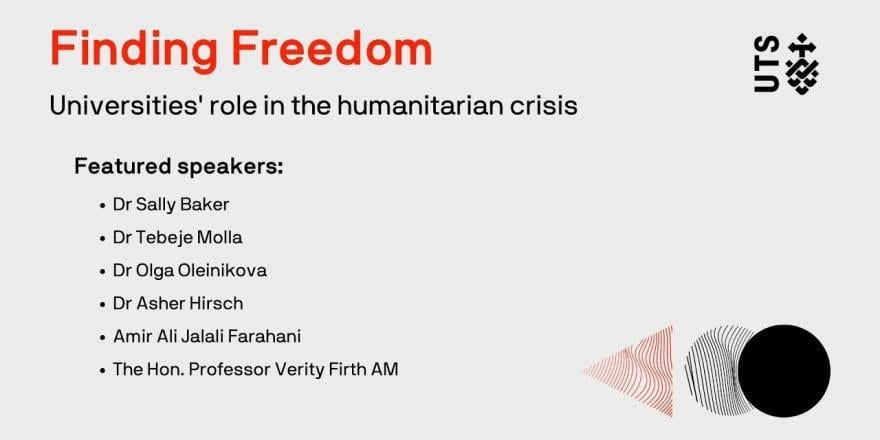
We're joined today by a great lineup of speakers: Dr Sally Baker, Dr Tebeje Molla, Dr Olga Oleinikova, Dr Asher Hirsch and Amir Ali Jalali Farahani, and I'll introduce each of them properly in just a moment.

The global humanitarian crisis is staggering. The United Nations High Commissioner for Refugees estimates that last year saw at least 103 million people forcibly displaced due to war, persecution, conflict, violence or human rights violations. This year's Refugee Week is focused on the theme 'Finding Freedom'—freedom to live without the fear of war, to have your basic human rights upheld, to live in safety and without the fear of persecution. Freedom should not be an ask. It should be a way of life.

Universities have a role to play in the humanitarian crisis. They can be agents for change—from providing equitable access to higher education to refugee students, advocating for equitable refugee laws and policies, to protecting academic freedoms and at-risk scholars.

I'm looking forward to hearing from each of today's panellists about how they see universities being able to contribute. So it is my pleasure to now introduce each of them to you.

Firstly, Dr Sally Baker is a Senior Lecturer in the School of Education at UNSW. Sally's teaching and research interests centre on language, literacies, transition and equity in higher education for culturally and linguistically diverse students and refugee students. Sally is the Co-Chair of the National Refugee Education Special Interest Group for students from refugee backgrounds, supported by the Refugee Council of Australia. Welcome, Sally.

Dr Tebeje Molla is a Senior Lecturer and Australian Research Council Future Fellow in the School of Education at Deakin University. His research focuses on inequality and policy responses in education. He recently completed a Discovery Early Career Researcher Award project, investigating the educational attainment of African heritage youth from refugee backgrounds. Welcome, Tebeje.

Amir Ali Jalali Farahani is a final year Bachelor of Engineering (Honours) and Medical Science student. He comes from a refugee background and is a UTS Humanitarian Scholarship recipient. Amir is driven to make a positive impact in his chosen field and, in his spare time, enjoys basketball and photography. Welcome, Amir.

Dr Olga Oleinikova is a Senior Lecturer and Director of the Social Impact Technologies and Democracy Research Hub in the School of Communication here at UTS. She is named among Forbes Top 40 Global Ukrainians and Forbes 30 Under 30 in Asia. Her recent projects include a report on the settlement of Ukrainian war refugees in Australia and their challenges working with settlement services and barriers to integration. Welcome, Olga.

Last but not least, Dr Asher Hirsch is a Senior Policy Officer with the Refugee Council of Australia, the national peak body for refugees and the organisations and individuals who support them. His work involves research, policy development and advocacy on national and international issues impacting refugee communities. Asher is also a Lecturer at Monash University in public law, human rights and refugee law. Welcome, Asher.

So I'm going to begin today with a question for each of you that I'll just get you to answer in turn. We'll start with you, Asher, and we'll work our way around. Can each of you share some insight into how universities currently respond to humanitarian crises?

[Dr Asher Hirsch:] Thank you very much. I think one thing that universities have been doing for a number of years, which is really welcome, is providing scholarships to people seeking asylum and refugees on temporary visas. I know UTS has done so, with even some of the recipients here today, and this was really heartening to see.

A few years ago, with the reintroduction of temporary protection visas, refugees weren't able to access higher education. They had to pay a high level of international fees and weren't able to get loans. But universities really did step up and provide access to classes and scholarships and even additional support. That was very welcome and for many people, life changing. So thank you to all the universities for doing that.

I also think a lot of universities invest a lot of time and resources into equity programs, ensuring support for disadvantaged students, and a whole range of other support services. That also needs to be acknowledged and welcomed as well.

[Verity Firth:] Thank you. Olga?

[Dr Olga Oleinikova:] Yes, I agree completely with Asher. First of all, I'll say that I never worked on the topic of refugees before Ukraine ended up in this trouble. I never thought that the topic of refugee would be a topic of my family and my friends. Because I'm inside UTS, I closely followed how universities were supporting Ukrainians. The scholarships that Asher mentioned are lifesaving for many students who want to come here on humanitarian visas and do a degree.

But also, another program which exists globally among universities is the Scholars at Risk program. I think UTS and other unis are part of it too, when they take esteemed scholars—not students, but they give employment to scholars from countries in war conditions or under ecological disaster, who are refugees for any reason.

I know a couple of very good success stories. Typically, it's very hard for people who are mid-career or professors from Ukraine or other countries who don't speak English very well to integrate and get a job in Australia, even for a short contract. It's hard; there are a lot of challenges. But I have learned there were a couple of great success stories of Ukrainian professors. For example, I know one Ukrainian professor from Kharkiv, she's in her 60s, and she managed to get to Sydney and now teaches mathematics and coding. She now has a permanent position. These programs can transform into permanent positions for scholars.

Universities also create webinars like this one for refugees, where we can talk about things important for people who are refugees and for stakeholders in this area. This is a brief note from myself.

[Verity Firth:] Thanks, Olga. What about you, Amir? What are universities currently doing to respond to the humanitarian crisis?

[Amir Ali Jalali Farahani:] Yes, I'll touch upon what Asher was saying as well. UTS obviously offers their Humanitarian Scholarship program, which actually goes beyond financial assistance. It provides tailored support services to mitigate barriers and promote success for students such as myself. That can be in the form of tuition fees, educational and living costs, or support and transitional onboarding, whether from UTS College or straight from high school.

[Verity Firth:] Thank you. And Tebeje?

[Dr Tebeje Molla:] Thank you again. I guess starting with the theme itself, I really found 'Finding Freedom' a very powerful theme. As you know, freedom is not limited to the absence of suffering or persecution. Freedom is also about having the opportunity to achieve one's aims and aspirations. Freedom is also about having the opportunity to make decisions for oneself. In that sense, it's really a powerful theme and I'm happy you picked that up and created this opportunity for us.

What are universities doing? I think universities are trying their best—most universities, especially in Australia—to meet that demand. We can divide the response of universities to humanitarian crises into three major categories. One is the most common: giving educational opportunities, which can be through special consideration at admission level or financial support. Over 80% of Australian universities offer that kind of assistance in one form or another.

The second category is research and training. Universities train the next generation of humanitarian leaders and generate knowledge on the causes, consequences, and solutions to humanitarian crises. For example, globally, the Harvard Humanitarian Initiative is well known in this space; within Australia, at Deakin, we have the Centre for Humanitarian Leadership.

The third category is advocacy. University staff and students are working to address the crisis. In the UK, the Universities of Sanctuary staff and students work together to create space for refugees and forcibly displaced people, including students and scholars.

So, we can see those three main categories of responses. Where are we here in Australia? I'm sure we will discuss those themes later on. Thanks.

[Verity Firth:] Yes, and in fact, Sally, I'm going to come to you to talk specifically about your research in this space. Tebeje, I know you research as well. Both of you research issues around university systems and their impact on people from refugee backgrounds to access and succeed in higher education. Sally, do you want to talk a bit about what your research shows?

[Dr Sally Baker:] Sure. Thank you for the invitation. Just before I do that, I want to mention one other thing that universities do and can do, and as public goods, should do: work with civil society organisations and NGOs like RCOA, and also the wonderful Refugee Action Support Program that the Australian Literacy and Numeracy Foundation runs, with Loshini Naidoo at Western Sydney very involved. The ASRC in Melbourne has partnered with the University of Melbourne to offer a PhD scholarship, for example. So, there are lots of examples.

What our research really clearly shows, though, is that this is very ad hoc. Some universities—big shout out to UTS—are very early adopters and very committed. Other universities are not quite as committed, or at all. There are still universities across Australia that do not offer scholarships. While Asher is right to point to this being an incredible contribution, there are nowhere near enough scholarships to meet the needs of the many people locked out of higher education.

While the end of temporary protection and safe haven enterprise visas was a massive moment of celebration for advocates earlier this year, there are still tens of thousands of people on bridging visas who will still face similar issues in terms of being locked out.

So, what our research tells us—and I am aware that I am the one that constantly bites the hand that feeds me as someone who works in a university and in the sector—is that universities don't actually do enough. They don't respond to the needs of refugees often. They might capture people with lived experience of forced migration because they fit into another equity category if they have a permanent protection visa, and they might be able to offer a small number of scholarships, often limited by issues of cost. There have been many conversations across the last six-plus years about whether there is an actual cost to the fee waiver component, so there is inconsistency across the sector.

This really comes down to the issue of the very broad umbrella categories for equity for universities to respond to through the Higher Education Participation and Partnership Program. Refugees are not a named, identified cohort. It's then up to individual universities to be responsive, or what Sue Webb, Jane Wilkinson and Karen Dunwoodie call 'go-arounds'—finding flexible ways of working around structures to provide what we know is a bespoke set of tailored services that account for cultural, linguistic and racial marginalisation in our predominantly white, Anglo, monolingual English-speaking institutions.

While I want to absolutely celebrate the great progress we've made, there are many issues that continue to create barriers that are structural, that come from having a reductive lens and an imagined student that we build our support services around. We've done a good job of opening access, but not a great job of supporting engagement, and we haven't done enough to help students move out of education and into employment. We know that refugees as a cohort, particularly first generation, have much lower postgraduate and employment outcomes. There's a lot more work to do.

[Verity Firth:] That's really interesting. Tebeje, is there anything you'd like to add in relation to your research?

[Dr Tebeje Molla:] Sure. Just to explain why universities are not fully supporting refugees to the extent they need to: I explored refugee education across four policy spaces. The first is the global policy space, mainly focusing on the UN. Australia is a signatory to major refugee frameworks and initiatives, including the Refugee Convention and the New York Declaration. In those, education is an important element; nation states agreed to provide education for refugees, and Australia agreed to that.

The second policy space is the national level. At the national level, refugees are recognised as specific equity groups. For example, you can take the Multicultural Statement, the Multicultural Access and Equity Guide, the National Education Declaration. Across all those, refugees are recognised as specific groups and governments are committed to supporting them.

The third policy space is the higher education sector. That's where they are missing. At the sector level, take any equity initiative within higher education, including HEPPP and the Job Ready Graduate package—the latest one—refugees are invisible.

The fourth policy space is the institutional context. Some universities are doing better than others, but they are doing something. Why are they not doing enough? Because policy invisibility means no funding. No funding means universities cannot provide ongoing targeted support because it's costly and resource intensive. That policy invisibility is a serious issue at the sector level that we need to work on.

[Verity Firth:] That's really interesting. I'm going to come back to you on this issue of policy invisibility and some of the current initiatives that the new government is exploring. But first, Amir, what has it been like—what has your experience been navigating the Australian university system, and from your point of view, how can universities better support students from refugee backgrounds?

[Amir Ali Jalali Farahani:] First of all, I want to say that I'm privileged to be a recipient of the Humanitarian Scholarship at UTS, and due to this program, my experience at an Australian university has been positive. Transitioning from high school straight to university and coming from a refugee and asylum seeker background, I thought I would never have a space at university and there would be no seat for me. Being part of this program provided me with the guidance and navigation system I needed to access those services. I know there are services available, but maybe not everyone knows about them or how to access them. The UTS Humanitarian Scholarship program actually provided me with that guidance.

With the extensive support that goes beyond just covering my fees, I have other support such as being able to focus on how to go to an interview for a job as a student who never experienced such a thing. It's a real privilege for me to look at this and how this can improve my career as well. These are the kinds of services that are such a small factor but contribute to the bigger picture as I'm moving as a student towards the end of my degree and towards my professional career.

To better support students from refugee backgrounds, universities should focus on providing guidance and fostering an inclusive environment where students feel valued and welcome. Programs like the Humanitarian Scholarship program offer assistance with tuition fees, transition support and mentoring, and even opportunities with paid internship programs, where most international students or people from a refugee background are struggling to find at the moment—which is an internship and that door to enter their professional careers. By expanding these initiatives across all Australian universities, more students from the same background as me will have the opportunity to access these valuable resources and overcome the barriers they are facing.

[Verity Firth:] That's a really good point. So, I'm now going to talk about this concept of policy invisibility. One of the things that the Federal Minister for Immigration has been raising as a possibility is Australia establishing refugee education migration pathways. There's no commitment yet, but they're beginning to explore the idea. I might come to Sally first, because I know she knows a lot about this subject. Internationally, refugee education migration pathways share responsibility between the education sector and the government. A good example is Canada's Student Refugee Program, which supports refugee students through active partnerships with over 100 Canadian universities and colleges. It's part of your actual pathway to Canada: you receive one of these education pathways.

Sally, coming to you first, how do you think this could work in Australia? How can the Australian government, universities and civil society work together to implement a similar type of program?

[Dr Sally Baker:] Thank you, Verity. What a thrill to be able to get to this point and talk about this as being an option that Australia is willing to consider and hopefully embrace. It's a win-win, the idea of an education migration pathway. It gives universities a real bespoke opportunity to co-create with government and civil society and, importantly, harness all of the goodwill that exists on every campus with students, staff and alumni, to come together and create a durable solution—a new durable solution. It fits within the community sponsorship space, and I'm sure Asher can speak to this more expertly than I can, but it's an important piece of sharing responsibility. It's about opening new pathways, so it really does need to be additional to the existing humanitarian quota.

It offers, like the skilled labour refugee mobility pilot that comes through a skilled migration pathway, an additional stream of humanitarian intake. That's what we hope—that will help to respond. It's not going to respond to the huge crisis you mentioned at the beginning, Verity, but it's going to do something important and give us a way of leveraging what we know is lots of energy and goodwill and meaningfully put it into a structure that will help support students through.

In Australia, we would benefit from following the Canadian model, which means using a humanitarian visa pathway, which then means people with permanent protection have immediate access to HECS and a Commonwealth-supported place. It means universities won't be quite so worried about having to fee-waive an entire degree, which we know is a challenge for the sector, and the sector hasn't emerged unscathed from COVID financially, so it's not putting additional financial risk on universities.

It gives students and staff a way of contributing—either donations or time and energy—and helping to create that wraparound support that Amir just talked about. UTS does a very good job of this. Not all universities do, and as I said, not all universities offer a scholarship at all. By giving student groups or community sponsor groups an opportunity and a structure with training and clear guidelines to support people as they come in, and hopefully an expectation that any beneficiary of that pathway will then join that local university student group, we're offering a durable solution. It's not a quick pilot; it's an ongoing program. In Canada, their program has lasted for over 40 years—amazing proof of concept.

It's also worth noting that there are now 26 countries offering educational migration pathways—33 pathways across the globe—and there's nothing at the moment in the Asia or certainly in the big resettlement countries of the Asia Pacific. So it's a really important and exciting opportunity for Australia to contribute meaningfully to the crisis in our region as well as the global piece.

[Verity Firth:] Yes, that's very exciting if it can happen. Asher, did you want to add to that?

[Dr Asher Hirsch:] I think what Sally said was that this kind of pathway is a complementary pathway. When we say 'complementary', it means it sits alongside and is in addition to the existing humanitarian program. This is a really exciting way for Australia to bring other refugees into the country who might have other things to contribute, whether it's a skilled pathway to contribute existing skills, or a student pathway for those wanting to study and then use that education to benefit Australia as well.

Where the existing regular humanitarian program should be set aside for those who are most vulnerable and need safety in Australia, complementary pathways can be ways to actually expand the number of people who are resettled. Out of the millions of refugees, less than 100,000 people get resettled every year. Complementary pathways try to expand that by having a win-win process. It's in addition to the humanitarian program, so it's a win for refugees, but it's also a win for the countries where they get resettled because they bring skills and expertise and contribute to the economy as well.

[Verity Firth:] Does anyone else want to comment specifically on education migration pathways? Tebeje?

[Dr Tebeje Molla:] Yes, just to add on the Canadian model, bringing people here is good, but widening participation or widening the pathways requires more work as well. I found the German experience useful. Following the 2015–16 mass arrival of refugees, opportunities were available for refugee youth to go to university, but what they discovered was that just by putting opportunities out there, you can't attract students—you need to work further.

The federal government intervened to make that possible. They funded an independent organisation called Uni Assist, which checks qualifications, migration documentation, and explores pathways for new arrivals. They also funded preparatory academic programs in colleges (like TAFE here), so students could study language and subject-specific knowledge before transitioning to university. The government also allocated money for universities to use for ongoing support for refugee students. So, yes, opportunities are important, but taking advantage of that opportunity requires extra. We need to take that into account as well.

[Verity Firth:] Thank you. Olga, if there's no one else who wants to expand on that, I might come to you. Russia's invasion of Ukraine has left 17.6 million people requiring humanitarian assistance and approximately 40% of Ukraine's population are in need of humanitarian assistance and protection. Recently, you and colleagues from Curtin University, University of Sydney and Deakin produced an industry report covering the settlement of Ukrainian war refugees in Australia. Can you tell us about your findings?

[Dr Olga Oleinikova:] Yes, thank you for this question. This report was the product of a pilot study with four universities together in preparation for a linkage grant. Some of the team members are Ukrainians, like myself. I was born in Ukraine, so I'm really connected—not just academically, but personally—to this topic.

We looked specifically at the role of language in agency: if they know English, how it enables agency; if they don't, how it disables it. We looked at how settlement services were providing those services, given the specific agency level and language skills level. We did research in New South Wales and in Perth, WA. In New South Wales, there is more state support and programs for refugees; in WA, not as much, partly because not many refugees arrive there.

We finished the focus groups in December last year. Most Ukrainian refugees had been here around six months, so it was quite early to determine how they integrate, but it was a good point to understand how settlement services help in the early days of migration. There's not much research on the early stages of migration and how settlement services are accessed.

We found a lot of gaps. First, as Sally mentioned, countries—including Australia—are not well prepared for what we call emergency humanitarian migrants: waves that emerge after a crisis or war. These are often treated differently to ongoing humanitarian migrants. For example, temporary protection visas for Ukrainians were announced in May and closed in July 2022—very quick, and yet the war continues. Ukrainians were not eligible for many services that regular humanitarian migrants receive. For example, with Centrelink, there are special programs for other groups, but Ukrainians were treated as regular Australians, which is strange. Settlement services faced barriers in providing services because government frameworks did not exist for Ukrainians.

Most focus group participants said the support was amazing at first—people met them at the airport, organisations like SSI, Red Cross and others provided early settlement support, housing, food, SIM cards. But after three months, the support drops off and it's hard to get anything from settlement services or anyone else. The focus is really on the first six months after arrival.

We also found that Ukrainian migrants were quite digitally literate and didn't feel much cultural shock, being well-travelled and exposed to democratic values. But language was the main barrier for Ukrainians to get along with things. Culturally, we're not that different, but language is a big issue. That's the core barrier for Ukrainians to integrate. I'll leave it at that for now.

[Verity Firth:] That's really rich and gives you an example. I'm coming to you now, Asher. When you hear Olga work through the industry report she did alongside other universities, giving a rich and detailed experience of Ukrainian refugees in Australia, how does the work of your organisation, the Refugee Council, intersect with the research carried out in universities? Does it help in terms of your advocacy to the federal government? Does it help to change Australia's federal policies?

[Dr Asher Hirsch:] Yes, at the Refugee Council we work alongside a lot of academics who are researching and advocating in this area, across a whole range of policy areas: international policy, asylum policy, settlement support. Their work really does inform our advocacy and research. We often rely on academic research to strengthen our advocacy, and also work alongside experts—joint submissions, joint reports, or having them join us in events. Our job is often to connect research into practical policy outcomes and advocacy. Does it always get taken up by government? Not always, but it really strengthens our advocacy to have detailed and considered research from experts behind us.

[Verity Firth:] My next question, and then I'll move to audience questions. Sally, do you think universities can play a bigger role in challenging stigmas or influencing public perception around people who've been forcibly displaced?

[Dr Sally Baker:] 120% yes. Universities have an incredibly important role—not least because as academics, we have our own area of expertise and can speak within our lane. We have academic freedom that protects us to speak truth to power. Universities could do a lot more to challenge some of the divisive discourses that circulate around forced migration and seeking refuge. I'm particularly enthused by the idea that universities can do more to shift employer perceptions.

Universities are more than pipelines, but for want of a metaphor, that will do. We push people into careers—Amir, for example, is going to work in engineering. Universities have direct relationships with industry bodies and can do more to facilitate employment and postgraduate opportunities for students, and to think about industry partnerships. When the education migration pathway is developed, that's a key potential facet.

There's a lot universities can do as brokers between civil society, employers, peak bodies, accreditation agencies. One thing we haven't mentioned, which is huge, is the issue of qualifications recognition in Australia. It's a challenge for all migrants, but particularly acute for those forced to flee who don't have their certificates. Universities could play a much more involved role in supporting government and working with the Minister for Education to support that capacity.

We have a lot of knowledge now—at least 10 years into a significant proliferation of interest in refugee education and settlement. We need to leverage that. What's significant is that we work in silos. You can't talk about education without thinking about health and housing. Housing is the number one concern for many, especially people seeking asylum who are on very little money. These things need to be considered together.

Universities have a licence to bring people together, working with colleagues from RCOA and other organisations, to have joined-up conversations. We know enough about these individual parts; now we need to think about how they crisscross. That aligns with the work RCOA does, having eyes across the whole space. So, yes, more please.

[Verity Firth:] Does anyone else want to answer that question? Tebeje?

[Dr Tebeje Molla:] Yes. Reflecting on that, last year over Christmas I read a book by sociologist Raewyn Connell, "The Good University". She identified five key features of a good university: democratic, engaged, creative, truthful and sustainable. For this conversation, let's focus on 'engaged'. A good university is engaged—fully present to the society that supports it. Universities need to recognise their dual identity: not just economic missionaries, but also social agents, responsible and responsive to emerging problems in society.

Universities have a role to play in responding to humanitarian crises, as well as environmental and social crises. An engaged university doesn't shy away from controversy or difficult issues. For example, take the issue of racism—what is the role of universities in creating a more tolerant and just society? Universities should be engaged; that should be their identity.

[Verity Firth:] I agree very much with that. I'll come to some questions from the audience. On the issue of having a more holistic response to the humanitarian crisis—integrating the siloed policy areas of health, education, housing and so forth—Nerissa asks: what are the funding sources for refugee migration education pathways? There's a lot of support services that need to go around an education migration pathway, including housing. Is the funding in other countries purely through government, or do universities and industry also contribute? Sally, do you want to tell us a bit about the funding sources for these sorts of pathways?

[Dr Sally Baker:] I need to be clear for the record that this is not a commitment of anything—these are just ideas and there is a lot more work to do. There's a process of co-design to come next. In Canada, for example, there's a levy in what's equivalent to our student amenities fee, where students can donate 1% and choose which charity it goes to. That's one form of fundraising. Other forms include staff giving and philanthropy.

My view is that there needs to be cost sharing between government (who will be committing to pay for things like Medicare, Centrelink and the ordinary costs of bringing in new humanitarian migrants) and universities, who will need to cover some things. That might include a foundation program for language and preparation for study before entering an undergraduate program. Every university has a version of this, often in a college. An ELICOS pathway is a po

Dr Sally Baker, Dr Tebeje Molla, Dr Olga Oleinikova, Dr Asher Hirsch, and Amir Ali Jalali Farahani joined The Hon. Prof. Verity Firth AM about how universities can better advocate for human rights and freedoms of refugees. 

If you are interested in hearing about future events, please contact events.socialjustice@uts.edu.au

The idea of an education migration pathway is a win-win. It gives universities a real bespoke opportunity to create, to co-create with government, co-create with civil society and, importantly, harness all of the goodwill that we know exists on every campus, with students and staff and alumni. Dr Sally Baker

Policy invisibility means no funding. No funding means university cannot provide ongoing targeted support because it's resource intensive. Policy invisibility is a serious issue at the sector level that we need to work on. Dr Tebeje Molla

Being part of the UTS Humanitarian Scholarship Program has been a privilege as its provided me with the guidance to navigate the university education system. By expanding these initiatives across all Australian universities, more students from the same background will have the opportunity to access these valuable resources and overcome barriers. Amir Ali Jalali Farahani

The Refugee Council work alongside academics who are researching and advocating across a whole range of areas: international policy, asylum policy, settlement support. Their work informs advocacy and our job is to connect the research into practical policy outcomes. Dr Asher Hirsch

Ukranian refugees werent eligible for many services as a regular humanitarian migrant. Its been almost a year since Australia closed the humanitarian protection program, and were [Ukraine] still at war Dr Olga Oleinikova

Speakers

Amir Ali Jalali Farahani is a final year Bachelor of Engineering (Honours) and Medical Science student. He comes from a refugee background and is a UTS Humanitarian Scholarship recipient. Amir is driven to make a positive impact in his chosen fields and in his spare time enjoys basketball and photography. 

Dr Asher Hirsch is a Senior Policy Officer with the Refugee Council of Australia, the national peak body for refugees and the organisations and individuals who support them. His work involves research, policy development and advocacy on national and international issues impacting refugee communities. Asher is also a Lecturer at Monash University in public law, human rights, and refugee law.   

Dr Olga Oleinikova is a Senior Lecturer and Director of the Social Impact Technologies and Democracy Research Hub in the School of Communication, UTS. She is named among Forbes Top 40 Global Ukrainians and Forbes 30 Under 30 in Asia. Her recent projects include a report on the settlement of Ukranian war refugees in Australia and their challenges working with settlement services and barriers to integration.   

Dr Sally Baker is a Senior Lecturer in the School of Education, UNSW. Sally’s teaching and research interests centre on language, literacies, transition and equity in higher education, for culturally and linguistically diverse students and refugee students. Sally is the Co-Chair of the national Refugee Education Special Interest Group for students from refugee backgrounds, supported by the Refugee Council of Australia. 

Dr Tebeje Molla is a senior lecturer and Australian Research Council Future Fellow in the School of Education at Deakin University. His research focuses on inequality and policy responses in education. His recently completed Discovery Early Career Researcher Award project investigated the educational attainment of African heritage youth from refugee backgrounds. 

Share