

• Posted on 29 Nov 2022
  • 47-minute read

Racism is an endemic problem in Australia that disproportionately impacts First Nations people. However, the true extent remains largely unseen and unheard. 

Call it Outis an independent, Indigenous-controlled platform that records all forms and levels of racism and discrimination experienced by First Nations peoples, without the usual barriers often inhibiting reports of racism.   

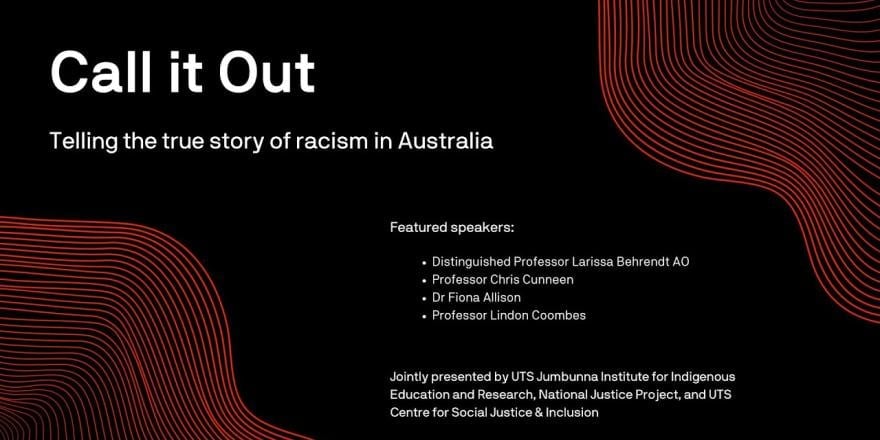
Distinguished Professor Larissa Behrendt AO spoke with Professor Chris Cunneen, Fiona Allison and Professor Lindon Coombes about the preliminary findings from Call it Out’s interim report, as well as the structural and cultural changes that are needed to address entrenched racism.
Read the Call it Out interim report

MgCgj_jss7M

Descriptive transcript

Well, hello, everyone, and welcome to today's event, Call It Out: Telling the True Story of Racism in Australia. I'm Larissa Behrendt, Distinguished Professor at the Jumbunna Institute in the Research Unit.

I'd like to start this forum with an Acknowledgement of Country. I know that all of us are in different parts of Australia, so as I acknowledge that I'm on the land of the Gadigal people, I hope that is an opportunity for you to reflect on the traditional owners of the land you are on.

This is a really important ceremony that we do, the Acknowledgement of Country, and particularly for an event like this, where we're looking at the impacts of colonisation on First Nations. It's a very important part of setting the tone, to acknowledge that wherever we are, we're on unceded First Nations country, and it's an opportunity for us to acknowledge the wisdom and knowledge systems that are on that land, and to pay tribute to the generosity with which First Nations share that knowledge and that country with us. So particularly for the Gadigal, where I've been very lucky to live and work, I acknowledge the Elders of the past and the Elders of the present.

With that, it's my great honour to be emceeing tonight. I'm filling in for Robynne Quiggin, who was going to have a role at the beginning but is unfortunately unwell, so I'm stepping in for her as well as moderating the panel.

Just as a little bit of background, the Jumbunna Institute for Indigenous Education and Research, in collaboration with the National Justice Project, developed Call It Out, an online register to record all forms and levels of racism and discrimination experienced by First Nations people. It's been a very important part of our collaboration between the two institutions. The Research Unit of Jumbunna and the National Justice Project have been involved in many cases for a very long time, starting with issues in the Northern Territory, particularly around the intervention, and we've done a lot of work in the anti-discrimination, anti-racism space and the criminal justice space. So this, in a way, has been a wonderful project to come out of that work, where there's a lot of synergy in our work for social justice.

It's my pleasure to be joined by my distinguished colleagues today, who will discuss the interim report and look at what the data shows for that first six months of the register being in place.

I'm going to introduce the panel. Chris Cunneen probably needs no introduction, but he is the Professor of Criminology at Jumbunna Research. He has a national and international reputation as a leading criminologist specialising in First Nations people and the law, in juvenile justice, restorative justice, policing, prison issues and human rights. It's a privilege to have him as a colleague and it's a privilege to have you here tonight. Thank you and welcome, Chris.

Fiona Allison is a Research Fellow at Jumbunna Research, whose focus is on improving First Nations civil and family law access to justice and justice reinvestment. She is also Data and Research Lead with Just Reinvest NSW, supporting Aboriginal communities to implement justice reinvestment. So welcome, Fiona. It's wonderful to have you here.

And Lyndon Coombs is Industry Professor and Incoming Director of Research at the Jumbunna Institute. He's a descendant of the Yuwaalaraay people of northwest New South Wales and has worked in Indigenous affairs in a range of positions, including Director at PwC Indigenous Consulting, CEO of the National Congress of Australia's First Peoples and CEO of Tranby Aboriginal College in Glebe. Welcome, Lyndon.

We know racism is an endemic problem in Australia that disproportionately impacts First Nations people. However, the true extent of the impact remains largely unseen and unheard. The Jumbunna Institute and the National Justice Project developed Call It Out as an independent Indigenous-controlled platform that records all forms and levels of racism and discrimination experienced by First Nations peoples, without the usual barriers inhibiting reports of racism.

So I want to start off the discussion with you, Chris. To start with, I wonder if you can tell us how the idea for creating Call It Out as an online register came about and then why you think, given all the work you do, that this is so important.

Chris Cunneen: Thanks, Larissa. As you mentioned, the true extent of racism is not known, and that was a motivating factor in setting this up, because we knew and we know there's a huge discrepancy around reports by Aboriginal and Torres Strait Islander people about racism, a discrepancy between that and the sort of numbers that we get through anti-discrimination complaints. This has been proved already by Call It Out. In the first six months, we had more complaints than what most of the anti-discrimination bodies would get in a year.

So for us, it's important to highlight the prevalence of racism, and it's far greater than what official data would indicate. Part of the purpose is to make denial of the problem of racism much more difficult to sustain.

Another reason that motivated us was that we really wanted to create a platform where the voices of Aboriginal and Torres Strait Islander people could be heard and where they could name and record their experiences of racism. That was really important for us.

Just to give you an idea of a couple of comments in the register: one person wrote in that Call It Out wasn't necessarily going to provide justice, but it was a real catharsis for him, in being able to write and tell his story. Another woman spoke to us of being brought to tears as she described her experiences on the register.

There are more practical reasons for setting it up. It's less complex, there are fewer barriers to using it than official mechanisms, and it's more accessible than surveys of racism. One of the things that was really important for us was to have something that was what we refer to as a respondent-generated initiative—in other words, it's driven by the people themselves who want to record what's happened to them. It provides an opportunity to record a whole different range of racism: institutional and systemic racism, interpersonal racism (which is mostly what's collected through surveys), and racism in the media and online. It really allows the person themselves to decide what is racism and how it should be classified and to put it on the register.

Most importantly, we wanted to provide a platform or an avenue which was an ongoing testimony from those First Nations people who have experienced and suffered the effects of racism. All of this is contributing to the larger story about the extent and the nature of racism against First Nations people in this country. I just want to honour the stories and experiences that have been shared with us on the register by people who we know are brave just being able to express that in a public way on a register. So we thank them particularly.

Larissa Behrendt: Wonderful, thank you. Fiona, I'll turn to you now. Can you share some of the top insights from the Call It Out interim report with us?

Fiona Allison: Yes, thanks, Larissa. I'd encourage everyone to have a look at the report. We won't be able to share masses of detail in the webinar today, but just some of the key themes that have come out of the reports that have been made to the register.

Firstly, some of the more common types of racism identified include racist stereotyping, institutional racism, racism in the workplace, and racism in commercial places. By that, we're talking about ordinary things that people do, like going shopping for food or dealing with real estate agents to try to access housing.

Sitting back and reading through the 267 reports that we've got sitting in the report that we're putting out today, the overwhelming sense is that racism is all around us—it's extremely prevalent. As one woman said in the register, she had a very depressing feeling that she was surrounded by racists, both covert and more overt. In the report, we've summarised the scope of the reports in the register as covering small private gatherings, racism arising in the street and in social media, in shops, cafes and buses, hospital beds and classrooms, and in our institutions—our government institutions.

Racism also has multiple layers to it, so it happens to people more than once. The register has reports of multiple incidents, and ongoing racism was reported in 25% of cases. For example, a person might report bullying in the workplace, racist bullying, and then try to go to their employer to get something done about it, and that employer fails them, and they report that as another racist incident.

Another thing that came out strongly was that it affects all generations. In the reports that have been made, there's discussion of the effects of past racism on current generations of Indigenous people, but also a number of reports that speak to children and young people being targeted by racism. For example, there's a report from a woman who is sitting outside with her children on what she calls a warm summer's night, as families do, and she's confronted by a group of people exiting a pub nearby that hurl racial abuse at her and damage her windscreen. She reported a deep feeling of sadness that she knew that was the first experience of racism her kids had had, but there would probably be many more. Another man reported that having experienced racism himself, he had the sense that his children would have a limited future because this would also be an issue for them moving forward.

Another common theme was aggression in racism. 34% of the reports spoke to various types of aggression: physical and verbal abuse, bullying, property damage, and so on. For example, there was a young man working in the public service who had made a complaint about a more senior colleague, and in a meeting with other colleagues, that senior colleague said that this young man should be hung. He reports continually having thoughts and images of himself being hung.

There are also a number of incidents reported about physical assaults. One is about an Aboriginal woman who is called a racially abusive name and has her teeth knocked out by a neighbour, with long-term health impacts related to that. Assault by police is also a theme that comes up in the reports.

The last thing I was going to draw out of the incidents is institutional racism. When we see surveys conducted with Aboriginal and Torres Strait Islander people about racism, interpersonal racism is a really common issue, like the example I just gave about the woman who's assaulted on the street. But what we do know is that institutional racism is a major issue with significant impacts across all First Nations communities. About 21% of the reports spoke to that issue, with a lot of comment about government institutions, including child protection, education and justice.

The reports that related to health really stood out because there were a lot of them, and also because people presenting to health services are often in a position of considerable vulnerability, looking for compassion and to be cared for. When that goes wrong because of racism, there are really significant health impacts. For example, there was a young Aboriginal girl in a hospital bed on a ward, really struggling with hearing impairment and delirium, and meanwhile a nurse reported that one of the other nurses was actively discouraging staff from admitting family into the ward to support her because they would be troublemakers, just because they're Aboriginal people.

Another example was a parent's report of their son who passed away just after discharge from hospital. He had not received adequate care, and the parent reported that was because he was Aboriginal, and he also had as a discharge address a corrective services address, and the assumption was that that had some impact on the care that he received.

In terms of institutional racism, when you look at the reports, you can see why it's difficult to call out. There's a report in there about child protection assessment frameworks as being inherently racist—they don't look like it, but in the way that they're implemented and written, they end up having terrible outcomes for Aboriginal families in terms of child removal. People don't need to be treated differently in order to be discriminated against. The woman who talked about the child protection assessment framework was concerned that there wasn't enough recognition of culture and cultural rights in the development and implementation of that policy.

Briefly, in terms of responses, we asked people what their responses were. One of the more common ones recorded was that people were turning to family and friends—about a third of cases—which tells a really important story about the solidarity and support that people find in their communities. There's a suggestion in there for initiating a larger scale collective Me Too movement for everyone to come together and share their experiences of racism in order to combat it.

Calling out racism is happening, and it was identified in the reports as a really important step to combating this issue. We saw 10% of people indicating they'd reported to police or an anti-discrimination body, and 20% had either defended themselves or defended someone else who'd experienced racism.

Although just over half of the reports came from people who had directly experienced racism, we got lots of reports coming in from witnesses and family and relatives, but particularly witnesses of racism. It was heartening to see people stepping up and trying to call this issue out and actually take some action. For example, a woman at a football match heard a racist comment from a group of young guys behind her. She called that out, and then a number of other people sitting in the crowd around her jumped in and also called this out. One went to report this guy to staff, and by the time they came back, he had voluntarily exited with his friends.

Overall, people are really calling out for more justice, more accountability, more serious consequences, while also discussing the considerable difficulties they have in trying to call it out.

Another common theme was that people might call this issue out and face retaliation and sanctioning. The woman who had her windscreen smashed actually went to police and tried to report it and was threatened with arrest. There's another account of an Aboriginal student, a young student, who ends up being suspended for retaliating when he's been repeatedly called an ape by another student.

The final point is that there's a really strong call in there for others to take responsibility. There's a quote in the report from an Aboriginal woman who said, "It can't be up to mob to constantly defend our existence." The reports speak to the importance of educating the public about their legal and ethical responsibilities to be anti-racist, and for more education about Aboriginal culture and history to combat the extensive racial stereotyping that sits within so many of the reports in the register.

Larissa Behrendt: Thank you. Chris, I'll come back to you after that. Obviously, Fiona has covered a lot of ground, but from your perspective, what were the findings that you found surprising?

Chris Cunneen: One of the things that came out, which we perhaps weren't expecting, was that of the self-reports—people who had experienced racism directly themselves—two thirds of those reports were made by Aboriginal women and the remainder by men. At one level, there was probably little difference in the reports on the type of racism by gender, but there were a few significant ones that stand out. Women were twice as likely to report racism in the workplace than men were, which was unexpected. Men tended to report racism more in commercial spaces, online, and in police, courts and prisons, which perhaps is not unexpected, but the size of the number of women reporting racism in the workplace was.

Another area, which perhaps is not surprising but is one of the most intense parts of the report, is the effects of racism on individuals. It comes through again and again: the pain of racism, which comes out through anger, disappointment, sorrow, humiliation, panic attacks—not only about the incident but by the way it was responded to. The lack of response or the type of response can exacerbate those pains.

Financial effects were also significant, given that a large proportion of reports related to workplace racism. People reported having to leave work, to give up their job, and suddenly being out of work and without money because of racism.

The effects on children, as Fiona mentioned—the first experiences of children seeing racism, the abuse shouted at their parents, and so on—and also on relationships. All of these feed into the broader problem about health impacts and long-term effects: suicide attempts, physical ailments, anxiety, depression, PTSD, breakdowns, hospitalisations—all mentioned as effects or outcomes of what people had experienced.

Avoidance and exclusion was another effect. People drop out of classes, drop out of employment, exclude themselves from shops in particular areas as a way of trying to deal with these longer-term effects of racism.

Two other areas that came out in terms of effects were the fact that racism was so blatant in many cases. This came up in reports from non-Aboriginal witnesses or friends of people who had experienced racism, where it was obvious that the Aboriginal person was being treated differently, treated in a racist way, and the other person wasn't. It was very blatant, very open, and there was no apology about it.

The final point in terms of effects is prevalence. As Fiona mentioned, the prevalence is not surprising to Aboriginal people, but it's certainly surprising when you see it all put together in a register like this.

A couple of other points that were perhaps not as expected were the corroboration of accounts of racism between those who witnessed racism—often non-Aboriginal people—and the victims themselves. We saw that in workplace racism, where we had other people calling out racism as a witness, but the accounts largely corroborate the types of things happening in the other reports that were self-reported. Similarly, in the health sector, we had people witnessing and calling out racism by doctors and nurses in terms of the way Aboriginal people were being treated.

A heartening point is that there are witnesses stepping up and doing something about it—not just reporting to the register, but actually doing something about it at the time. That goes to the heart of the point that confronting racism is a shared responsibility for all of us.

Larissa Behrendt: I want to bring you into the conversation now, Lyndon. We've heard a great overview of the many elements and the many manifestations and the many places that people have reported experiencing racism. From your perspective, with the work that you've done, do you think that snapshot that's come through in the interim report gives an account of the scope of racism towards First Nations people?

Lyndon Coombs: Yes, it's done a great job of giving an insight into those experiences, the different types, and particularly the effects. As Chris said, providing an option for people—one of the other points is that people who report racism don't do it the first time it happens, because there's a lot of gaslighting that can go on with reports of racism. Generally, Blackfellas just want to do their job, go to the footy, go to a restaurant like anyone else and not be harassed, but unfortunately they're consistently subjected to this horrible behaviour.

I remember my first experience of racism was at a rugby league game. I experienced it consistently at something I loved. I loved going to watch my cousin play rugby league, but it became a bit of an ordeal for an eight-year-old as I was at the time, hearing such venom against a family member and someone I loved. So, picking up on those particular things and reading through that, that gelled with me, particularly the one going to sport. It's hard for a report to encapsulate the full experience of racism, particularly just based on six months, but this has done an excellent job.

Larissa Behrendt: Just following up on that, how can we ensure that First Nations peoples' voices and approaches lead any actions that we take to address the issues being uncovered through the Call It Out register?

Lyndon Coombs: One of the consistent themes I've come across in my work at Jumbunna is that when you go out and talk to communities, regardless of the issue—health, education, housing, anything—it's not the first time that people have raised the issue. It's the same with racism. The key thing is to listen. It's not that Blackfellas aren't saying this. It's similar with violence—people pretend that Aboriginal people aren't calling out ranges of behaviour. It's that there's no listening to it, or it's deliberately misinterpreted because people find it all a bit too much for them, perhaps personally, emotionally, or intellectually.

My one thing would be to listen to Aboriginal people and to believe them. It's incredibly rare that an Indigenous person will put their hand up, share what is many times a very personal, very hurtful experience, just for attention or to make it up to try and prove a point. That's where this sort of gaslighting comes in. We've seen that with our work, where Indigenous people may have raised issues over and over again, but until it was corroborated generally by a non-Indigenous person, they weren't taken seriously, their claims were doubted, people would claim a lack of evidence, lack of proof, and things would be swept under the carpet. So those are the two key things: to listen and to believe Indigenous people when they speak.

Larissa Behrendt: Chris, I'll come back to you now. Obviously, a lot of time and energy has gone into the Call It Out register, and we're asking people to share experiences that can often be traumatic. What are you hoping the findings from the interim report will achieve in terms of any change, and what do you see as the next steps?

Chris Cunneen: It is the first step, and we see a range of different areas where change might occur. One of the things we want to do is get out to the community level. We'd like to have a mixture of advocacy and assistance to people who have experienced racism, as well as encouraging people to fill in the Call It Out report. We can have communication strategies, promotion, advertising—all of that's important—but an important part, and one we're deeply committed to, is getting out at a community level and talking to people, so we can provide both support and advocacy if that's required, as well as expanding the use of Call It Out.

As we build this, the range of effects are multiple—whether it's about anti-discrimination commissions improving the way they respond and work with Aboriginal people, advocating for law reform, or other types of change. This is really just the beginning. We've only had the register up and running since March, in the first six months, and we've been astounded by the number of reports we've got in with actually minimal communication around Call It Out.

We're hoping to build that and build this as a testimony. There are all the policy areas that it can impact on, but for me personally, I would really like to see this as a living testimony to what's happening, and that's what we need to understand to go beyond it.

Larissa Behrendt: What about you, Fiona? What are you hoping, with the work that you do, that the register and the findings in the interim report might lead to?

Fiona Allison: Hopefully, the stories that have been called out by witnesses, by people experiencing racism in the register, and also the accounts of people calling things out in person that we've got in our report, might encourage others to do the same, given the difficulties people face in doing it. We hope it will be educative, because one of the key themes that's come out is that one of the strategies people are putting forward to combat racism is to educate people about racism and its impacts, particularly in relation to institutional racism, which is still fairly misunderstood.

There are some really important first steps in thinking about how self-determination fits into this space, something Lyndon has just been talking about. We need to listen to the voices of Aboriginal and Torres Strait Islander people in terms of how they think this issue should be responded to, and there are already some really good examples in there to be listened to, but we hope there'll be more coming through as well, given that we've only really just started.

Larissa Behrendt: Lyndon, what do you hope can be triggered by a project like this that seeks to capture experiences and give a platform for people to talk about their experiences of racism? What would you hope might be transformative about that, and what transformations are you hoping might evolve?

Lyndon Coombs: I think it's education and awareness. Even for someone like me who's had a lifetime of experience with it, with my family and working in the area, even some of that struck me at different times. Often people don't understand an issue until they see it, until they experience it or it happens to them. Similar with people's experience with police—they may be fans of police, but it takes one bad interaction and they start to reconsider the role of police and the relationship they have with society.

I would hope that people would be a bit more aware, that they would be educated a bit more to find ways that they are comfortable with intervening—firstly, identifying it, knowing it when it happens, and providing support to those who are affected, as we heard from that example earlier.

Larissa Behrendt: Chris, one thing I was just wondering in listening to the range of experiences that have been captured, and the point was made at the beginning of the seminar, but I wonder if you have any reflections on it. When legal frameworks are set up—anti-discrimination laws, workplace laws, etc.—to combat racism, they're quite narrow. What are your reflections about that narrowness compared to what we're seeing in this interim report, in the scope? I'd be interested to hear your responses or reflections about the limitations of the legal mechanisms and response compared to what the problem is that you're mapping out with this project.

Chris Cunneen: There's a yawning gap between the two. It relates back to that point about community. We've seen it over and over again—policies and law reform are constructed in a way that is absent from the voice of community. It's usually a bunch of whitefellas dressed like I am sitting around a table, talking about what needs to be done in relation to law reform or policy development. The lack of intersection or interaction between knowledge of what's happening in the community, knowledge of ways of confronting it, the problems of racism and dealing with it—it's that absence, I think, which is a core problem in relation to policy and law reform and development. Added to that, you might have what on paper looks like good policy, but it's not implemented in any way that's meaningful.

I'm sure Fiona is keen to say something about the importance of direct action, so she might have some reflections on this as well.

Larissa Behrendt: Sure. I was going to ask you that too, about what you think individuals can do. Fiona, what can individuals do? You mentioned that people aren't necessarily passive when they see racism, but what would your advice be to people?

Fiona Allison: Definitely to call it out on the register, because we need to pull this national story together through the register on what's occurring and what responses are in relation to racism at the moment.

There are examples in the register of non-Indigenous people modelling good behaviour in the workplace or in educational institutions—not necessarily calling out, but educating people in their spaces about good ways to avoid being a racist, basically.

Larissa Behrendt: Lyndon, what's your reflection? You talked a little bit about listening, but what are other actions individuals can take to combat racism?

Lyndon Coombs: I think it's a bit of individual reflection. I know this is difficult for people who have racist views and express them, but one of the things I've learned—and I'm still learning—is that it's never just racism. Within an organisation, we've learned that when we look at instances of racism, it's never just racism; there's something else going on. When we did the Collingwood report, it was on the basis of Heritier Lumumba, who reported instances of racism, but he also said there was homophobia, sexist jokes, an environment that just wasn't professional. My experience with people who are racist—it's never just the racism. They're not a great person who looks after their family, has healthy relationships, is a good person except they're a little bit racist. It just doesn't work that way.

I've also tried to think around how we know that racism is a destructive force, that it manifests in so many ways and does so much damage, but in a way of trying to take away its power a little bit. If you're in a pub having drinks with your mates and they say something racist, shoot them down a little bit in a constructive way—what else is going on? What is causing you to lash out at people who have done you no harm, who are just minding their own business existing? What's causing you to be that angry to people who've done nothing to you? Start deconstructing that a little bit, and then I think you find behind racism is weakness, and people can use their racism as a front for that.

As I said, I'm still learning about this, but those are some of my observations.

Larissa Behrendt: One of the big national agenda items coming from the Uluru Statement from the Heart is about truth-telling. What is the role of calling out racism in relation to that?

Lyndon Coombs: It's fundamental. The reason that we need a truth-telling process is because it's been contextualised, grounded in racism. That's the whole point of this. We can't leave these discussions unattended to. If we go through a truth-telling process and are not serious and open to difficult conversations—they are difficult—but racism underlies so much of where we are as a country.

Larissa Behrendt: Chris, any additional thoughts about what individuals can do in this space?

Chris Cunneen: In a nutshell, call it out on the register if you have been someone who's experienced racism. Also, the point that both Fiona and Lyndon have made—the importance of people who aren't necessarily directly experiencing racism to stand up and respond to what they see as racism, whether it's in their workplace, cultural activities, football, whatever it is. Those are the most important things to do.

Larissa Behrendt: Fiona, just picking up on a couple of questions that have come through in the Q&A. First, was there any particular information about the perpetrators of racism? Was there anything that came out in relation to that?

Fiona Allison: There was data that indicated that perpetrators were more likely to be female, but we also had more reports from women, so that may be a function of the reporting. For this interim report, we didn't delve into the information around perpetrators—we wanted to focus more on people that experienced racism—but it's something we want to look at more in the annual report when we have more numbers to look at.

Also, there is quite a lot in there about institutional perpetrators, and there's a real need for much tougher consequences for institutions as well, setting aside the gendered issue. One of the innovative responses that came in terms of what needs to be done was the suggestion that we should have a register of racist institutions, government or non-government, so they can be named and shamed. Businesses as well—an Aboriginal woman said she would bo

If you are interested in hearing about future events, please contact events.socialjustice@uts.edu.au

Jointly hosted by Jumbunna Institute for Indigenous Education and Research, the National Justice Project, and the Centre for Social Justice & Inclusion. 

The true extent of racism is not known and that was a motivating factor in setting this up. In the first six months we had more complaints than what most of the anti-discrimination bodies would get in a year. It's important to highlight the prevalence of racism and it's far greater than what official data would indicate. Prof. Chris Cunneen

Although we had just over half of the reports coming from people who had directly experienced racism, we got lots of reports coming in from witnesses and family and relatives. It was heartening to see people stepping up and trying to call this issue out and take some action. Fiona Allison

People who report racism often don't do it the first time it happens because there's a lot of gaslighting that can go on with reports of racism. Generally blackfellas just want to do their job, they just want to go to the footy, they just want to go to a restaurant like anyone else and not be harassed, but unfortunately, they're consistently subjected to this horrible, horrible behaviour. Prof. Lindon Coombes

Speakers

Distinguished Professor Larissa Behrendt AO is the Director of Research and Academic Programs at Jumbunna Institute for Indigenous Education and Research, UTS. Larissa, a Eualeyai and Kamillaroi woman, is a writer, lawyer and academic. She has a legal background with a strong track record in the areas of Indigenous law, policy, creative arts, education, and research.

Professor Chris Cunneen is Professor of Criminology at Jumbunna Institute for Indigenous Education and Research, UTS. He has a national and international reputation as a leading criminologist specialising in First Nations peoples and the law, juvenile justice, restorative justice, policing, prison issues and human rights. 

Fiona Allison is a Research Fellow at Jumbunna Institute for Indigenous Education and Research, UTS, whose focus is on improving First Nations civil and family law access to justice and justice reinvestment. She is also data and research lead with Just Reinvest NSW, supporting Aboriginal communities to implement justice reinvestment.

Professor Lindon Coombes is Industry Professor and Deputy Director at Jumbunna Institute for Indigenous Education and Research, UTS. Lindon is a descendant of the Yuallaraay people of northwest NSW and has worked in Aboriginal Affairs in a range of positions including Director at PwC Indigenous Consulting, CEO of the National Congress of Australia’s First Peoples, and CEO of Tranby Aboriginal College in Glebe.

Share