

• Posted on 14 Sep 2022
  • 9-minute read

Congratulations to Alex Connor, Kathy Walsh and Mihajla Gavin on receiving the Teaching and Learning Award at the 2023 UTS Business School Achievement Awards. The trio were recognised for their outstanding work developing the Big Issue Hackathon student initiative.

Read more about the initiate below.

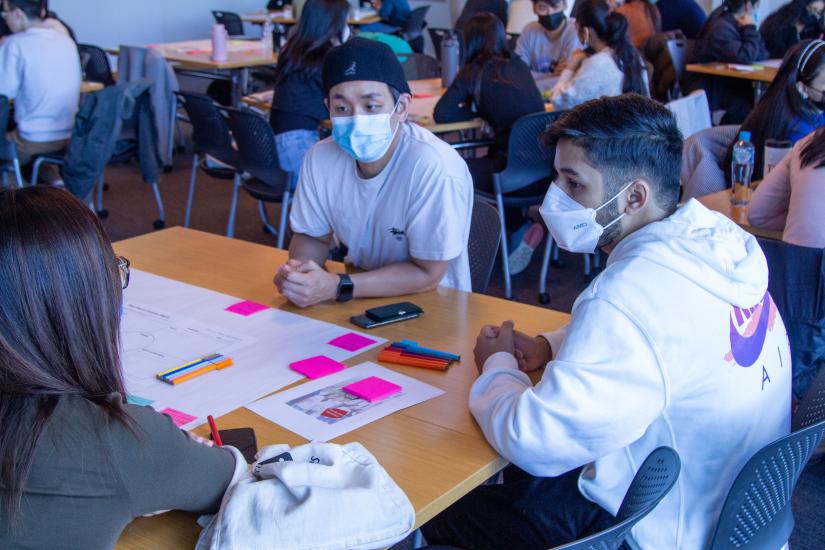
The UTS Business School, in collaboration with The Big Issue and UTS SOUL Award, hosted students from various faculties to participate in the UTS Big Ideas Social Impact Hackathon. 

Over two weekends in August, participating students developed a project idea to address social disadvantage and marginalisation, with a focus on creating meaningful employment opportunities for those experiencing homelessness.

Learning from lived experience 

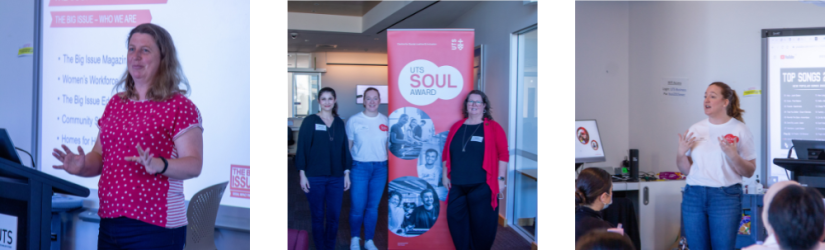
The Big Issue mentored the students throughout the program and provided guest lectures and resources for students to design business ideas with social impact. The Big Issue is a not-for-profit organisation that supports people experiencing homelessness, marginalisation and disadvantage by creating work opportunities.  

Students had the opportunity to hear from a panel of speakers from The Big Issue with lived experiences of homelessness, helping them shape their project ideas whilst challenging their assumptions.

“I came to day one [of the Hackathon] as one of those people that had solutions already in mind and tried to almost make it fit the mould. And then I learnt that it’s really important to listen and to understand what [people experiencing disadvantage] need. And it’s also prevalent to [understand] the barriers to get out of that trap of homelessness.”
Mihajla Gavin, Senior Lecturer at the UTS Business School, said it was important for students to understand what it was like to have lived experience of homelessness.

I think many students had their assumptions tested. Rather than tackling issues ‘solutions-first’, students learnt the value of genuinely understanding social problems and hearing directly from those with lived experience to shape their actions.

– Mihajla Gavin

Students were also challenged to think about the role of business in society for creating social good.

“We learnt that businesses don’t need to be built on the foundation they need to make money. Having a social and community purpose makes it better for everyone.”
The winning project idea 

The student groups pitched several ideas addressing the following issues:

  • employment opportunities for people experiencing homelessness
  • helping newly arrived refugees and asylum seekers
  • programs for upskilling migrants
  • supporting education in juvenile detention 
  • re-skilling older workers 

A panel of experts in social change carefully assessed the project ideas and chose the most innovative, evidence-based idea. Students benefitted from panel feedback on their project ideas, including from Professor Carl Rhodes (Dean, UTS Business School) and The Hon. Professor Verity Firth (UTS Pro-Vice Chancellor (Social Justice and Inclusion)), Mangala Martinus (Managing Director of Payments Consulting Network), and Chris Campbell (State Operations Manager for The Big Issue). The winning idea, led by students Aya, Christina and Thea, focused on public speaking opportunities to support refugees arriving in Australia. 

Driving social change while developing 21st-century skills

The Hackathon helped students develop critical employability skills, including teamwork, problem-solving, cooperation, and leadership. 

For me personally, I learnt a lot about myself in terms of my confidence to speak and how creative I can be. You come up with a much better idea when you work with everyone and get opinions from every source that you can, especially those with lived experience. – participating UTS student

The Hackathon was made possible through funding from a Social Impact Grant provided by the Centre for Social Justice & Inclusion and UTS Business School.
Iux25ziegfY

Descriptive transcript

So the Hackathon came about in partnership with The Big Issue, and we were quite lucky to actually start the partnership in the first place through a grant that we received from the Centre for Social Justice and Inclusion.

The real spirit behind this program is getting students across a range of different faculties and year levels to consider how we can tackle really big issues like homelessness, marginalisation, and people experiencing disadvantage within communities today.

We thought that working through a Hackathon model with a community partner would make sure that students were working on a real, live issue with experts who could help guide the work.

Doing it as a Hackathon meant it could be extracurricular, so students could work across faculties and really connect with new and different people.

We thought that by coming together and getting them to ideate, bringing their passion and ideas into a room, we could really show people what action they can take towards making the world a better place, because people are struggling with barriers and often don't know where to go next.

So it's an act of hope and collaboration, and we're just really excited to see what the students can come up with and how we can support them to take that first step to making social change for the rest of their lives.

Over two days, students are coming together, working in groups to solve this really big social issue that we have in the community, and designing business plans or project ideas that they'll put forward to a panel, thinking about how we can tackle some of the major issues in society today.

The Big Issue is a social enterprise. We provide work opportunities for marginalised or disadvantaged people in the community, giving them the option to run their own business by selling the magazine. They make a profit for every magazine they sell, but they choose when, where, and how many magazines to sell. It's about giving independence and helping people to help themselves.

Hopefully, there'll be some ideas from the social impact project that might help us improve and build what we do, creating more opportunities for people who have barriers to work and connecting with the community.

I signed up for this program to get a better idea of social enterprise and what social change really looks like in action. I think being around other people is a great way to do that, because I get to not only collaborate and bounce ideas off others, but it's a fresh perspective. I really appreciate that, because social change is only derived through those fresh perspectives, in my opinion.

I thought it'd be a good opportunity to collaborate with people in other faculties and discuss a big social issue and how we can potentially tackle that. Being able to get insights from other people, collaborate on ideas with other students, and really make a positive impact—I think that's the main thing.

The only way to learn about something is to hear it from someone who's experienced it first. Being given that insight and that kind of subjective response allows you to understand the issue a lot more and really empathise with an individual who's been through that. Through that empathy, you're able to come up with ideas to actually assist them and know exactly what they want and what their lived experiences are. I think that's the best way to tackle this issue.

This was a program that we were really happy to support. It was a successful recipient of a social impact grant from the Centre for Social Justice and Inclusion, and we were really happy to partner with the Business School because we knew this would deliver an opportunity for students already involved in our student volunteering program, the SOL Award, to get their teeth into some serious social issues and think creatively about how those issues can be solved—particularly in this case, in a social enterprise space, in a way that is sustainable and ongoing.

We were really looking for students to use all their skills across all the different disciplines to help us solve some of these issues, and it was really impressive seeing what they came up with today.

These sorts of ideas are a great way of getting people exposed to different ways of thinking, but also teaching them the skill sets to be able to pitch that idea to their company.

Universities feed the corporate world with employees and new ideas, but corporations have the real-world experience and usually the financial backing to create those solutions that come out of the universities. I think it's really a marriage that needs to happen and works really well.

The importance of social and economic wellbeing to business education and to students in general is to ensure that our students leave here with knowledge of how to be good citizens, not just good workers. This program is attended by people from across the university, but to have the opportunity to take some leadership in that really speaks to our own vision of being a socially committed business school.

Byline: Zain Warsi, Communications Coordinator, Centre for Social Justice & Inclusion


Share