

- Posted on 2 Aug 2021
- 53-minute read
The law could be one of the most effective tools to achieve gender equality, but our laws are failing women.
Domestically and abroad, the law is male-centric. It’s written, implemented, and judged by men. But women’s rights can be achieved with law reform – without dismantling the system.
Laws formed with a gendered lens are a key part of the fight against domestic violence, guaranteeing reproductive rights, and promoting shared responsibilities for care at home. But lawmakers are failing to consider the gendered effect of all laws, from the environment to taxation and corruption.
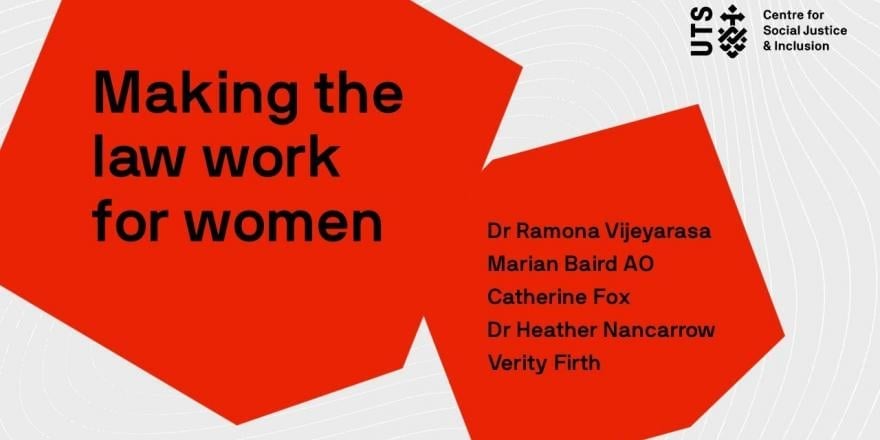
To celebrate the launch of Dr Ramona Vijeyarasa’s new book, International Women's Rights Law and Gender Equality: Making the Law Work for Women, UTS Centre for Social Justice & Inclusion and the Faculty of Law brought together an expert panel to discuss how the law can be a more effective tool for gender equality.
If you are interested in hearing about future events, please contact events.socialjustice@uts.edu.au.
If we actually got to 50/50 and had parity, it's not necessarily that there would be more women putting legislation on the table, but it will be a different type of political climate... where if they're putting ideas on the table, they're not swept away for other reasons. Dr Ramona Vijeyarasa
It's not just culture... where does the power lie in an organisation to ensure that the law is addressed, is implemented, and is monitored? I do think in all organisational implementation programs we have to look at structures and culture together and how they interact. Professor Marian Baird
We must design laws and implement laws... that are informed by our local context, recognising that we're on unceded Aboriginal land wherever we are here and that there is a different relationship between First Nations communities and the state. Dr Heather Nancarrow
A long as you continue to blame a marginalised group who are out of power, which isn't even logical, what you do is embed the very stereotypes that cause the problem in the first place. So we don't challenge the system, we don't challenge power, and we don't actually change the cause. We continue to look at the symptoms and incorrectly blame the group that's been marginalised. Catherine Fox
Speakers
Dr Ramona Vijeyarasa is the architect behind the Gender Legislative Index, the first comprehensive IT-based tool to make legislation more effective in improving women’s lives. A Senior Lecturer in the Faculty of Law at UTS, she is editor of International Women’s Rights and Gender Equality: Making the law work for women (2021) and author of Sex, Slavery and the Trafficked Woman: Myths and Misconceptions about Trafficking and its Victims (2015).
Marian Baird AO is Professor of Gender and Employment Relations at the University of Sydney. She is one of Australia’s leading researchers in the fields of women, work and family, and was instrumental in the development of Australia’s paid parental leave scheme. She is co-convenor of the International Parental Leave Network and is currently a Chief Investigator on the Centre of Excellence on Population Ageing Research.
Catherine Fox is a leading commentator on women and the workforce, and an award-winning journalist, author and presenter. She has published five books, including Stop Fixing Women which, along with her journalism, was awarded the 2017 Walkley Award for Women’s Leadership in Media.
Dr Heather Nancarrow is the retiring CEO of Australia’s National Research Organisation for Women’s Safety. Heather has worked for 40 years to address violence against women. Heather’s book, Unintended Consequences of Domestic Violence Law: Gendered Aspirations and Racialised Realities was published in 2019.