

• Posted on 25 Aug 2021
  • 87-minute read

A new app takes the legal guesswork out of conducting fundraising raffles for not-for-profit organisations.

a coil of raffle tickets

Fundraising is a critical source of income for not-for-profits, however, fundraising approval processes for organisations are resource-intensive.

Autism Spectrum Australia (Aspect), the largest autism spectrum service provider in Australia, says the current manual administrative process of both applying for, and approving fundraisers, is complicated and laborious. 

“Our community fundraising team aren’t lawyers, so we were looking for a way to help potential fundraisers navigate local laws and understand how to comply with all of the legislative requirements,” said Josan Abels, Community Fundraising Manager, Aspect.

Enter Team Moral Code, a group of students from the University of Technology Law Faculty.

The Team created an app, called the Raffle Fundraising Assistant, that helps individuals firstly determine whether they are eligible to hold a raffle.  The app then identifies state and territory-specific legal requirements, and creates a proposal application that is sent directly to Aspect.

“The app has significant time saving capabilities that will allow Aspect to refocus their energy away from complex legalese and bureaucratic technicalities towards impactful work within the community,” said Jordan Roods, Quality Assurance Specialist for Team Moral Code.

“Why should they have to waste their time on these difficult administrative tasks when the Raffle Fundraising Assistant can do the work for them?”

“Ultimately, the app was built to inspire,” said Dana Rutner, Team Moral Code Project Manager.

“Due to our extensive research and optimisation processes, we've already formulated the solution to tedious tasks, providing a strong base for further expansion without the challenges.

“We believe that there is a real potential to expand and scale to other organizations, as they grapple with the same kinds of problems that Aspect was experiencing. This is particularly the case since many charities operate on a national basis and deal with laws across multiple jurisdictions.”

The Team developed the app as part of the Allens Neota Logic UTS Tech Challenge.  The Challenge brings together lawyers from international law firm Allens, and technologists from Neota Logic Software, to create law apps using artificial intelligence technology. 

Lesley Hitchens Dean, UTS Faculty of Law

Lesley Hitchens Dean, UTS Faculty of Law

Each team works closely with a participating not-for-profit organisation to identify a problem experienced by the organisations’ clients and then develop an online solution.

UTS Law students and mentors from Allens build the apps using Neota Logic software, designed specifically for developers with no prior programming experience.

Lesley Hitchens, Dean of the UTS Law Faculty, says the Challenge epitomises everything UTS Law is trying to achieve through legal education and research.

“It’s about, above all, social justice.  That is something that’s absolutely core to this Faculty, along with law and technology.  We want technology to be used responsibly, we want it to be used for good.

“So this Challenge, with the support of Allens and Neota Logic, really gives students an opportunity to understand and to engage with technology, but also to do it for a purpose,” said Professor Hitchens.

The Head of Innovation Services at Allens, Liza Greenwood, says while it’s imperative to have a sound understanding of emerging technology, client-focussed solutions are also essential.

“Learning to work with clients collaboratively to develop solutions that solve their problems -  and solve problems that really matter - we believe that’s critical for the future of the legal profession.

“We think that’s critical for the future of the legal profession.”

Team Moral Code says this is just the beginning.

”At the moment the app clearly captures the law as it applies to raffle fundraising, but it can be adapted to cater for all fundraising events, such as fun runs, private event proceeds, and even more novel circumstances, like selling Pokémon cards on eBay,” says Dana Rutner, Team Moral Code Project Manager.

“We are proud to be providing the not-for-profit sector with an innovative solution that will help channel modern donations towards these vital community organisations.”

Alongside Autism Spectrum Australia, student teams produced apps for RESPECT. NOW. ALWAYS, International Social Services Australia and the Women’s Justice Network as part of this year’s challenge.

Video: Moral Code

View the winning team’s app presentation with UTS Law students and Team Moral Code members Amelia Qiosese, Dana Rutner, Emma Hilton, Jordan Roods and Anneliese Bergman:

Sb3rdkzVYak

Descriptive transcript

Fundraising is a critical source of income for not-for-profits, or NFPs. With more than 50,000 NFPs registered in Australia, it's essential for these organisations to ensure that the fundraising process is manageable and easy to understand. In the 2015–16 financial year alone, an estimated 14.9 million Australian adults gave $12.5 billion to charities and NFP organisations. But what precious time and resources are being taken away from NFP organisations when they attempt to navigate through the matrix of legislation that exists for fundraisers from state to state within Australia?

That's exactly what Niki and Josanne from the Community Fundraising Team at Autism Spectrum Australia, or ASPECT, came to us about. ASPECT is Australia's largest autism spectrum service provider, with one of the biggest autism-specific school programs in the world. ASPECT provides people on the autism spectrum with the opportunity to realise their unique learned potential, as well as providing support to their families, carers, friends and colleagues. All of this support is done in part with the assistance of fundraisers through the Community Fundraising Team.

It's therefore integral for ASPECT to ensure that their fundraisers are aware of all of the legal requirements in their state or territory, and that the process to undertake a fundraiser is simple and streamlined. However, Niki and Josanne were finding that they were being inundated with questions and queries about how to host a fundraiser. ASPECT is a nationwide organisation, and therefore understanding how to comply with all of the legislative requirements of each state is difficult and time-consuming, especially for non-lawyers. Not only that, but the current manual administrative process of both applying for and approving fundraisers is complicated and laborious.

Initially, we wanted to focus on the gambling and gaming rules across Australia, but given the timeframe of this app, it just wasn't possible. Instead, we focused on one type of fundraising activity—raffles—which was identified by ASPECT as the most useful to tackle.

Now we will demonstrate our solution to this problem, where we'll meet David, a potential fundraiser. David is a teacher who lives in Brisbane, whose son Michael was recently diagnosed with autism. David did some research into organising a raffle, however was overwhelmed by the process. He came to the ASPECT website and was referred to the Raffle Fundraising Assistant.

David is presented with our welcome page. In discussion with our client, we wanted to ensure inclusive practice was throughout our app. This can be seen with the inclusion of the translation tool that can translate our content into 98 languages.

David is made aware of the fact our app does not offer legal advice on our disclaimer page. Given the context of ASPECT's privacy policy, which is presented in a text box to minimise information overload, as well as an easy to read document, and thus begins the first part of the app's function.

This is the beginning of the assessment of David's eligibility to host a raffle. He is asked whether he understands what a raffle is, what state he will hold his raffle in, as well as questions relating specifically to the laws that govern raffles within Queensland. David would answer three to six questions prior to being informed of his eligibility to host a raffle, based on his answers to these simple questions.

We chose to use a broad testing group made up of individuals of all ages to help us refine our questions, as well as to understand how accessible the raffle information would be to a variety of people. This led to our team rephrasing sentences, as well as using an ASPECT-specific tone in the information sheets we created.

Now that David has progressed through the first part of the app and has come to the end of the eligibility phase, he is informed that he can host a raffle with a permit, where he is given a link to the permit application for Queensland, as well as an information sheet which is also provided in an easy to read format, which highlights his obligations to host said raffle. These documents were recreated by the Moral Code team. These documents were created in accordance with W3C standards to further expand the accessibility of our app.

At this point, David is forwarded to the Document Automation section, where he will submit his approval to host a raffle to ASPECT. On this proposal form, he will need to provide specific details about his fundraiser. This process was initially tedious, however after much discussion and feedback from our testers, we were able to rephrase our questions and add in text boxes, which explained specific content and aided our user.

After just a few pages of information, the user is taken to ASPECT's waiver, which also includes a hyperlink to their fundraising guidelines. This element was included to provide the client with an engaged and informed user who is aware of their duties to ASPECT and to the law.

Finally, David has come to the end of the Fundraiser Assistant where he has been given feedback on his eligibility to host a raffle, as well as created a proposal application. This highlights the efficiency and informative full service our application provides.

It does not only provide this to the user, but also to the client, as upon completion of his journey through the app, ASPECT's Community Fundraising Team will receive his application in real time. This includes his proposal form, as well as a draft Authority to Fundraise form that was completed with the details he provided in the app. By drafting and automating this Authority to Fundraise, we are helping ASPECT minimise their workload and eliminate a step in a bureaucratic process.

After months of intensive work, we are happy to announce that our app has been finalised and is ready for upload. It will be embedded in the ASPECT website using a separate URL. We have also completed the maintenance instructions, which includes advice on what to do if and when fundraising legislation changes in the future, to ensure that the app stays relevant and up to date.

In terms of impact, this app has significant time-saving capabilities. It will allow ASPECT to refocus their energy away from complex legal needs and bureaucratic technicalities towards impactful work within the community. Why should they have to waste their time on these difficult administrative tasks when the Raffle Fundraising Assistant can do the work for them? In the testing stage, many people were surprised that an app like this had not already been created, highlighting in particular the ease and efficiency of the process.

Last year, ASPECT received $7.6 million from community fundraisers alone. By removing the legal technicalities from the fundraising process, our app will allow this donation pool to grow, thereby providing ASPECT with the freedom to continue doing the amazing work that they do.

Ultimately, our app was built to inspire. Due to our extensive research and automisation processes, we have already formulated the solution to tedious tasks, providing a strong base for further expansion without the challenges. We believe that there is a real potential to expand and scale it to other organisations as they grapple with the same kinds of problems that ASPECT was experiencing. This is particularly the case since many charities operate on a national basis and deal with laws across multiple jurisdictions. But this is just the beginning. At the moment it only captures the law as it applies to raffle fundraising, but it can be adapted to cater for all fundraising events, such as fun runs, private event proceeds and even more novel circumstances like selling Pokémon cards on eBay.

Through our tireless work, we are proud to be providing the not-for-profit sector with an innovative solution that will help channel more donations towards these vital community organisations.

Video: Tech Challenge Grand Final

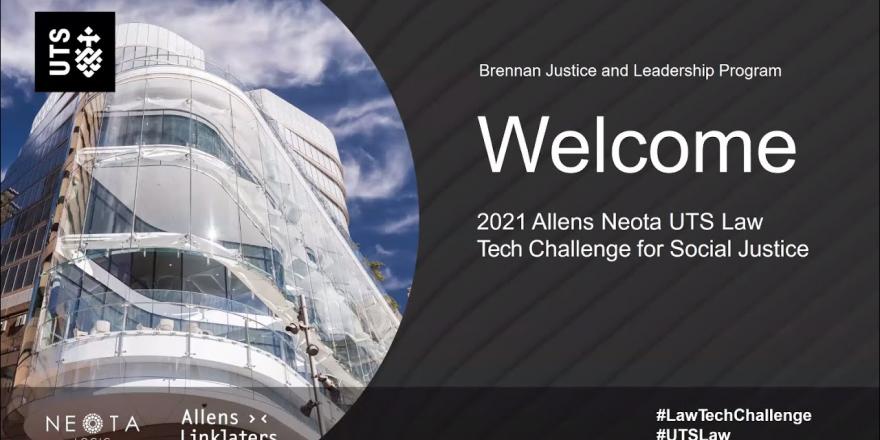
View the 2021 Grand Final event, and learn more about three additional apps that are now assisting these not-for-profit organisations with their access to justice problems:
QBDDxiAOp90

Descriptive transcript

Fundraising is a critical source of income for not-for-profits, or NFPs. With more than 50,000 NFPs registered in Australia, it is essential for these organisations to ensure that the fundraising process is manageable and easy to understand.

In the 2015/16 financial year alone, an estimated 14.9 million Australian adults gave $12.5 billion to charities and NFP organisations. But what precious time and resources are being taken away from NFP organisations when they attempt to navigate through the matrix of legislation that exists for fundraisers from state to state within Australia?

Well, that's exactly what Nikki and Josanne from the Community Fundraising Team at Autism Spectrum Australia, Aspect, came to us about.

Aspect is Australia's largest autism spectrum service provider, with one of the biggest autism-specific school programs in the world. Aspect provides people on the autism spectrum with the opportunity to realise their unique learning potential, as well as providing support to their families, carers, friends and colleagues. All of this support is done in part with the assistance of fundraisers through the Community Fundraising Team.

It is therefore integral for Aspect to ensure that their fundraisers are aware of all of the legal requirements in their state or territory, and that the process to undertake a fundraiser is simple and streamlined. However, Nikki and Josanne were finding that they were being inundated with questions and queries about how to host a fundraiser. Aspect is a nationwide organisation, and therefore understanding how to comply with all of the legislative requirements of each state is difficult and time-consuming, especially for non-lawyers. Not only that, but the current manual administrative process of both applying for and approving fundraisers is complicated and laborious.

Initially, we wanted to focus on the gambling and gaming rules across Australia, but given the timeframe of this app, it just wasn't possible. Instead, we focused on one type of fundraising activity, raffles, which was identified by Aspect as the most useful to tackle.

Now we will demonstrate our solution to this problem, where we'll meet David, a potential fundraiser.

David is a teacher who lives in Brisbane, whose son Michael was recently diagnosed with autism. David did some research into organising a raffle, however was overwhelmed by the process. He came to the Aspect website and was referred to the raffle fundraising assistant. David is presented with our welcome page.

In discussion with our client, we wanted to ensure inclusive practice was throughout our app. This can be seen with the inclusion of the translation tool that can translate our content into 98 languages.

David is made aware of the fact our app does not offer legal advice on our disclaimer page. Given the context of Aspect's privacy policy, which is presented in a text box to minimise information overload, as well as an easy to read document, and thus begins the first part of the app's function.

This is the beginning of the assessment of David's eligibility to host a raffle. He is asked whether he understands what a raffle is, what state he will hold his raffle in, as well as questions relating specifically to the laws that govern raffles within Queensland. David would answer three to six questions prior to being informed of his eligibility to host a raffle, based on his answers to these simple questions.

We chose to use a broad testing group made of individuals of all ages to help us refine our questions, as well as to understand how accessible the raffle information would be to a variety of people. This led to our team rephrasing sentences, as well as using an Aspect-specific tone in the information sheets we created.

Now that David has progressed through the first part of the app, and has come to the end of the eligibility phase, he is informed that he can host a raffle with a permit, where he is given a link to the permit application for Queensland, as well as an information sheet which is also provided in an easy to read format, which highlights his obligations to host said raffle. These documents were recreated by the Moral Code team. These documents were created in accordance with W3C standards to further expand the accessibility of our app.

At this point, David is forwarded to the Document Automation section, where he will submit his approval to host a raffle to Aspect. On this proposal form, he will need to provide specific details about his fundraiser. This process was initially tedious, however, after much discussion and feedback from our testers, we were able to rephrase our questions and add in text boxes, which explained specific content and aided our user.

After just a few pages of information, the user is taken to Aspect's waiver, which also includes a hyperlink to their fundraising guidelines. This element was included to provide the client with an engaged and informed user who is aware of their duties to Aspect and to the law.

Finally, David has come to the end of the fundraiser assistant, where he has been given feedback on his eligibility to host a raffle, as well as created a proposal application. This highlights the efficiency and informative full service our application provides.

It does not only provide this to the user, but also to the client, as upon completion of his journey through the app, Aspect's community fundraising team will receive his application in real time. This includes his proposal form, as well as a draft authority to fundraise form that was completed with the details he provided in the app. By drafting and automating this authority to fundraise, we are helping Aspect minimise their workload and eliminate a step in a bureaucratic process.

After months of intensive work, we are happy to announce that our app has been finalised and is ready for upload. It will be embedded in the Aspect website using a separate URL. We have also completed the maintenance instructions, which includes advice on what to do if and when fundraising legislation changes in the future, to ensure that the app stays relevant and up to date.

In terms of impact, this app has significant time saving capabilities. It will allow Aspect to refocus their energy away from complex legal needs and bureaucratic technicalities towards impactful work within the community. Why should they have to waste their time on these difficult administrative tasks when the Raffle Fundraising Assistant can do the work for them?

In the testing stage, many people were surprised that an app like this had not already been created, highlighting in particular the ease and efficiency of the process. Last year, Aspect received $7.6 million from community fundraisers alone. By removing the legal technicalities from the fundraising process, our app will allow this donation pool to grow, thereby providing Aspect with the freedom to continue doing the amazing work that they do.

Ultimately, our app was built to inspire. Due to our extensive research and automation processes, we have already formulated the solution to tedious tasks, providing a strong base for further expansion without the challenges. We believe that there is a real potential to expand and scale it to other organisations as they grapple with the same kinds of problems that Aspect was experiencing. This is particularly the case since many charities operate on a national basis and deal with laws across multiple jurisdictions.

But this is just the beginning. At the moment it only captures the law as it applies to raffle fundraising, but it can be adapted to cater for all fundraising events, such as fun runs, private event proceeds and even more novel circumstances like selling Pokémon cards on eBay.

Through our tireless work, we are proud to be providing the not-for-profit sector with an innovative solution that will help channel more donations towards these vital community organisations.

Interested in studying Law at UTS?Find out more about our courses

Share