

• Posted on 3 Jun 2021
  • 51-minute read

How does the media shape the conversation on human rights issues in Palestine and Israel?

Hear from Samah Sabawi, Antony Loewenstein, and Professor Saba Bebawi on how the words chosen, the narrow focus, and the heat on journalists is affecting how reality is relayed.

Social media is driving a change in popular sentiment and the push to include more perspectives in reporting. So where will the media go from here?
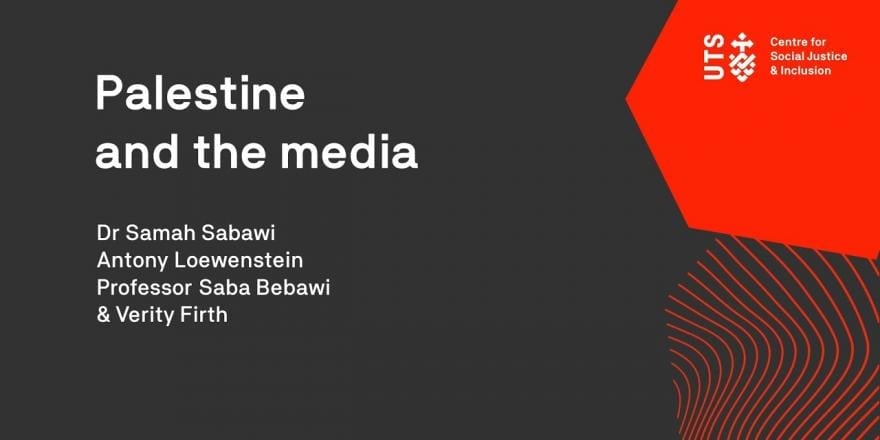
fzHdEFeoPSc

Descriptive transcript

[Upbeat music plays. The UTS logo appears on screen. The video transitions to a live online event with multiple speakers visible in a Zoom webinar.]

VERITY FIRTH: Hello, everyone who's joining us today. I'll just wait for about 30 seconds so people can enter the virtual room and then we'll begin our session for today.

Thank you so much for being online with us. We've reached 120 people, so I'm going to begin now and I'm sure more people can join us as we go along.

Firstly, thank you, everyone, for joining us for today's event. Before I begin, of course, I'd like to acknowledge that I'm on the land of the Gadigal people of the Eora Nation. I want to pay respect to Elders past and present, and I particularly want to acknowledge the Gadigal as the traditional custodians of knowledge for the land on which this university is built. I know and I want to extend respect to all the different lands that you are all on, wherever you may be.

My name's Verity Firth. I'm the Executive Director of Social Justice at UTS, where I lead up our Centre for Social Justice and Inclusion. It's my huge pleasure to be joined today by Samah Sabawi, Antony Loewenstein, and Professor Saba Bebawi, who I will be properly introducing in a minute.

Unfortunately, Sara Saleh has lost her voice due to sickness and isn't able to join us today. We're obviously wishing her a very speedy recovery, but I particularly want to thank Samah, who's coming online for us today with about one hour's notice. So just a special thank you for being so readily available.

[On-screen text: “Live Captioning is available. Click the ‘CC’ button or use the link in the chat.”]

First, a couple of key pieces of housekeeping. Today's event is being live captioned. To view the captions, click on the 'CC' (closed caption) button at the bottom of your screen in the Zoom control panel. We're also going to post a link in the chat now, which will open the captions in a separate internet window if you prefer.

If you have any questions during today's event, please type them into the Q&A box, which you'll also find in your Zoom control panel. We'll have time—hopefully—to put your questions to the panellists, but please keep them relevant to the topics we're discussing today.

We also want to acknowledge upfront that today's discussion does include topics that can be upsetting and can cause people distress. If you do feel overwhelmed or distressed in any way, just take a break. You can turn off the webinar; you don't have to keep watching. And if you really do feel that you need to talk to someone, remember there's a free 24-hour service like Lifeline or Beyond Blue, and you should feel free to reach out to those support services.

[The video shows the panelists on screen: Verity Firth, Samah Sabawi, Antony Loewenstein, and Professor Saba Bebawi.]

So thank you, everyone, for joining us here today for this important discussion. As you know, we're here today to talk about Palestine, Israel, and the role of the media in covering the human rights issues in the region and the human impact of violence. Mainstream media plays an undeniable role in narrating and shaping our reality. Where Palestine and Israel feature in the news, the human impact of violence can quickly become obscured in the choice of words used and the heat that's often applied on journalists covering these stories.

We're also going to be looking at how the media itself has come under attack—either directly, like the offices of Al Jazeera and the Associated Press in Gaza, which were destroyed in targeted aerial bombing, or indirectly, like the journalists who face accusations that they are engaging in activism rather than investigative journalism. And when there is a vacuum left in mainstream media, is social media helping or making things worse with misinformation? We'll be discussing that as well today.

So I'm honoured to now introduce today's speakers. First, to Samah Sabawi, who's stepped in for us and we're very appreciative of.

Samah wages beautiful resistance through her art. A recipient of multiple awards for her critically acclaimed plays, Tales of a City by the Sea and THEM, Sabawi also co-edited Double Exposure: Plays of the Jewish and Palestinian Diasporas, winner of the Patrick O'Neill Award. She co-authored the poetry anthology I Remember My Name: Poetry by Samah Sabawi, Ramzy Baroud and Jehan Bseiso, winner of the Palestine Book Award. Samah was awarded a PhD from Victoria University with her doctoral thesis titled Inheriting Exile: Transgenerational Trauma and the Palestinian-Australian Identities. Welcome, Samah, and thank you for joining us.

SAMAH SABAWI: Thank you for having me.

VERITY FIRTH: Antony Loewenstein is a journalist who has written for the New York Times, The Guardian, the BBC, The Washington Post, The Nation, Huffington Post, Haaretz, and many others. Between 2016 and 2020, Antony lived in East Jerusalem. He is a best-selling author whose books include My Israel Question and Disaster Capitalism: Making a Killing Out of Catastrophe, for which he was also writer and co-producer of its associated documentary, Disaster Capitalism, and most recently Pills, Powder and Smoke: Inside the Bloody War on Drugs. He's currently working on a book due to come out later next year on how Israel's occupation has gone global. Welcome, Antony. Thank you for joining us.

ANTONY LOEWENSTEIN: Thanks for having me.

VERITY FIRTH: Professor Saba Bebawi is Head of Discipline for Journalism and Writing at UTS. She holds a PhD in international news and has published on media power and the role of media in democracy building, in addition to investigative journalism in conflict and post-conflict regions. She is author of Media Power and Global Television News: The Role of Al Jazeera English, Investigative Journalism in the Arab World: Issues and Challenges. Saba has also co-authored The Future Foreign Correspondent and co-edited Social Media and the Politics of Reportage: The Arab Spring and Data Journalism in the Global South. Bebawi is founder and project director of the Foreign Correspondent Study Tour, funded by the Australian Government's Department of Foreign Affairs and Trade. Thank you so much also for joining us, Saba.

PROF. SABA BEBAWI: Thanks, Verity.

VERITY FIRTH: So, I'm going to begin by talking about the language of objectivity. It's obviously what we expect of our journalists, but does it dehumanise violence? When we talk about casualties rather than children dying, is this objective reporting? How does the panel think this language of objectivity affects reporting on Israel and Palestine? I might begin with you, Saba.

PROF. SABA BEBAWI: Sure. Thanks, Verity, for that introduction, and I'm really happy to be with this fabulous panel with Antony and Samah. The idea of objectivity is a very interesting one in the scholarly literature, and when we talk about reporting reality, we don't necessarily lean towards providing an objective account as far as the academic literature goes. Rather than offering a portrayal of what reporting reality is, it's not objective journalism. It is about offering a portrayal of what is actually happening on the ground by including all aspects of the event. I like to refer, and I would like to even quote, CNN correspondent Christiane Amanpour, who talks about this, and I use it very often, in an interview about her experience with the Bosnian War. She says, "It's important that calling it as it is, is not biased reporting, and it is not taking sides." She believes that objectivity means—I'm going to quote her—"giving each side their hearing, but not treating each side the same. Not drawing a moral equivalence, which would be a false equivalence. Not saying, 'on one hand' and 'on the other hand.'"

This is, in essence, what she's saying. She's saying the person who's being sniped and killed is somehow equal to the person who's sniping and killing. And the forces who are bombarding, besieging, and shelling a city full of civilians do not have the same moral standing as those who are being bombed, shelled, starved, and besieged. And that is the truth.

So, having said that, and I'm sure Antony and Samah have more to say about this, but I'd like to raise another point here, specifically in regards to the Palestinian-Israeli conflict. This is from personal observation. Even if the reporting is objective, it does remain very limited. For example, to reduce the conflict, in my opinion, to reporting on numbers of casualties without providing the overall context is not only problematic, in my view, but dangerous. This is a conflict that is the longest ongoing conflict in modern times. It has a complex and layered history, but also the current situation is extremely complicated. So, we cannot diminish it to a number or a counting story, which is what I seem to be seeing.

The other point I'd like to make is that the media somehow have been focusing on Gaza. It is not the Gaza conflict. It is the Palestinian conflict. Gaza is part of the Palestinian territories. In my opinion, this is a deliberate, where I see it as a mediating redrawing of the borders in an attempt to eliminate other parts of Palestine from the story, and in turn, form the Palestinian discourse.

I've got a lot to talk about and I'll stop there, but just some brief points I wanted to start and kick off with.

VERITY FIRTH: Thank you for that. Antony, what are your views?

ANTONY LOEWENSTEIN: I think the question of objectivity is one that's regularly used by media organisations when they're teaching young journalists or universities, for that matter, how to report on the conflict or, frankly, any issue. But often, I think it's a false question. Let me briefly explain why. I think a better word to talk about journalism is fairness rather than objectivity. Fairness, I think, is a much better way to view how we should be seeing any number of issues, not just Israel-Palestine, whether you report on a war, whether you report on a local issue, whatever it may be.

Objectivity very much suggests that there's two equal sides. And as Saba said, there's "he said this" and "she said that." You, audience, you decide. It's kind of a nonsense question. The reason I say that is, particularly when it comes to Israel-Palestine, as someone who's reported on it for 15 years—I was based there for years, often doing work there always independently in Israel, the West Bank and Gaza—there's not two equal sides here. There is an occupied and occupier. Israel occupies Palestine and Palestinians are occupied.

That does not mean that one is uncritical towards, for example, Palestinian leadership. It doesn't mean one doesn't say that the Palestinian Authority or Hamas are corrupt, awful organisations. One can say that; one should. One doesn't become a propagandist for one side or the other. That's not at all what I would suggest. But good, fair reporting would suggest that there is context for what is happening.

For example, there is context to say, why is this the longest-running occupation in modern times? As a journalist myself, who is thankfully often not being forced or required to play along with certain rules that my media bosses may tell me I have to play along to—which is often how it works in this sort of situation—you too often have, I think, a false equivalence here where a lot of the coverage in the last few weeks very much frames it as: Hamas fires rockets, Israel defends itself and shoots back.

Now, an average person seeing that or hearing that might think, "Oh, okay, these two sides are at it again. They're fighting again. Why can't they just get along and hug and move on?" Maybe not hug, but why can't they just shake their hands and just move on?

The reason that's a false equivalence is this is not two equal sides here. This is a situation where too often the context of, for example, Gaza remains occupied. The land, sea and air borders are controlled by Israel. There's been a 15-year siege, which Israel and Egypt have imposed brutally. Most people in Gaza cannot come and go freely. Only a handful of people can, for a range of reasons.

So ultimately, without that kind of context, the last two weeks can seem like just another round of a war that seems to go on indefinitely.

I'll just finish on this one point. What's so interesting, though, despite the fact that so much of media reports it like that, in many Western countries, public support, in fact, in the last five or ten years is far more moving towards sympathy for Palestinians. And I've often on one level wondered why that is—not because I don't share that view, but because I often wonder where people are getting that information from. They're not getting it from most of the mainstream press. They're not getting it mostly from the political elites. They may be getting it from social media, from their friends, et cetera. And yes, I think there's maybe a growing awareness of what Palestinians are suffering for in the last 50 or 70 years, but I think that public opinion is definitely shifting, including here in Australia. And I think we should often wonder if that's happening more despite mainstream media rather than because of it.

VERITY FIRTH: That's a really interesting point, and we will explore that later, because I think opinion is shifting. But exactly why that is, is something that's up for debate. Samah, do you have anything to add around the language of objectivity?

SAMAH SABAWI: I do, but I want to pick up on that last point, which you said you'll come back to later. Just to say that in previous decades, we always relied on the media to shape public opinion. We knew that the media could shape public opinion. I'm hoping at this point, seeing that shift in public opinion that ran way ahead of the media institutions, that it might just be public opinion for once that's going to actually shift how the media responds to the question of coverage of Israel and Palestine.

On the question of objectivity, I'm really more interested in accuracy and humane reporting. I think objectivity is a very difficult bar to explain and to hold and to prove. What is being objective when you're dealing with an occupier and occupied, when you're dealing with an oppressor and the oppressed? When just reporting on the crime within itself exposes the criminal, then the criminal is not going to be happy because you haven't been objective, because in their opinion, you've taken sides by exposing the crime. And that's exactly what happens with Israel every time that the Palestinian voices are allowed to express their stories in the mainstream.

I'm also interested in when we talk about objectivity in looking at the representation of the voices and of stakeholders. How much access do we have as Palestinians to tell our stories and to explain the narrative that goes with the news footage? I'll tell you one thing: during every Gaza bombing, but certainly during the last one as well, the Palestinian community and members of the Palestinian activism circles were hounded by reporters—which you would think is a good thing—but the reporters didn't want us to talk about the context. They didn't want us to analyse what was going on. They didn't want us to explain what was happening in Sheikh Jarrah, which triggered this entire recent episode. They wanted the human story, but they wanted the human story taken completely out of the context in which it was happening, which to me is just mind boggling.

And it goes back to the idea that a lot of Israeli supporters would always begin every conversation with, when they're having it with you, "It's complicated. It's complicated. This is a complex situation." And of course it's complicated when every time you're looking at footage of people being bombed, civilians being bombed with no place to run to, being besieged, being kept at checkpoints. I mean, some of the footage that comes out of Palestine, you know, in your worst nightmare or in the most incredible science fiction film, you cannot imagine having people caged up in those ways in order to go to work every morning, for example. But the footage never makes sense because the analysis that comes with it is completely taken from another planet, which is the Israeli analysis of what is going on.

So the people who are consuming mainstream media are left confused because what they're hearing, the sound bites that are coming with the footage that their eyes are looking at, are so different and so contradictory. And I think that is why we're seeing change shifting in public opinion, because the Palestinians are now actually trying to tell their stories in any other means possible, having given up on the mainstream in hosting their voices and giving them a platform to speak.

VERITY FIRTH: That's really interesting. Thank you for that. So my next question is around activism as opposed to investigative journalism. So when covering issues from the MeToo movement to Black Lives Matter and again on Palestine, there have been some high-profile cases where it's been suggested reporters care more about advocacy than investigative journalism. Saba, can you comment on that?

PROF. SABA BEBAWI: The eternal question, advocacy or journalism. There are a few points here to highlight, and I'll probably refer to my own research where I did a study on Al Jazeera English, comparing it to BBC and CNN and its coverage of events in the Middle East. I found two interesting points. The first point is that each news organisation reported from its national perspective. Probably didn't need to spend six years doing that, but it was good to get the facts to support it. And we call that selective reporting. That's choosing one fact over others and eliminating others to form a particular narrative or to form a new social reality.

The other thing that I found particularly interesting is Al Jazeera English always had two different and often opposing narratives on the same event, on the same day, from the same newsroom. That was based on the reporter's political allegiance. So Arab reporters tended to give an Arab angle to the event, and Western reporters were giving a Western angle to it. So what this means is that reporting is selective across the board, and a phenomenon that I actually called mediated advocacy.

There's another point I would like to raise here, that there is no universal culture of journalism. When we talk about advocacy being different from journalism, this is a Western discourse. There is no one way of doing things. There are different cultures of journalism. There are different journalisms across the world. I'll bring one example from China, where I have a colleague of mine, Haiyan Wang, who wrote about transformation of investigative journalism in China, and the fact that Chinese investigative journalists cannot practise investigative journalism in the Western way.

So what they've been doing historically is marrying it with advocacy journalism, and that is the way they do investigative journalism, because she found that in order for them to achieve their aims and full potential, investigative journalism in China needs to be integrated with the practice of activist journalism. So although investigative journalism is what we define as fact-based, evidence-based journalism, it is fuelled by a sense and purpose of advocacy in many parts of the Global South, and particularly in the Arab world. So working with Arab investigative journalists, it's the passion that leads them to talk about a particular thing, not only find the issues, but how they report on it. But they still do it in a facts-based, evidence-based way. And in that situation, in that context, it works.

VERITY FIRTH: That's really interesting. Antony, I'll go to Samah, because I went to Antony, and we want to mix things up a bit. Do you have anything to add around that advocacy piece?

SAMAH SABAWI: Yes, I'll talk about Palestinian journalists, because I've dealt a lot with Palestinian journalists over the years. For Palestinian journalists living in Gaza, for example, they know that getting the story out is advocacy. They're being honest to the story. They're shooting what is happening. The camera is showing things as they are, and they're reporting things as they are. But they know that our lives as Palestinians under occupation and in Gaza—our lives are very political, regardless of whether we want it to be or not. And just by telling a Palestinian story, a side has been taken.

So the idea of objective journalism in that sense is very difficult to really—it's very difficult to apply for people who are in war zones, who are part of the war zone. So a journalist who is a war zone journalist, who's an American with an American passport, who goes to Afghanistan and reports, might still be able to have that distance between what they're reporting, and might have the protection gear and the protection, everything of being an American citizen.

A journalist in Gaza knows that whether or not they report the story, they might be killed, because a bomb might fall, and their entire family might be wiped out. And so they know they have no protection. And they know that their lives and the lives of the people they love and they care about depend on how much they tell of that story and about the details of the story as well—not just about, you know, such and such happened today. Such and such happened to this family who live in this house, who are eating this food. This child was torn to pieces as he was having his sandwich. These details matter.

So, you know, with Palestinian journalists on the ground, in the middle of it all, who are themselves part of an occupied people, who are themselves part of an oppressed people, I don't think that question applies.

VERITY FIRTH: Yes. Antony?

ANTONY LOEWENSTEIN: The question of advocacy or activism is something that's come up a lot in my life, because often I'm accused on this issue of being both. And I guess I refute that. Let me just briefly explain why. So this is generally raised by people who are either blindly pro-Israel, who don't like the fact that there is someone who is more critical or sceptical of Israeli claims, Israeli actions. I'm Jewish myself, although I don't think my Judaism—I don't really practise my religion, I'm not religious—I don't think that really informs my reporting, except for the fact that I know that Israel claims to be acting on behalf of me. In other words, Israel explicitly says, as a Jewish state, that our role is to act in your interest and to protect you.

Now, my view is they're doing the exact wrong thing and the opposite of that, but that's how they claim to be. And many Jews in the Diaspora, including in Australia, will argue that. And when I was growing up, I used to hear that, that my family, many of whom were killed in the Holocaust, would say—my family wasn't madly pro-Israel, but the argument was always said, God forbid something happened, there was always somewhere to go to protect us.

On one hand, I understand that logic. I mean, considering the 20th century, that makes sense, except for the fact that it's on the back of another people, the Palestinians, which is why, in my view, it's completely unacceptable. So when I'm reporting on Israel-Palestine, I think you have to not view this issue as—as I said before—two equal sides. You have to be sceptical and critical of all claims. I don't think one should be a blind advocate for any one particular side.

On the other hand, if anyone spends any time in Gaza, in the West Bank, in East Jerusalem, where I was based for four years and have been going there for 15, a blind man can see what's happening there. I mean, as Samah was saying before, yes, some parts are complicated. Yes, like any conflict, things are not necessarily just black and white. But ultimately, this has been a conflict, a war, an ongoing level of daily violence.

One of the problems with reporting is too often, even in the last two weeks, the New York Times can put headlines saying, "After a period of calm, violence flares up." Well, what does that mean? Peace for whom? I mean, yes, for a lot of Israeli Jews, life's been relatively okay. There has been no real violence, and that's great for them. But if you're in the West Bank or Gaza, every day there's violence in a different way. There's literally virtually every day a Palestinian civilian being killed in the West Bank, almost every day by Israeli forces or Israeli troops, almost every day. That's violence, and it's obvious to say that.

So if advocacy or activism is saying that and reporting that, which is simply fact, then yes, one can be accused of activism. But I don't think reporting accurately what's going on as a human being— to me, the problem I often find is that too many people who are invested in this conflict, Jews particularly, put their religion first and their human being cap second. In other words, they are seeing it through a very tribal lens. And that, to me, is unhealthy. I mean, we all have tribal views. I'm not saying that we can all necessarily escape that.

But this is a very quick example, and I'll finish on this point. It is unimaginable that you would have the equivalent on the Palestinian side of what the New York Times has done in the last 20 years. Almost every correspondent there, bureau chief in Jerusalem, has either had a child who's in the IDF or has had a partner or someone close to them who works for advocacy for the Israeli government as their job. It's not a conspiracy theory. It's just a fact. And people can Google that if they don't believe me.

Now, can you imagine the equivalent on the other side? I mean, can you even imagine it? The idea that you would have, for example, Palestinian journalist X working in Jerusalem and her husband was a part-time fighter for Hamas, for example. Can you imagine? It would never happen. I'm not saying it shouldn't happen on either side, to be honest, as a reporter. My point being that that sort of reality for the New York Times is uncontroversial. It's just normal. That's just a normal part of journalism. How is that not activism? How is that not advocacy for one side? And the reporting often has reflected that.

The New York Times got a little bit better during the recent conflict, which we can discuss later if you want, here and there. But those are the sort of organisations that frame so much the reporting for the Western audiences, particularly in the US and the Western world. And I think when those organisations start to shift their coverage, which to some extent I think they're slowly doing, that's when you realise many people in the very blind pro-Israel community are worried that they're losing the information war. Ultimately, this is not really a violent conflict. It's an information war. And there's no doubt to me that Israel in the last five or ten years is increasingly losing it.

VERITY FIRTH: That's really interesting. Antony, I'm going to stick with you because last year you wrote an essay where you said that Australia is almost unique globally in its consistent support for Israel in diplomatic forums like the United Nations. And it's interesting what you were just saying then too about the information war. So what is the reason that Australia has had that approach? And how does it affect Australian media coverage of these issues?

ANTONY LOEWENSTEIN: Let me briefly explain this because you could write a book about it, as many people have. But let me briefly give an overview. I think the reason Australia—and this is generally quite bipartisan, by the way, this is not particularly more Liberal Party. I think when Labor has been in power in the last 30 or 40 years, there have been slightly more shifts. Whitlam was a bit more sceptical of Israel. There were times during the Kevin Rudd era where he was a bit more sceptical. So there are differences. I'm not saying they're exactly the same. But in general, there is virtually bipartisan support for Israel.

Why? I think a few reasons. One, I think there is still in many Western countries, including here, an ingrained sympathy or guilt because of the Holocaust. I think that actually still plays quite a large part. I'm not saying that's explicit, but the sense that essentially the world didn't stop the Nazi Holocaust, and therefore we in the West have a responsibility and duty to support Jews to form and build a stable homeland. That's one reason.

Two, I think 9/11 has been a wonderful gift for Israel. And what I mean by that is just after 9/11, Netanyahu, who was then not prime minister but a political leader in Israel, was on the media essentially saying that now, he argues, most of the West will understand what we have been going through for decades—namely, that we in Israel have been fighting a war on terror against Muslims, against terrorists. And now you in the West, you get it. Welcome to our reality. And I think many people in the West shared that view. They still share that view. That Israel is almost on the front line, so the narrative goes, of fighting this war against terrorism. And in fact, often Israel explicitly says to Europe that we are fighting a war so you don't have to. In other words, we're doing those kind of battles against terrorists and all these extremists.

And I think finally, there's a question of—for the last about 20 years, very leading Israel lobby groups here in Australia have been sending politicians and journalists on free trips to Israel. And these trips, I think on one level, have been very successful. They are essentially a week or 10 days of propaganda. You are being shown a very narrow slice of reality. And again, Labor's taken it, Liberal politicians have taken it, a lot of journalists have taken it, not so many from the ABC, but SBS. In fact, the current head of SBS three years ago went on a lobby trip and came back raving about how great Israel is. Now, that to me is inherently deeply problematic. And it almost strikes to me as, if you are going to take those trips—which I don't think one should—even if you do, the idea that most of these people wouldn't even say, "Hmm, maybe I'll spend one more day in the West Bank." It just doesn't enter their minds. And you know the impact of these trips because when they come back, they talk about it. It impacts their coverage.

So I think all these reasons—and this finally—when there's a UN vote, pretty much anything to do with Israel in the last years, particularly since the Morrison government, but it was similar under Turnbull as well. You have pretty much the entire world on one side. And the other side is Israel, the US, a few Pacific islands, Micronesia, Palau, and Australia. Now, those small states, I kind of get in a way why they support it because they're client states and they need the cash. I kind of understand that, fair enough in a way. What's our excuse? It's not because we need the money; we don't. So I think it's partly ideological and also philosophical.

And also, just finally, finally, Australia frames the support for Israel as so-called shared values. It's said all the time, as does Biden, as do many Western leaders. What does that mean? Shared values in what way? They frame it around democracy, human rights, one person, one vote, all that sort of stuff. But the fact is shared values essentially mean that Australia and many Western states not just overlook the occupation, but support it, back it, defend it, arm it. So as a settler colonial country as we are, and as Israel is, and in fact many Western states are, I think there's also that affinity between all these states that they see almost a kindred spirit.

VERITY FIRTH: That's controversial. I rather love that. Do you have anything you want to add on that?

PROF. SABA BEBAWI: No, nothing to add. That was very clearly articulated.

VERITY FIRTH: Over to Samah.

SAMAH SABAWI: Yes, we did talk about how our names are very similar before we started going on. It's not that I want to add, I just want to highlight the last point that Antony spoke of—and I take all his points on board—but the last point I think is really important for us in order to really—we really need to make that conne

Jointly presented by the UTS Centre for Social Justice & Inclusion and UTS Faculty of Arts and Social Sciences.

If you are interested in hearing about future events, please contact events.socialjustice@uts.edu.au.

In previous decades we always relied on the media to shape public opinion. We knew that the media could shape public opinion and I think, I'm hoping at this point, seeing that shift in public opinion that ran way ahead of the media institutions, that it might just be public opinion for once that's going to actually shift how the media responds to the question of coverage of Israel and Palestine. Samah Sabawi

Australia frames the support for Israel as socalled shared values They frame it around democracy, human rights, one person one vote, all that sort of stuff, but the fact is shared values essentially means that Australia and many western states not just overlook the occupation but support it, back it, defend it, arm it. So as a settler colonial country as we are and as Israel is and in fact many western states are, I think there's also that affinity between all these states that they see almost a kindred spirit. Antony Loewenstein

The media have been focusing on Gaza. It is not the Gaza conflict. It is the Palestinian conflict. It's part of the Palestinian territories. In my opinion, this is deliberate, where I see it as a mediating redrawing of the borders in an attempt to eliminate other parts of Palestine from the story and, in turn, from the Palestinian discourse. Professor Saba Bebawi

Speakers

Samah Sabawi wages beautiful resistance through her art. A recipient of multiple awards for her critically acclaimed plays Tales of a City by the Sea andTHEM,  Sabawi also co-edited Double Exposure: Plays of the Jewish and Palestinian Diasporas, winner of the Patrick O'Neil Award and co-authored the poetry anthology I Remember My Name: Poetry by Samah Sabawi, Ramzy Baroud and Jehan Bseiso, winner of the Palestine Book Award. Samah was awarded a PhD from Victoria University, her doctoral thesis is titled Inheriting Exile: Transgenerational Trauma and the Palestinian Australian Identities.

Antony Loewenstein is a journalist who has written for The New York Times, The Guardian, the BBC, and more. He is a best-selling author whose books include My Israel Question, The Blogging Revolution, and Profits of Doom. He's currently writing a book, out in late 2022, on how Israel's occupation has gone global.

Professor Saba Bebawi is Head of Journalism and Writing at UTS. She holds a PhD in international news and has published on media power, the role of media in democracy-building, and investigative journalism in conflict and post-conflict regions. She has authored a number of papers including Investigative Journalism in the Arab World: Issues and Challenges.

Share