

• Posted on 15 Apr 2021
  • 17-minute read

Trust, openness and building community is the secret sauce to creating engaging learning experiences for students and fostering lifelong learning, says one of Australia’s top higher education teachers and YouTube star, Dr Amanda White.
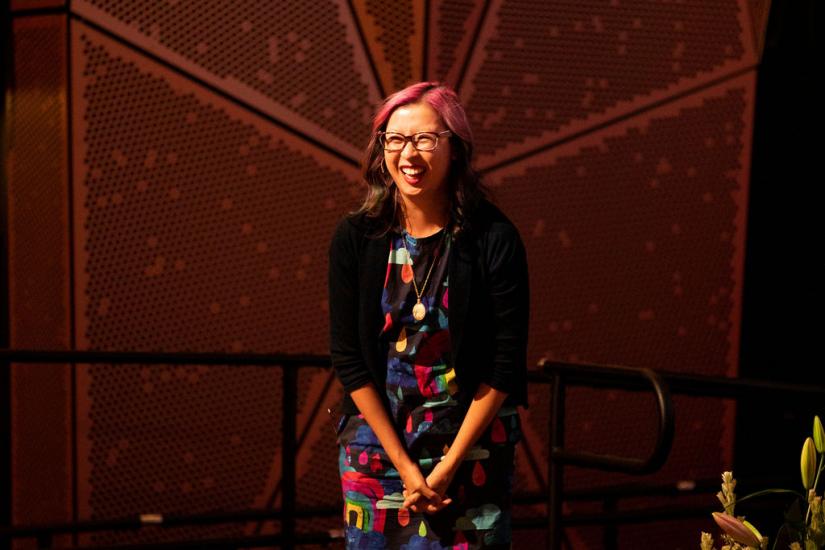
UTS Business academic Dr Amanda White has shared the secret behind her passion for teaching and student experience, in a keynote presentation at the annual UTS Vice-Chancellor’s Learning and Teaching Award ceremony.

Amanda, who was recently recognised with one of Australia’s top higher education awards for teaching excellence, says that her initial decision to follow a career in teaching came from a desire to make a greater impact.

After spending the early years of her career as a partner in a large accounting firm, she says that the events surrounding September 11, 2001, were a catalyst for her to rethink her corporate career trajectory.

 “At that point, I thought ‘What am I doing? I want to do more, I want to have real impact’. I wanted to make social impact.”

In the two decades since, Amanda has educated thousands of students in accounting practices, and become well-known the world over on her popular YouTube channel Amanda Loves to Audit, where she dishes up bite-sized lessons on why ‘Audit programs are like fried rice’ and topical advice on study and exams.

Building trust with students

For Amanda, building trust is an essential part of creating a high-quality teaching and learning experience.

“Learning is not only a cognitive process, but an emotional one as well. Trust is required for students to invest emotionally in learning, and when they invest emotionally, they are so powerful in terms of their learning.

“But today, trust is not automatically given to us as educators. When I was a student, we just trusted the professor, we trusted the co-ordinator – so how do we earn it?”

She says that being open with students is an essential part of her teaching approach in her role as Senior Lecturer and Deputy Head (Education) in the UTS Business School’s Accounting Discipline Group.

“I’m open with my students about who I am as a person – that I’m a daughter of migrants, about my story.

“I’m bringing my whole self to class. My students know about ‘Audit Senior’ and ‘Audit Junior’ – my two children – and how that fits into my life."

More than teaching: Student wellbeing key to student success

A passion for student wellbeing is also at the heart of her teaching role.

“I’ve always been a big proponent of pastoral care. Wellbeing is at the heart of what I do, it’s about building that trust, and showing that you care about students – asking, ‘How was that job interview?’ or ‘Tell me about your work’ and trying to relate that," she says.

“I want to know my students, I want them to be able to come to me for advice, I want to be part of their learning journey.”

She says being open to acknowledging failure, as well as creating feedback loops with students help to continually improve learning experiences is key – which has been so successful that she is incorporating student co-creation in Introductory Accounting subjects in the popular Bachelor of Business program from 2022.

“I build trust by experimenting with my students. I’m always asking them for feedback – sometimes I think they’re sick of it. ‘What did you think of this week’s activity? Did it help you? Could it be improved?’ So we’re always experimenting with our students.”

"I acknowledge that I make lots of mistakes, I tell that to my students – talking about failure is talking about learning."
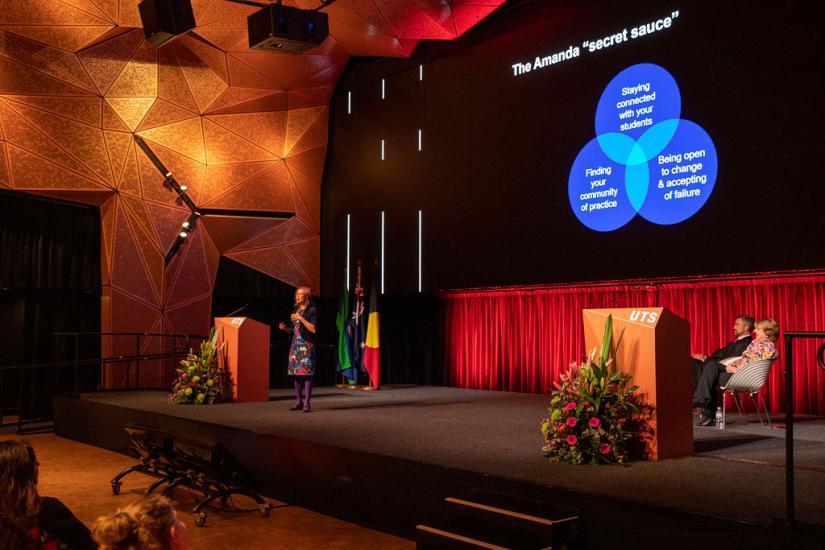
Building connections beyond the classroom

Amanda also credits staying connected with students after graduation and building a sense of community as rewarding for both herself, and her students.

“Community is really really important,” she says

“This is my 20th year at UTS, I’ve been part of the institution for such a long time, and my secret sauce to staying optimistic and staying passionate when it comes to education – amidst all the doom and gloom that we often face in higher education – is to stay connected with your students.

"Staying connected with students after graduation is such a wonderful thing.”

“If I need to connect students – someone’s looking for a job opportunity, someone’s looking for some advice on forensic accounting, or what a career assessment centre is like, I can almost always find them an alumni to connect with, and that community flows through, students come to my subject, knowing what to expect, knowing that they’re going to be looked after, that if they need help, they’ve got it,”

As a teacher, she credits inspiration from fellow academics and the support of UTS's community of practice - through initiatives like the university's LX.Lab and Institute for Interactive Media & Learning (IML) designed to delivery next-generation learning experiences.

"Teaching is a reflection of our soul, and we need to be willing to hold ourselves up to the mirror, and it’s not always going to be pretty – sometimes you try something and it’s just not going to work, and you have to acknowledge that.

"Listen to those voices that lift you up. Being a teacher is a great privilege, and a great honour – let’s treat it like that."

Watch Amanda's keynote in full here:
aIZMVZK8bUQ

Descriptive transcript

Hello. Would everyone please take their seats? We are about to begin the livestream. Thank you, everyone.

Excellent. Thank you. Good afternoon, everybody, and a very, very warm welcome to you all. Thank you so much for taking the time to be with us today.

Before we begin, and on behalf of all those present, I'd like to pay respects to the Gadigal people of the Eora Nation. It's upon their ancestral lands that UTS stands. Similarly, I pay respects to Elders both past and present, acknowledging them as the traditional custodians of knowledge of this place. And as this is a livestream, I'd also like to acknowledge the traditional owners and custodians of the various lands for all of our online guests joining today. A very warm welcome to you all.

It is fantastic that, despite the circumstances, we're still able to invite friends, family, and colleagues to celebrate with us today, for all of us in the hall and for those of you watching online. It really is important at times to pause and celebrate—the incredible achievements that you've made, your colleagues have made, and that, as a community, UTS has been able to do for our students.

So I am absolutely delighted to be here. Every year, I say to Shirley, this is my favourite event. I'm allowed to have one favourite child, perhaps—so this is my favourite event of the whole year.

And now, while this event is a celebration of your hard work, importantly, it's also a recognition of the leadership that you've all shown—a leadership across the university in our learning and teaching. Over the last 12 months, we've all faced monumental challenges. The world has changed in a very rapid way, and so too has the way that we teach and provide learning for our students.

Your hard work, and particularly as part of last year, your incredible persistence, perseverance, and creativity, has been paramount to helping the university overcome these challenges and to continue to provide a world-class education for our students, whether that be in the classroom or in the virtual classroom. It's important to note that UTS's transformation didn't start with COVID-19, nor will it stop. We will continue to strive for improvement and innovation for many years to come. It's the foundation of who we are as a university.

So every time we think we've got it right, we'll reflect on it and do it better again. At the heart of UTS 2027 is this transition to a lifetime of learning. We're driving this transformation by curating and supporting learning and professional development for our students throughout their entire lives.

And as you know better than most, the key to that is also partnering with industry and others to evolve traditional learning methods, to provide learning experiences that more relevantly face today's challenges, to enable those in society to change, and importantly, to help people think about what the challenges are in the future. So it is always, I think, one of the most incredible things that you are able to do as educators—to fast forward into the future and think: what are the challenges going to be, and what do we need to do now to help prepare our students, our community, to face those challenges that come?

It's our commitment to innovation and evolution that will require us to help equip our students with the skills and capabilities to, as I said, not just help them in the workplace today, but the workplaces of the future—not just help them in their lives today, but in their lives in the future. And each and every one of you in the learning and teaching community across UTS has been instrumental in ensuring that our graduates are able to thrive.

The recipients we recognise today, and importantly their innovations, are once again, as is with every year, stellar examples of the innovation we do across the university, and particularly this year about how we are going to transform to a lifetime learning. Just some of the examples we'll hear are: enhancing in-curriculum career education; developing skills in critical and abstract thinking by taking a holistic and life-thinking approach; facilitating institutional reflection on Aboriginal sovereignty; and transforming students into transdisciplinary future thinkers—again, enabling them to think about the way the world is going.

I want to stress, as I always do, that today's recipients are not alone in their extraordinary efforts. I am incredibly proud and grateful for all the enormous effort, hard work, from each and every one of our teaching and learning community across the university. As well as a great disruptor, COVID-19 has proven to be an accelerator for many of the trends we saw that were happening pre-COVID.

So we now have a fantastic opportunity to use the lessons we've learnt over the last 12 months to continue to innovate, to lead the way for future education, both in the physical and digital. By coming together today as a community and sharing our experiences, hopefully we'll be able to foster this excitement in others. You'll be able to share your vision with others. You all play an integral role in creating an inspiring learning environment for our students and colleagues.

So I'd like to wholeheartedly thank each and every one of you for your ongoing contributions. Thank you, Carly. I now, apparently, am meant to throw—I'm not quite sure what I'm going to throw Shirley—but I'm throwing to Professor Shirley Alexander, Deputy Vice-Chancellor, Education and Students.

Thank you, Attila, for not throwing at me. I just want to say how wonderful it is to see everyone here in person. It's one thing to see everyone on Zoom, but I have to say you all look so much better in person than you do on the Zoom screen. So thank you all so much for coming.

I also want to acknowledge a number of my senior executive colleagues who are here: the Provost, Professor Andrew Parfitt; our DVC International, Ian Watt; our DVC Resources, Patrick Woods; and we've got a couple of Deans—Alan Davison from FAS and Karl Rhodes from Business. So thank you very much for coming.

I know a couple of Deans are in isolation, having been in Brisbane on the weekend, so we're glad they're not here.

So I'm going to start out with our citations. The citations are awarded for those who have made a significant and sustained contribution to student learning, student engagement and student experience by individuals and teams.

So in 2020, the teaching and learning citations are awarded to: Dr Chris Bajada, Dr Sonika Singh, Dr Walter Jarvis and Rowan Traylor from the UTS Business School; Timothy Boy from the Faculty of Engineering and Information Technology; from the Faculty of Health, Dr Sheree Lucas, Dr Carolyn Hayes, Dr Tamara Power, Dr Caleb Ferguson, Dr David Kennedy, Gail Forrest, Professor Bronwen Hemsley, Dr Amy Freeman-Sanderson and Michelle Courtney-Harris; from the Faculty of Science, Associate Professor Simon Mitrovic; from the Faculty of Arts and Social Sciences, Dr Beata Muller and Associate Professor Susan Aguro; Nina Smith from the Faculty of Design, Architecture and Building; Dr Linda Steele from the Faculty of Law; and from the UTS Business School, Christina Vovoda.

So please join me in congratulating all of our citation winners again. [Sound of loud clapping.]

I would now like to award our Teaching and Learning Awards. These awards recognise learning and teaching for undergraduate and postgraduate students within the framework of the UTS Model of Learning and the Learning Futures Strategy. Each winner or winning team will provide us with a three-minute presentation about their award-winning teaching or project.

The first award is for academic support, and I'm very pleased to announce that that is awarded to the UTS Careers Team comprising Sam Berry, Helena Asher-Chang, Claudia Cowell, Stephanie Gonzalez, Candy Jenkins, Steph Miller and Ruth Wilcock for enhancing student employment and confidence within curriculum career education. As you know, the UTS Careers Team inspires students to explore their life and career options, to develop their employability skills and build confidence to navigate their future by embedding career education within the curriculum at UTS. Congratulations to the team.

Navigating transition points such as starting and finishing uni, deciding a profession or making a career change can be challenging. UTS Careers has an aim to equip all students with knowledge and methods for finding their way and developing their career. This involves an understanding that we need to build self-awareness, understand our career options, make decisions and take action to transition to next steps.

By embedding this career education within degrees, we can ensure that all students have access to this important learning. It's a lifelong learning approach that extends beyond just getting the first job. Students take this knowledge with them so that they're empowered to design their careers well into the future.

A key element of our work is to provide meaningful work-integrated learning with an aim of supporting students to have purposeful, ongoing connections with the professional world. The careers topics included in these subjects help guide students through preparation for their professional experience to reflect and gain insights.

Some examples of activities include reflecting on pride moments where students share examples of achievements with their peers and help each other to identify their interests, strengths and transferable skills—building self-awareness. Students also discuss challenging workplace scenarios and brainstorm solutions for tackling them.

We've been able to invite industry representatives into the classroom for interviews and discussion panels, and to support students with their projects to help them gain a real-world view of different types of careers. To support this learning, we've developed career education modules in Canvas, which can be utilised by subject coordinators and customised for subjects, providing an engaging, blended learning experience.

Most recently, we've been introducing career and life design at UTS. Career decision-making is a wicked problem in that it has no one perfect solution. With the world of work constantly changing, we found that the design thinking approaches of ideating and prototyping are helpful ways of working with students as they explore their careers.

The design mindset of radical collaboration has also been particularly relevant in encouraging students to work with each other and across disciplines to share ideas and identify next steps. We started to build a dedicated network of staff, alumni and employers that we're calling our Career Activators Network. And with them, we're providing a range of learning opportunities for students in the curriculum and alongside for exploring their careers.

On behalf of the team of careers consultants receiving this award, I'd like to take the opportunity to thank our manager, Julianne Katruppi, and the Director of Student Services, Brett Smout, for their wonderful leadership and support. Thank you also to our colleagues, including the academics and professional staff within the faculties who have worked with us and endorsed us for this award. We're very lucky to have such fantastic partners. Thank you.

Our next award is the Early Career Teaching High Commendation, and this is presented to George Harb from the Faculty of Arts and Social Sciences for educating students to embrace 21st century skills and affect positive change. George is a science and maths teacher with 20 years' experience in secondary schools. Since 2017, he has worked with subject coordinators in FASS and in redeveloping the M-TEACH program to enhance the teaching practices of pre-service teachers. Congratulations on your high commendation.

Good afternoon, Vice-Chancellor, Professor Alexander, ladies and gentlemen. In autumn 2020, we were confronted with an unprecedented challenge—COVID-19. At the time, I was coordinating the subject Professional Experience and Classroom Management II in the Master of Teaching in Secondary Education program. A mandatory requirement for this subject was for students to successfully undertake a professional experience placement. The students enrolled in this subject were final year students, expecting to complete their studies by the end of autumn session.

The pandemic presented three immediate challenges for this cohort of students. The first challenge was the transition from on-campus face-to-face learning to fully online. The second challenge was the suspension of professional experience that was scheduled from 4 May to 12 June—a reasonable and justified decision under the circumstances. The third challenge, because of professional experience being suspended, was for these final year students to successfully complete their course by the end of the autumn session and hence be in a position to seek employment in the second half of 2020.

In autumn 2020, we were confronted with some challenges, but challenges provide opportunities. Firstly, it was an opportunity for me to adapt and to demonstrate to our students effective online teaching and learning. This included implementing and modelling contemporary educational technologies and digital pedagogies. Secondly, it was an opportunity for our students to extensively engage with the online environment. The tutorials provided students with numerous online experiences, both as students and as the teacher. Furthermore, an assignment was modified to give students the opportunity to deliver a full lesson completely online, employing contemporary educational technologies and digital pedagogical practices.

In consultation with some principals, including some ex-colleagues, I quickly learnt that many schools were finding it challenging to adjust and to deliver quality online teaching and learning. I was extremely confident that our students had considerable experience in this space, although in a relatively short period of time, they were classroom online ready. I suggested to these principals the possibility of our students assisting their staff. The principals, following discussions with their respective executives and staff, accepted the offer.

This was an exciting opportunity for our students, not only to undertake their final practicum, but more importantly, to genuinely lead in the online environment. The positive impact of our students was significant. Firstly, the entire cohort of students had been placed in a school. A significant proportion, 80% of the cohort, accepted their placement. One in five students, however, had some reservations and declined their placement, postponing it to spring. Secondly, in relation to the 80% of students who accepted their placement, 100% successfully completed their practicum, thus completing the subject Professional Experience and Classroom Management II and their course as was originally planned by the end of the autumn session.

Thirdly, and most importantly, all the students who successfully completed their practicum had a teaching job for the commencement of semester two 2020. In fact, a significant proportion of them were offered continuing positions at the school where they undertook their final professional experience. This was testament to their outstanding online teaching and learning and the significant positive impact they had at their respective schools during unprecedented and challenging times for education. Thank you.

[... Intermediate awards and presentations omitted for brevity ...]

I'm now very pleased to introduce, in case there's anyone in the room who doesn't know her, Dr Amanda White.

Amanda is the Deputy Head in Education of the Accounting discipline in the UTS Business School and has been part of the Business School for almost 20 years.

Now you may have heard that there's something Amanda loves to do—audit! Amanda loves to audit and she puts her heart and soul into improving the student learning experience through the use of technology. Learning is a social and emotional journey for students and she designs learning experiences with that in mind.

Now Amanda has been the recipient of a UTS Individual Teaching Award, numerous faculty awards, an AAUT citation for outstanding contribution to student learning, and in 2020 she was awarded the Australian Awards for University Teaching Excellence Award for Law, Business, Economics and related areas.

Now there are only three national teaching awards given out last year, so it's a wonderful acknowledgement of everything that Amanda does for students that she was one of those three recipients. It is a really important award—it recognises Australia's most outstanding university teachers. It's about the enrichment of the student experience and the improvement of learning outcomes through innovation and quality teaching over a sustained period.

So in the absence of a National Teaching Awards Ceremony, the Vice-Chancellor is going to present Amanda with her award.

I'm going to pop this over here and I forgot to say that Amanda is going to give the keynote address.

Thank you, Shirley, and to everybody here.

I'm standing away from the lectern because I'm sort of short and standing behind it makes me feel really closed in.

So I'm going to try and keep to my 10 minutes—I can see the countdown and there's a lot of pressure there, it's very authentic.

So this quote here comes from 'The Courage to Teach' and it's the late Professor Tracey Bretag that introduced me to this book in 2019 and it just crystallised everything that I couldn't put my finger on that was why I wanted to be a teacher—that it's holding a mirror to my soul, it's that I'm bringing my whole self to my class.

My students know about 'Audit Senior' and 'Audit Junior'—my two children—and how that fits into my life. And they're not upset when assignment marks are late for one week because I've got two kids with gastro, so helping bring myself into the class for me is really important and I thank Tracey for that. Unfortunately, she passed away last year.

So when I was asked to give this keynote, people were saying, "We want to hear about your story." So this is me—18, 19, 20 year old me. I wanted to be an accounting partner at a public accounting firm and then on that track I was doing my honours program as part of a research program thanks to Professor David Brown, and September 11 happened and I remember getting in a taxi to go to the airport and the taxi driver said, "Are you sure you want to go to the airport?" I said, "Why?" and he explained what had happened and that was a point in time that was a real reflection point for me.

I thought, "What am I doing? I'm helping big companies make a lot of money." And I read Dr David Suzuki's book about superspecies and evolution and I thought, "I want to do more, I want to have real impact. Rather than help big companies make more money, I wanted to have that social impact," and it was then—I don't even think Dr David Brown at that point—who said, "Come to university. This is where you can make impact."

And I remember being at my first ever faculty retreat with my school and I think somebody from IML was there facilitating a discussion about what did we see ourselves as when it came to teaching, and people were talking about content delivery and skills and I said, "I want to know my students, I want them to be able to come to me for advice—I want to be part of their learning journey."

And I was pooh-poohed on that idea quite a lot. It was, "Amanda, in two years you'll be as cynical as the rest of us, every student is trying to screw you over, everybody is trying to get the highest mark for the least amount of work possible, you don't want to get to know these people." And I'm really glad that I didn't listen to the people that gave me that advice, and I listened to the fabulous educators that I met across the university, people like Jon Tyler, who said to me, "Amanda, teaching is so important, what you're doing is so important—you're representing young Asian women and what they can do in academia, in business, and accounting."

So it's really important to listen to the voices that tell you the positive things about being a university educator—it's not just the thing you do besides research. What we do has real impact, and so that advice—holding on to those nuggets—was really important.

Now I haven't attributed this to anyone because I guess I say this a lot and I didn't get it from anywhere so I guess it's me. I should have self-attributed—I don't know how that works within my academic integrity knowledge.

But learning is not only a cognitive process but an emotional one as well. Trust is required for students to invest emotionally in learning and when they invest emotionally they are so powerful in terms of their learning. But today, trust is not automatically given to us as educators. When I was a student we just trusted the professor, we trusted the coordinator.

I wanted to share my journey about how we earn trust with generations today and so the first one is considering student well-being. I've always been a big proponent of pastoral care. Every student since I started teaching in 2002 has my mobile phone number and I have not received one terrible phone call ever. I've received wedding invitations by text, baby shower, bridal shower invitations.

But well-being is at the heart of what I do. It's the heart of building that trust, showing that you care about students: "How was that job interview?" "Tell me about your work," and trying to relate that.

The other thing that helps me build trust is by being open. This is an Instagram story where I'd written a fantastic quiz for the wrong week and then I had to write another one but I was open with them that I'd made that mistake. I'm also open about who I am as a person, that I'm a daughter of migrants, about my story, and the picture there is me and fried rice and for anybody who's watching on the livestream who's one of my former students, they will understand how fried rice comes into the accounting and auditing area.

I'm also open with all of my resources and I have UTS to thank for this. When I started making videos somebody came to me from IT and said, "Amanda, you're using all our bandwidth. Did you know every time a student presses play on one of your videos that's embedded in Blackboard, it downloads and we get charged for that." So they said, "Put it somewhere else," and they were the ones who said, "Start a YouTube channel." So whoever that was in IT, thank you!

So I'm sharing resources to help students, to help other academics at other institutions. We share all of our work on academic integrity board game—thank you to Tyler Key and Emma Gogolewski, who are my students as partners in this project. This now is being used across many universities—it's Creative Commons—they've remixed it, they've reused it—it's fantastic.

And also being open about my journey as an academic—when it's tough, when it's great, because not everything is, you know, smiles and awards. There's lots of times where things don't work—which takes me to experimentation.

I build trust by experimenting with my students. I'm always asking them for feedback—sometimes I think they're sick of it—"What did you think of this week's activity?" "Did it help you?" "How could it be improved?" So we're always experimenting with our students.

I'm really excited to announce that in 2022 I'll be teaching the Introductory Accounting subject as part of the new, revamped Bachelor of Business, and we are going to have students as partners, students as co-creators and it's going to be one amazing experiment—you won't be able to hold me back. I'm going big bang, wholesale change on Introductory Accounting, so I apologise to all the other disciplines in business if I do manage to convince all 1,600 of our students to come into the Accounting major.

The other thing that helps build trust is by building community—it's that reputational value. I always say to students, "If you go to a job interview don't be afraid to drop my name"—I've taught almost everybody in audit across UTS for the last 15 years. My former students are partners, they're directors, and so I build community and that means when I turn up to a conference, like at top left, people are waving me down, "Amanda, let me tell you about what I've been doing."

I needed auditors for an industry event and I put out a call on LinkedIn and by the end of the day I had 20 people who wanted to come and participate. William Tan is one of those who came through the U@Uni program—the first year of U@Uni program. We're so proud of him and Camille Woods is one of my tutors now, so she's an industry academic that comes in to work with us.

It also means that I really miss graduations! I don't know about anybody else—all the clapping, all the shaking hands, all the high fives. It's by creating that community, and I really rode the wave of social media—I have, I don't know, 3,000 friends on Facebook—that's all my former students—LinkedIn. It means that if I need to connect students—someone's looking for a job opportunity, someone's looking for some advice on forensic accounting, or what a career assessment centre is like—I can almost always find them an alumni to connect with and that community flows through.

Students come to my subject knowing what to expect, knowing that they're going to be looked after, that if they need help they've got it. And even for my students that don't end up being accountants I don't hold that against them—we can't all be awesome accountants. But that means I can leverage off those students and say, "Hey, do you want to share your story about how working at Arnott's as a brand manager—how you use accounting every single day in your job?" So community to me is really, really important.

I love hearing good news stories from my students: "I got a grad job," "I got to the next level," "I've just been promoted to partner," "Oh my God, I've just been made CEO." So the CEO of ClickView is one of my former students. Oh, impressive, oh, there we go.

So the key here is that mirror from that quote at the beginning, where teaching is a reflection of our soul, and we need to be willing to hold ourselves up to the mirror. And it's not always going to be pretty—some days you try something and it's just not going to work—and you have to acknowledge that.

I acknowledge that I make lots of mistakes—I tell that to my students. Talking about failure is talking about learning, and I'm really passionate about sharing that with my students.

They say, "Amanda, why is the quiz so hard?" and I say, "Because it's hard when you do it on your own, but, hey look, in a group of five you've got 100% attempting the questions the first time around," and they see the value of learning from that failure and from reflection.

I've revamped my subject—I think I've torn it to the ground and rebuilt it three times in 15 years, which I think is quite an interesting perspective.

Now I've got one second to go so I don't know if it's going to start counting the other way but—"What is my secret sauce?" people often say. Like, "Amanda, how do you stay so optimistic?" This is my 20th year at UTS and I was an undergraduate here as well back in 1997. So I've been part of the institution for such a long time, but my secret sauce to staying optimistic, to staying passionate when it comes to education amidst all of the doom and gloom that we often face in higher education—is to stay connected with your students.

Staying connected after graduation is such a wonderful thing. Even through their programs, being open to change and accepting of failure—we don't talk about failure enough—we had a failure festival last year with the LX Lab and people said it was just so great to talk about stuff that didn't work. It's so important to talk about the stuff that doesn't work and then finding your community of practice.

At UTS we have the LX Lab and we have IML and Kathy and the great first year experience—first and further year experience, I should say. I found a lot of that community on Twitter. If you're not feeling that you're in that community, that you're not getting that support—higher education Twitter is a fantastic place to be for new ideas and for support. And sometimes that's virtual, sometimes it's in person.

I once cornered Carol Dweck of 'The Growth Mindset' at an event. I just said, "Look Carol, Professor Dweck, I'm just so excited to meet you—I just want to tell you about how we're implementing this for university students and what a difference it's making."

So find those people, listen to those voices that lift you up, and ignore those voices that say, "Teaching is just a thing we do, it's a thing to phone it in, it's a thing that, you know, you just have to be barely passable at." Being a teacher is a great privilege and it's a great honour, and let's treat it like that.

Byline: Rebecca Whalen


Share