

• Posted on 19 Feb 2021
  • 49-minute read

'One minute you're a 15-year old girl who loves Netflix and music and the next minute you're looked at as maybe ISIS.'

A generation born in the aftermath of the 9/11 attacks are coming of age. These young people – Muslim and non-Muslim – have grown up only knowing a world at war on terror, and a climate of widespread Islamophobia, surveillance, and suspicion.

Coming of Age in the War on Terror is the ground-breaking new book by award-winning author, scholar, and social commentator Randa Abdel-Fattah.

In this session Abdel-Fattah and Verity Firth explore the impact of a rising far-right, the discourse of Trump and Brexit, and growing partisanship on the lives and political consciousness of young people.
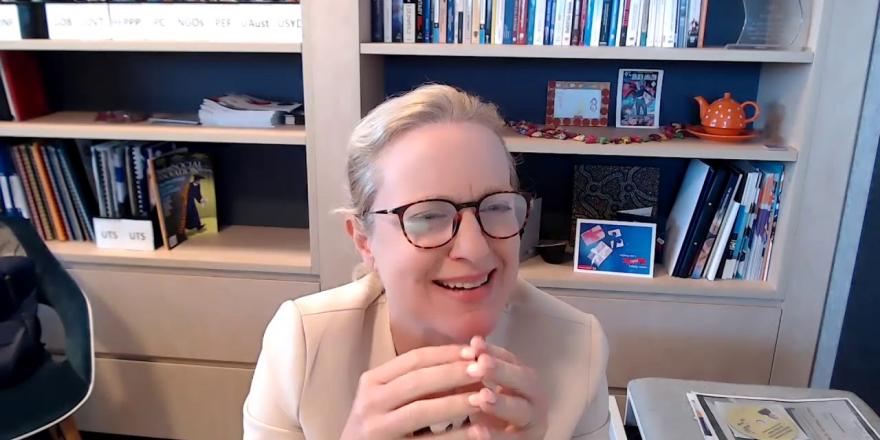
J33ZjlZpLrU

Descriptive transcript

Thank you, everyone, for joining us here today.

Before we begin, I'd like to acknowledge that while I'm meeting on the land of the Gadigal people of the Eora Nation, it's the land where this university is built, and I want to pay respect and extend that respect to Indigenous Elders past, present and emerging, particularly for their custodianship of knowledge for this land on which this university is built.

My name is Verity Firth. I'm the Director of Social Justice and Inclusion here at the University of Technology Sydney, and it's my pleasure to introduce and to be joined today by the brilliant and distinguished Randa Abdel-Fattah, who I'll be introducing properly in a moment. But that's the book that we're going to be talking about today, so have a good look at it. I absolutely loved it. It's fantastic.

Before I introduce Randa, I've just got a couple of housekeeping things to talk to you about. The first is that the event is being live captioned. To view the captions, you click on the link in the chat and you can find it at the bottom of your screen in the Zoom control panel. The captions will then open in a separate window.

There will be an opportunity to ask questions during the event. If you have a question, you'll see there's also a Q&A box. You can click on that box, type in your question, and you can also upvote other people's questions. To be honest, I tend to ask the questions that have the most votes. I take a pretty democratic approach to it, so you type in your question there and you can also vote for the questions you'd particularly like Randa to respond to.

This month, Randa released her newest book, titled "Coming of Age in the War on Terror". It's the first book of its kind to deep dive into the lives of the generation born after the 9/11 attacks. Now, for a lot of us here online today, we probably remember the moment in time—where we were and what we were doing. It's a marker in our history, delineating global politics and events into a before and after. But for the generation of young people that Randa interviews in this book, there is no pre or post; they have lived their entire lives in a world at war with the war on terror, post-9/11.

That means growing up in a context of widespread Islamophobia, surveillance, suspicion and fear. It's also a time in which we've seen the far right gain traction, public discourse in a number of well-established democracies—such as England with Brexit, Trump in the US—and a deepening polarisation of politics is becoming more and more the norm.

In the opening of your book, Randa, you note that the majority of students you work with, the high school-aged students, don't consider themselves political. Randa notes that this aligns with research showing that young people tend to consider "political" to mean parliament, political parties or electoral processes, rather than everyday issues. But what this book makes really clear—and probably the thing that spoke to me the most—is that young people are deeply invested in the political. They may not think they're political, but they really are, and they've got deep thoughts about the political, yet they're almost completely missing from the public dialogue.

This book rectifies this. It places young people at the heart of a treatise on racism and Islamophobia post-9/11, and it particularly looks at the distinctive nature of Australian racism. I really enjoyed this book and I'm therefore delighted to be properly welcoming Randa to this webinar.

Randa Abdel-Fattah is a multi-award-winning author and postdoctoral research fellow in the Department of Sociology at Macquarie University. Her books include "Islamophobia and Everyday Multiculturalism in Australia". She also serves on the editorial boards of Journal of the Contemporary Study of Islam and Continuum: Journal of Media & Cultural Studies.

Randa is also a lawyer and a prominent Palestinian and anti-racism advocate. She's the multi-award-winning author of 11 novels—published in over 20 countries. She is co-editor of the anthology "Arab, Australian, Other" and is currently adapting her best-selling novel "Does My Head Look Big in This?" into a feature film. As I mentioned before, Randa's latest book, "Coming of Age in the War on Terror", has just been released. If you're interested, we're going to post a link in the chat and you can click on it and purchase the book. So it's like a book launch, except it's a virtual book launch, so you can go and click on the link.

So, welcome, Randa.

Thank you so much for having me.

No worries. We're going to have an opportunity for Q&A, but I'm going to ask you some questions first.

Your book begins by boldly declaring that Australian racism is profoundly linked to the unfinished business of Indigenous sovereignty. I thought it was a really beautiful way to start the book and I just thought you might be able to expand on this concept for our audience, and how this concept of Indigenous sovereignty impacts on the issues that you explore in your book.

Yeah, so of course I was quoting Aileen Moreton-Robinson, the distinguished professor, when I was talking about that quote. The reason I was setting up the scene there is that I start by looking at the massacre of 51 Muslim worshippers in New Zealand by Australian Brenton Tarrant in March 2019. What fascinated me and frustrated me about debates at the time was how suddenly the conversation was that this man was aberrant, he was an anomaly, he was fringe, and he was not one of us. "This is not us," that was the rhetoric. Of course, Indigenous people were coming out, like Chelsea Bond, saying actually race is foundational to this country and to this nation, and it is very much part of the intrinsic structure of this nation's base. So to say that racism is something that is somehow on the fringes is to go against the very history of this nation.

So what I wanted to do there was trace how a person who was 28 years old could commit such a terrorist crime and to link it to the war on terror. Aileen Moreton-Robinson has an incredible article about sovereignty and about the war on terror in her book. She talks about how the anxiety over dispossession, the anxiety over having stolen from you what you stole from others, is what characterises this white patriarchal anxiety that fuels race in this country.

So what I was arguing was that somebody like Brenton Tarrant has grown up in the war on terror, where we have seen in the name of the war on terror Muslims being killed globally. That has emboldened domestic terrorists to then see Muslim life as game in a domestic context. We cannot ignore the fact that what has been enabled and allowed on the global scale in the name of the war on terror has inspired and emboldened white supremacist terrorism on the domestic front. This is what's missing from the conversation, which the apologetics of this being a fringe crime was covering up.

And it's interesting because that theme of tracing the history of Australian racism—you also in that opening chapter talk about the vagaries of racism, how racism actually moves from one form to another, ignoring logic or contradiction. The example you give is Pauline Hanson, who railed against Aboriginals and Asians in 1996, and then used exactly the same language to substitute Muslims into the same dialogue a decade later.

She went from Asians to Dancing with the Stars to Muslims—opportunistically. The projection.

So are we in the same pattern with 9/11, or is there something intrinsically different about this time from other periods of history? Is this going to wash over us and move on to another group of people, or is there something intrinsically different?

No, see, when I started my activism as an anti-racism activist, that's what really fired me up. But after 9/11, I fell into the trap of fighting racism and Islamophobia post-9/11 and all that was happening in the Muslim community on the logic that this was our turn. So what we had to do was explain ourselves, counter the negative stereotypes and misconceptions, provide the correct definition of jihad and explain why we aren't a problem. When I came to my PhD to look at Islamophobia and race from the point of view of perpetrators, I realised very quickly that understanding Islamophobia only from a position that we are a problem people was the wrong way to go about it. I had to understand what race means in this country and then the racism that is expressed against all other minority groups, which takes on its own nuance, but then it can be understood. That's why I always start back to what is the foundational injustice of this country. Of course, all of my knowledge has come from understanding race and racism from the point of view of Indigenous people. That's why that article—that book by Aileen Moreton-Robinson—really helped me understand the Muslim problem in Australia by tracing it back to the roots of anxiety over dispossession and of having stolen from you what you've stolen from other people. The fact this is happening on stolen land was the elephant in the room.

So I think that it's very tempting for us to think that 9/11 was this watershed moment, but first of all, that also erases the experiences, for example, of black Muslims, who have always been visible. 9/11 rendered the Muslim population visible and a problem people at large, but that also ignores the fact that there was a greater issue of race at play in this country for Muslims as a minority population.

I think that it's really important to make those connections when we talk about race. So we understand that 9/11 was in some ways a watershed moment—it launched the global war on terror—but it was an extension of empire, an extension of Western imperialism. I think that's constantly missing in our conversations about the war on terror, and it also accounts for why we fail to understand, in terms of policies and political discourse and media debates, the conversations we have about radicalisation, the conversations we have about terrorism become focused on the individual rather than state terrorism or global terrorism in the name of national security.

In your book, you talk a lot about the policies that governments implement around the anti-radicalisation of young people and the different programs that they seek to roll out into schools. Can you elaborate a bit on that, about why they're so problematic and not particularly effective?

Yeah. The thing about a lot of the policy frameworks is there's such a lack of transparency about which schools they're applying to, what kind of training is going on. We do know that with some of the programs, and in particular some of the policy frameworks, they are implemented in certain schools based on Muslim populations and the numbers of Muslims in those schools, but there's a lack of transparency about that. That's why in the book I try to forensically analyse these policy documents, but also acknowledge that we actually don't know how they're being implemented in schools, who are the subjects of these policies, and that's a real problem in and of itself.

In terms of the millions that's been poured into grants programs working with young people since the problem of "home-grown terrorism" emerged and the way that Muslims—these grants programs, most of the students I spoke to had no clue that these grants programs or policies existed. It was not something that was under their radar at all. The point for me is that they are material practices in the war on terror. There is a cumulative impact and there is an effect and impact that these grants and programs have in terms of reinforcing the perception of the Muslim young person as at risk, as a problem community, as a group of Australians who are future risks of attack. So they need to be civilised into adhering to Australian values, they need to be schooled in Judeo-Christian values, whatever that means.

There's a long pattern of this. A lot of us have forgotten this has happened, where it was very explicit, particularly in the Howard years. If you look at even the press releases around a lot of the grants programs, they were programs that introduced sports into schools, into community groups, working with media, music, media training. But the way that they were represented officially was always that they were targeting at-risk youth. Now, there are so many huge implications of racialising an entire community as at risk, as inherently on this conveyor belt to being radicalised, but also to think that there were parents who sent their children to these programs not realising that they had been officially labelled as at risk is, again, there is an effect long term, at least in the collective imagination, that young Muslim youth, particularly young Muslim boys, are potentially vulnerable to radicalisation. And again, even the word radicalisation is fraught and meaningless.

In fact, one of the things that hit when I was reading all of that was about when you actually talked to the young people, actually talked to the young boys, young girls, none of them put up on their list of concerns their impending radicalisation. They all had just the normal teenage concerns of any young person. This is basically what your book goes to great lengths to tell—to put their words and their voices into this issue. Can you talk a little bit about the project you did with students using the Childish Gambino song "This is America"? Because I thought that was very powerful.

Yeah, definitely. I also wanted to raise, for example, one of the students—going back to that point I made—his main issue for me when I asked him about the war on terror, he said to me, "I'm not afraid of terrorism, I'm afraid of being accused of being a terrorist." That hit me so hard. Another student had absolutely no idea about any of these policies, the war on terror, in terms of he didn't pay attention, his life was soccer, he just loved soccer. But he said to me when he goes and plays soccer in the local park, he wants to play with anyone who will play with him and sometimes he tries to put on a good act so that people don't assume—because he says, "I look Muslim", he had the beard—and he said, "I have to try to look a certain way so they don't think I'm like those people on TV." That for me was profoundly sad, that he'd internalised the idea he'd be suspected or perceived in a racialised way, and that in itself was affecting the way he was behaving. For me, these are the things that I'm looking at—those quiet moments where young people have internalised these expectations and stereotypes.

So I was sitting in the car on my way to a school—I had arrived early—and Childish Gambino's song "This is America" had just dropped and I was listening to it in the car, absolutely mesmerised, I loved it, was watching it on repeat. Then I felt there was a lot to work with in this. So I experimented with the class that I was going to speak to and I got them to watch it and then on the board I asked them to workshop with me: what if we were to create our own song lyrics, not "This is America", "This is Australia"? I got them to start thinking about what does Australia mean to you, how is it represented, what are the common myths, what would you like to see improved?

Mind you, this is a class where most had said, "I'm not political", "Politics, I hate it", "Oh, politics is voting." That was the extent. Then they produced these remarkable poems—the sarcasm, the wit—they are just scathing and so incisive. The time I was conducting these workshops was around the time of the plastic bans in Coles and Woolies, and it was also the time that Scott Morrison had taken over as Prime Minister, so there was a lot happening. That was also very important to me to see, because I've run this workshop over a long period of time now since then at different schools, and it's really interesting to see how what's happening filters down into these poems.

Yes, and I'm going to read one of them because it is true, everything Randa is saying is true. All the kids went, "We're not political", and every poem is like a searing indictment of Australia. This is one of them by a young boy called Nick: "This is Australia. We're not really nice to Aboriginals. The Queen is our God. We really enjoy alcohol, unjustifiably patriotic. Tony Abbott ate a raw onion." They're all as hard hitting, but you're right, cheeky and witty as well.

I think on your previous point it also shows, I suppose, the depth of understanding. People always assume young people don't understand what's going on. Even when you talk about the internalising of those messages, they do understand what's going on.

That was something that was very important, as somebody who has been an activist for so many years now. I started in high school, in 1992. I came of age at the time of the first Gulf War. It directly impacted me at school, attending Islamic school—vandalism on the walls, constant graffiti, "Go back home, wogs." This was my teenage years. That was my principle of activism.

I also realised change is slow and young people also need to have confidence that their small, informal acts of protest—the small gestures they make online, for example, refusing—I had one student who said, "I'm not political", but proceeded to tell me he refuses to read the Daily Telegraph. I thought that act of refusal is a conscious political act. It is withdrawing your attention, withdrawing your business—your consumerism—from a media empire, and that in itself should be lauded and celebrated. So when people understand that the way you curate your social media, when they have confidence in those small informal acts of protest and realise it doesn't have to be spectacular, they can understand these are the sorts of things that quietly mobilise a mass force to reckon with, and it takes time to do that. All of us would love for it to be quicker, but we have to do what we can with the resources and the talents that we have.

So that's what I was trying to do with young people—to get them to realise these small acts they're participating in are just as important politically as casting your vote when you turn 18.

So throughout the book you talk about how governments on both sides of the political divide introduced and backed policies that were designed to identify and prevent extremism in Australia, and of course this led, as we all know, to increased surveillance and policing of people's lives down to the colour of their tights, which is one of the examples you use. Could you give us all some insight into how this played out in the community and at everyday level and the sorts of impacts the young people you talked to felt?

One year in particular that stood out as particularly difficult for the Muslim community was 2015. It was after the horrific murder of the police accountant Curtis Cheng in Parramatta and a raft of new policies that were introduced by the NSW Government then, particularly directing it at schools, and also ramping up the rhetoric about home-grown terrorists and radicalisation among younger populations. The way that this collectively projected the idea of an entire young Muslim community suddenly even more at risk and needing to—being cautioned to look out for warning signs as though there was a checklist that you could just tick off, and as though race had nothing to do with it.

In terms of how this impacted young Muslims, the people that I spoke to—there was one boy who said to me that there was an incident at his school, it was in the media, and so him and his friends had to change the route that they took to get to school because they would be mobbed by the media, by the cameras.

It played out differently for girls who wore hijab. Parents felt worried about their girls catching public transport. They'd make changes to their work schedule and drop the girls at school. It squeezes space as well and mobility for young hijabi Muslim girls, because suddenly they are, as we know through empirical evidence, the first people on the frontline when it comes to hate crimes—Muslim women wearing hijab. I spoke to girls who wear hijab, students who had actually been attacked.

So immediately there's a community who feel under siege, who start changing their behaviour, their patterns. For me it was just shocking that this has to happen to 13-, 14-, 15-year-old kids.

Another impact is—the way that this also has a chilling effect on young people in classrooms who suddenly feel all eyes are on them to explain, to be ambassadors for an entire community, to explain the actions of an individual as though they somehow bear a culpability for those actions. They're 15, 16. That's not the world that they live in. Suddenly they have to get on top of politics and geopolitical nuances. For me that's trying to understand the pressure on them in that sense.

There was a wonderful interview you made with that young woman who was saying she started to study up and learn everything about the entire history because she felt such a sense of responsibility. You thought what a wonderful young woman, but also, you're right, why is she bearing this entire responsibility on her shoulders?

She borrowed Edward Said and tried to read it. She could not make sense of it at that age.

So getting back to that—I think this, because the next question I was going to ask you is about the chapter you write about class and geography and where people feel safe. I think that relates quite nicely to what you just said about how when you're not feeling safe, there was one story you told of a girl whose family moved from the Hills District to south-western Sydney because they actually wanted to be in a place where they felt safe and she could be herself and probably not have to feel she had the whole world on her shoulders and explain to everyone in her class and be the sole representative of Islam.

So talk a little bit about what you discussed in that chapter about the overlay of class and geography and also what this means, because basically it's everyone retreating into their own spaces. It's also Anglo-Saxons retreating into their single-sex private schools as well. Talk a bit about that.

Yes, and Christina Ho, academic at UTS, looks at that in her research on selective schools and the way that race plays out in schools. What I found—and it's always lovely to be a researcher and to go into your research and be surprised by something or go in arrogantly expecting something and then being totally turned around.

What I found very quickly was I could not assume this master category of Muslim, that every Muslim young person would be thinking the same thing and feeling the same thing. Instinctively I knew that, but I still felt they'd all have this sense of being furious about the politics of the war on terror and equally be experiencing the impacts of it.

But what I found quite quickly was that class and gender, of course, had a massive impact on how the war on terror was experienced. So I found, for example, that a Muslim student in a private school in the Hills District of Sydney had more in common in terms of their experience of the war on terror with their non-Muslim peers at that school than they did with a Muslim student in south-west Sydney. Those lines were very quickly drawn, that the war on terror was clearly being waged differently according to these landscapes and racial geographies, which makes sense given the paranoia and moral panics around Western Sydney and what's been happening for a long time in those schools.

So that definitely had an impact. People who were growing up in, say, schools in Bankstown or Greenacre or Punchbowl understood what it meant to feel the burden of being securitised, to have police as a regular guest speaker at your school, to be constantly seen as people who need to be moved away from this potential path of radicalisation, whereas the people I spoke to in suburbs in the eastern suburbs and northern just had no clue about any of this. Some of them didn't even recognise some of the key moments, the shooting of Curtis Cheng. It was just a headline they might have paid attention to because they hadn't experienced the counter-terrorism raids, hadn't experienced the community grants projects that were directly targeted at them. So that certainly was surprising for me.

The other thing I really wanted to dig into is your critique of the Australian curriculum and that was particularly damning. In your book you talk about how of the 102 prescribed texts for the NSW HSC curriculum, only two are authored by Muslims, and the list of top 15 books includes no texts by Australian women, no texts by migrant Australians, no texts by Indigenous writers, let alone Muslim writers. So the sort of homogeneity is pretty stark.

But the analogy or metaphor that I thought was brilliant that you used was you talked about your son doing a puzzle, creating the frame first and then filling in the detailed pieces afterwards, and you say the frame is the whiteness—the frame is the whiteness of the curriculum—and it doesn't matter how many diverse or inclusion pieces or bits you throw into the middle, the frame, the master frame, remains white.

Because of this, you write quite movingly about how a lot of the young people you spoke to stressed about how much they relied on teachers to set the conditions of school as a safe space and how much they wanted teachers to creatively deviate from the constraints of the curriculum and open up new and critical routes of learning and discovery.

So I really wanted to talk a bit about this because it's such a critical part, I suppose, of the work that we also do at a university—how do you make sure that the truly diverse or true knowledges are being taught to our young people?

Yeah, I mean, what I'm effectively talking about is revolution when it comes to our education system, and of course I'm not the first to say it. My work is deriving and building on what Indigenous scholars have been saying for a long time and still saying that, and also referring to the work that's done in the UK and the US—this idea of the white master script as Ladson-Billings talks about.

So it's this idea that everything is referred to this white ways of knowing and histories, and if you do get included, it is done in a tokenistic way or it's an add-on. It's never respected in and of its own right as a knowledge system in and of its own right. It's always in reference to the core central white paradigm of knowledge.

It's not just about the lack of—for me it's staggering, those statistics—because when we have curriculum, for example, the Australian curriculum, which explicitly talks about the need for young people to be Asia literate, and then you have the majority of Muslims in the world living in Asia, and then you have a curriculum that has these lofty goals, but it's not translated into what young people are actually reading and being exposed to.

In fact, it's even more insidious than that. There are texts that, for example, in the K to 10 curriculum of prescribed texts, English texts, and there are three about Afghanistan, with Afghan characters, but written by white writers, and then they're mapped on explicitly to this goal of intercultural understanding of Asia. It's not even that it's something that is an afterthought, it's actively using white voices to speak for people of colour. So there's so much work that needs to be done.

But going back to the young people and how they experience this, there's a lot of different ways. Like you said, it leaves to chance a teacher who is actually going to have the time and the resources—because let's face it, we're talking about people, human beings here, who are juggling a lot on their plate as teachers, probably the most overworked profession—who actively then have to go and write a new curriculum.

I'll give you an example: when my daughter was learning about the Dark Ages in Year 8 and I was speaking to her teacher, who I know very well, and she said, "Do you want to come in and do a lecture about the Dark Ages but from the point of view of the rest of the world, which was actually in its lightest time—the Golden Age?" I came and spoke to this class. It took me a long time to write that material, but what was so frustrating for me and sad at the same time was that I was giving this lecture to a class of Year 8 students at an Islamic school—Pakistani background, Bangladeshi, Lebanese, Egyptian, Palestinian, as many ethnicities as you can get in one class—who had no idea about their own histories and heritage, who had no idea about the depth of history that has been denied to them.

So this curriculum not only distorts what white students are learning; it deprives people of colour, young students of colour, of their own histories—something they can take pride in and give them a sense of identity as well. So I think there's so much to work with.

Another impact of this is that young people, particularly when you talk to Muslims about the curriculum that they're exposed to when it comes to talking about the Middle East or 9/11, they feel this responsibility to compensate for these gaping holes in the curriculum, to fill and plug these gaps. That's a lot of responsibility on a young person.

For me what's even more poignant about this, it assumes students are already comfortable with the idea of being a young Muslim. Many of the ones I spoke to said, "I feel that I have to come to terms with my Muslimness because of what's happening around me. I still don't know what it means to me." "I'm not a religious person," for example, one person told me, "but I feel I have to be the Muslim spokesperson in the classroom or talk about these issues that I really have no idea about." One girl said, "I like fantasy novels, I hate reading about history and that." But after she did a class on 9/11, she felt this responsibility to go and learn about it.

So that's not their job to teach their teachers and other students. That's the job of an education system that's actually responding to what's happening now in real time in a New South Wales context to a significant portion of the population.

Yes. And it's the thing, they keep saying we want people capable of critical thought and creativity. Well, you need all of the actual history of the world to be laid out in its complexity and nuance for you to be able to do that.

I'm going to move on to audience questions in a minute because we have a number over here and they're all building up, but I know I spoke to you yesterday about this, but there's this amazing research out of Harvard where they talk about how is it that you basically build anti-racism in young people, how do you actually get this working properly, and they see two significant ways to do that.

They talk about diversity of cohort, where they say it's actually really important that you get to know people from all different backgrounds—something that increasingly we don't do in Australia, as everyone retreats into more segregated schooling, as we talked about before with Christina Ho's work. But they say diversity of cohort isn't enough. If you just have diversity of cohort and nothing else, that still doesn't lead to anti-racist attitudes. You've also got to have explicit instruction and teaching about structural and systemic disadvantage and the history that created that, and it's those two things that produce the effect. Either alone won't necessarily do it.

I just think a lot of what you're talking about speaks directly to that point, and it's also a role that we can play at universities—making sure that we have those diverse cohorts, but that we're telling people the truth about how the world works and what's happened in the past and what's happening now.

Absolutely.

So what I'm now going to do is turn over to the audience because they're all obviously champing at the bit to ask you some questions. In my typical way, I will start at the top where the person with the most votes gets the question.

Nilmini Fernando: Randa, could you talk to us more about the uses or differences of the term Islamophobia versus anti-Muslim racism?

Yeah, it's one of thos

If you are interested in hearing about future events, please contact events.socialjustice@uts.edu.au.

One of the students [I spoke with] his main issue when I asked him about the war on terror, he said to me 'I'm not afraid of terrorism, I'm afraid of being accused of being a terrorist.' That hit me so hard. Randa Abdel-Fattah

Speakers

Randa Abdel-Fattah is the multi-award winning author of 11 novels published in over 20 countries, including Does My Head Look Big in This? – currently being made into a feature film. Her new book, Coming of Age in the War on Terror, is available now. You can get a copy here.

Share