

• Posted on 28 Dec 2020
  • 3-minute read

Grab your lab coat and goggles – it’s time to discuss why it’s so important to communicate science to young children.
urAqxssbDlA

Descriptive transcript

When we want to encourage people into STEM, people tell me it's really the three to five-year-olds that matter most. It's at that time that they get most interested in science because they're curious. Science doesn't happen in a vacuum, and kids are the future of science. So we need to make sure that they stay engaged, and to keep a pipeline of not only interested people, in terms of science being so integral to modern life, but also building that next generation of scientists.

Everybody's got some curiosity somewhere, and whatever your field or interest specifically, there is something scientific. There's an interesting question to be asked. You only have to listen to some of the questions that children were producing today, just from the top of their heads. It's great to see that when there's that diversity of questions, there's also that diversity of curiosity and creativity to be found.

[Children speaking] Why do sharks eat humans? That's what I think.

That's a good question. Did you know that sharks don't really want to eat humans? It often happens when they can't really tell that it's a human, so they mistake you for some sort of other food. So most of the time we're okay.

Or a fish!

Exactly! They might misunderstand us for a fish.

I liked doing fingerprints, and we got all messy.

The coolest thing I learnt today was tasting the honey.

The coolest thing I learnt today is magnets—if they connect, then they take a long time and then they fall off.

I think girls and boys are awesome scientists.

Kids can't be what they can't see, so if we're out there, we're talking to kids, we're being more involved in the community, and really keeping that passion for science over their lifetime, then that will inspire more kids to come into science.

Because I want to be an engineer, and a doctor, and a scientist at the same time.

Science is fun!

Was it an awesome day? Yes! Give me a high five. Nice.

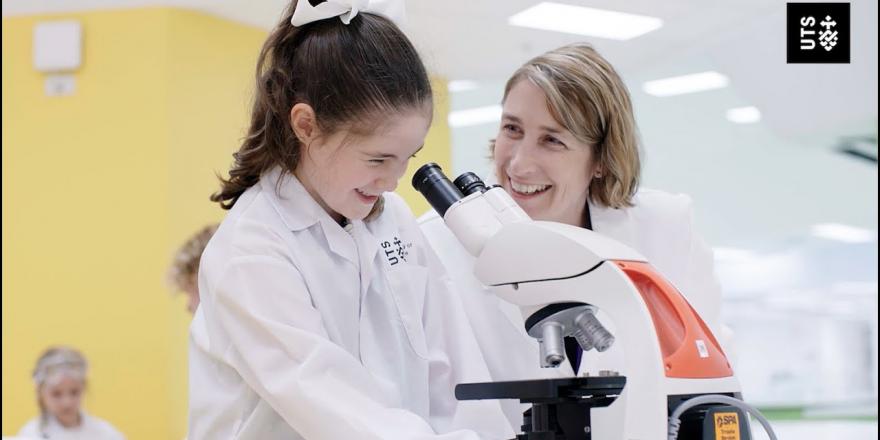
It’s an experience not many kids have - the opportunity to observe what scientists get up to in a world-class laboratory.

University of Technology Sydney (UTS) academics invited a group of four- to seven-year-olds into the Hive SuperLab to engage with research going on around campus.

The kids tasted honey samples with a microbiologist and pulled apart model eyeballs with orthoptists. They talked numbers with a mathematician and sharks with a marine scientist. And they asked questions in an almost endless stream.

Researchers say it’s never too early to get kids involved with science.

Continue reading on UTS Newsroom: Research for beginners


Share