

- Posted on 18 Nov 2020
- 52-minute read
The challenge that 2020 presented us forced us all to make significant changes in a very short period of time to the way that we work, live our lives and – crucially – what we expect from organisations, business and government.
What we have seen across the country throughout the COVID-19 pandemic, and the devastating bushfires earlier this year, is that a localised response has delivered for our community.
That response relied in large part on local government. Local government agencies are often the first line of connection and response in our communities. They are at the coalface – providing essential services, connecting community and groups, and engaging with vulnerable members of society.
Moving into the future, the digital role of government, trust in institutions, sustainability and climate action will play an increasing role in governance. Local government will be necessary to maintain a robust democracy that delivers for its citizens, fostering community resilience and supporting the most vulnerable members of society.
Local government also needs to be supported and acknowledged for the contribution that it makes to the resilience and wellbeing of communities across Australia.
Looking to the near- and long-term future, we asked a panel of local government leaders how can we ensure that our local tiers of government have the capacity to deliver for their communities?
This webinar formed the Australian leg of the OECD’s global conversations on ‘Government After Shock’. It was hosted by the Centre for Social Justice & Inclusion and the Institute for Public Policy and Governance.
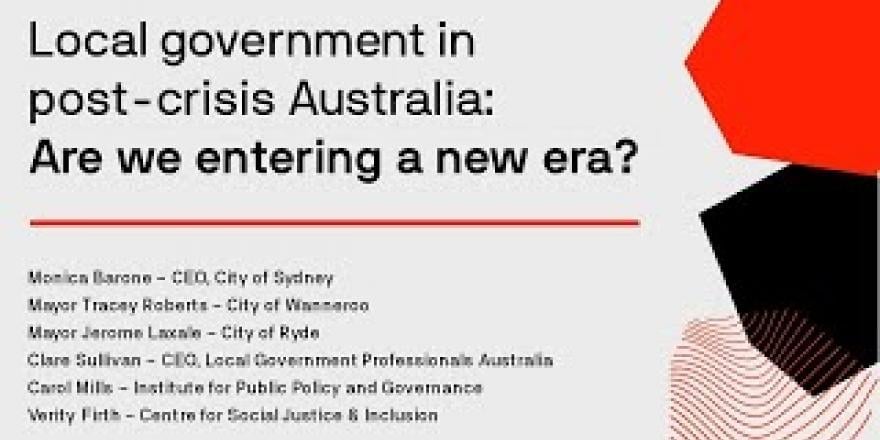
Speakers
Monica Barone – CEO, City of Sydney
Mayor Tracey Roberts – City of Wanneroo
Mayor Jerome Laxale – City of Ryde
Clare Sullivan – CEO, Local Government Professionals Australia
Carol Mills – Institute for Public Policy and Governence
Verity Firth – Centre for Social Justice & Inclusion