

- Posted on 26 Nov 2020
- 4-minute read
This week the Centre for Social Justice & Inclusion was awarded a Knowledge Exchange sponsorship by the City of Sydney to scale up a COVID-response digital mentoring program. The grant will allow us to expand the program from its pilot in our local neighbourhood, Glebe, to a wider geographical area, starting with the adjacent suburbs of Ultimo and Pyrmont.
Universities can have an immensely positive role to play in their local neighbourhoods. We are not only global centres of learning, we can also be local institutions, with a footprint in our local precinct and a responsibility to the people who make up our local communities.
UTS has a longstanding role in the Glebe precinct as part of the Glebe Connected project, engaging with community groups, individuals and organisations in the area to benefit the community through pooling our resources, expertise, build up community networks.
Our most recent project has involved meeting local needs through working with Glebe’s aging population, who have been at a heightened risk of social isolation throughout the impacts of COVID-19.
Moving online risks leaving people behind
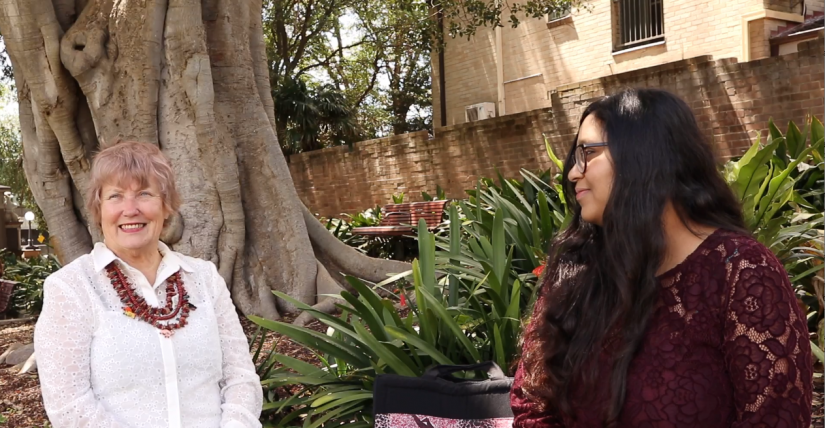
Jaz Stephens, who participated in our program as a digital mentee, says, ‘IT was in many ways unknown and secretive to me … my mentor Rusafa extends that boundary.
‘We might be looking at going from A to B, so we look at maps. We might look at ways to send email, management of digital photographs, and also how to search and find. As a result, my world has opened a lot. Put me with my computer now and I know where to go.’
Her mentor, Rusafa Rabi, says ‘I’m loving it … we have been doing this for two months, and I’ve really enjoyed the program. And I’ve learned a lot too. While the program says that I'm meant to be the mentor and I'm helping my mentee, at the same time I think I've developed so many qualities.’
When 2020 brought a global pandemic, many services and facilities made a rapid pivot to being provided online. Huge leaps in access to technology and online access have enabled many of us to maintain access to basic needs. But COVID has also exposed a digital divide for significant portions of the population.
This came to light earlier in 2020 in the work that UTS and others were doing as part of Glebe Connected. In particular, residents over the age of 55 were less likely to have had access or experience in accessing online services. Gaps in digital literacy were directly affecting social isolation for this portion of the population.
Simultaneously, UTS was embarking on another COVID response plan for their own international student cohort who were facing their own issues with lost employment, social isolation and uncertainty. UTS created a COVID response plan in March specifically to find and support students who found themselves in financial hardship.
The Glebe Digital Mentoring Program was developed to bring both of these groups together to provide mutual benefit, increasing digital literacy confidence and skill in older residents while offering income and experience for student mentors.
The Glebe pilot employed UTS International students as corporate volunteers for up to ten hours a week over three months to mentor people over 55 who needed support with their technological needs.
Building connections
Support included digital skills like checking email, creating folders, accessing MyGov, downloading apps and taking and storing digital photos. Where residents are undertaking digital literacy programs elsewhere, mentors can support and supplement their learning. But the program has delivered more than just acquiring new skills.
On the cultural exchange element of the program, Jaz says, ‘I’d never met someone from Bangladesh before – a cultural difference which is absolutely delightful. Along with learning useful skills, we’ve become friends.’
‘The thing that I’ve noticed is it’s about so much more than just acquiring digital skills, it’s so much about the relationships. Both for the international students who can also be quite isolated, especially at this time, and for the mentees – it’s about the relationship for them alongside acquiring the digital skills. Students are making connections with members of the population they may not have had access to before, with the potential for genuine friendships,’ says Bilquis Ghani, Social Impact Practitioner at the Centre for Social Justice & Inclusion.
‘We’re looking forward to expanding the program. This grant will enable us to reach more community members by scaling our footprint in the local area.’
Byline: Laura Oxley, External Communication Officer, Centre for Social Justice and Inclusion