

• Posted on 2 Oct 2020
  • 25-minute read

How to market your startup on the cheap

Great products fail often, because no one hears about them.

What can we do to make sure that word gets out about our startups? Or, even better, how can we get the message out to the right audience, while not spending money (which we probably don't have)?
oGwJIFu33F4

Descriptive transcript

Sharon: All righty, so just a little bit about Asendium before we get started, in case some of you don't know. We help financial planners reduce their compliance burden by up to 90%. We primarily work in the B2B space, although Scott has some experience with the B2C space. This presentation is mainly tailored towards B2B. I am the Creative Officer of Asendium and Scott's the CEO, and he's the one with the financial planning experience. So, the points we're going to be discussing today are how to craft your story, case studies and Google reviews, free PR and media, partnerships, LinkedIn marketing tips, and just some random tools and tips that may help you. So, the first one is craft your story. Turn your weaknesses into your strengths, and I'll let you take this one.

Scott: Yep. So, what we focus on, when you're doing a startup, you always hear objections. You hear you don't have this, your MVP can only do a select few things, or you focus on key pain points when you're starting your startup. So, what we found when we first started about 12 months ago was we had a lot of objections or assumptions or weaknesses about Asendium. For one example, maybe "we don't offer data feeds". So, what we did was we evaluated that as a weakness in someone's eyes, but it's a strength in someone else's. When we look at the bigger players within the industry where we work, they want to make sure that you're focused on data security and protection. So, given that we don't store any data, we actually started marketing our solution towards the bigger players. As a result, that got planners from those licensees on board with Asendium because we didn't have data feeds.

So, when it comes to turning objections and assumptions into content-rich articles, videos, and call-to-action banners—by this, what I mean is, 12 months ago, the first 45 minutes of a one-hour meeting would be objections, questions, assumptions about the product or service we offer. Fast forward 12 months' time. During those 12 months, we actually took those objections or assumptions or weaknesses and turned them into articles. Articles such as, "We don't integrate with your CRM, and here's why it doesn't matter." Through planners and customers reading about our negatives in a positive light, they actually reduced the amount of assumptions that we got in following meetings. So, over the 12 months that we've been operating, we saw objections and assumptions actually reduced to just one question: "I know about your product. How can you help me now?" And this is all through content and video. So, when we develop that, that answers a lot of questions before we even have to do it. And, Scott, use your customer feedback to your benefit. Sharon?

Sharon: Yeah, so you don't just have to use your own objections or assumptions as your marketing message. You can also use what you're hearing about your competitors as a way to craft your story. And this is an example. What we used to hear very often is, "They just don't get it," in relation to our competitors. A bit of context: all of our competitors are from either tech backgrounds or bankers or wealth managers, and very few of them have true financial planning experience, which is why the solutions they developed weren't right, and they just didn't get the problem. So, what we did was, we took that saying, put it out there, and crafted a story basically saying that we have deep industry experience, and this is why Asendium is unique and we've designed it with the financial planner in mind. Our goal is to turn "they just don't get it" into "they get it right every time with Asendium". I think from that message we had one of our users write a very lengthy email up to their licensee to push Asendium up the chain to the decision makers who can really make the decision on adopting Asendium through their practice.

Scott: Just adding to that, as Sharon just highlighted, from one planner seeing this post, crafted an email, sent it up to their C-suite, and the C-suite then reached out to have a meeting. Also, following this post, because it resonated with our users about what they're constantly complaining about or seeing in our competitors, it actually led to three meetings the next day for myself. And when I asked them what prompted them to reach out, they referenced this post because it resonated.

Sharon: Alrighty. Case studies and Google reviews. Why is it super important? Well, if you have no money to spend on marketing, the first thing you should be doing is creating social proof, and that is through case studies and Google reviews. It shows that people are willing to vouch for your product or your service. And one of the ways to do case studies is to collect key data points.

Scott: So, with these key data points, you have to understand: what does your consumer or customer relate to? What key points are they looking to pull away from your case study or Google review? For us, for example, it's about the time savings, the dollar value of that time, and the comparison on before using our software and after. So, there were four key data points. What we did is, we emphasised those four key data points to show a dollar value saving, a time value saving, and the impact to that business and the return on investment. All our case studies on our website follow that particular template. And what we find is that any planner that reads that template usually is actually very responsive because the case study resonates to how they receive information and what data they're looking for.

Sharon: Yeah, now an important thing is we have this case study that's on our website, where a planner is saving 85 days per year with Asendium and his overall return on investment is over 18,000%. We had a potential customer who had a meeting with Scott and he said, "Yeah, I read through all your case studies, but it just seems too good to be true. Are these real people?" So that made me think that if you are creating extreme value that isn't seen on the market yet, it can be quite sceptical if your case studies demonstrate that extreme value. So, one thing we would suggest is putting the person's LinkedIn, or Facebook, Instagram, or website at the bottom of the case study so that any potential customers can follow the digital footprint and verify the authenticity of that case study and Google review.

Right. Free PR and media outlets. So, this has been a new strategy that we've started to incorporate to help expand the brand awareness, and this has worked really well for us. The first thing we did was connect via LinkedIn to any key journalists.

Scott: So, what we did was we evaluated, "Okay, well, how does our consumer receive information? What are the media outlets that they read? What are the digital publications that they look at?" And once we narrowed those down, my job was to go connect with all the journalists and editors within those publications in the relevant sectors. For example, you may have the AFR (Australian Financial Review), and within the Australian Financial Review you have journalists and editors in the startup section or the finance section, and that's who we connect with. You wouldn't connect with real estate or political. And what I did was I would connect with every single editor and journalist in the relevant publications. I would then send them a friendly message. Now, this message was crafted purposely just for the PR. I would introduce myself, say we're a startup as part of UTS Startups and we're making great traction. I just want to share with you something we've done recently, and this would be on the back of a case study or an article. "I don't know if this is newsworthy for you, I just thought I'd like to keep you in the loop. Is this something that you would like to be kept updated on as we progress?" Now, once you send that, they'll either respond, "Yep, keep me updated," or they'll respond with, "Tell me more." You do have some journalists that don't respond straight away, but they'll respond once they see you in other publications.

Now, what I did with this was once I had one publication pick me up based on that message, I messaged other journalists as a follow-up a week later to let them know we've just been published in the Financial Standard, and here's another piece of information that we've progressed. So, I'm using the competition between the media outlets to actually get them to want to support us. And this plays into another impact on the marketing: free SEO. Google verifies trustworthy sources—Financial Standard, AFR, Daily Telegraph—these are all trustworthy sources. So, if you have a link from that website and that article onto your website, that is a free backlink from a verified source, and then you start to rank a bit better with Google. Plus, these articles go into the News tab within Google, which also then gives you further traction in the Google rankings.

So just by connecting with these journalists, sending a friendly message but not very regularly—just find one article once a month to send them—that's where the benefit is. Now, what they do is they have to pitch articles to editors daily. They have to have content daily. So you've got to remember that these journalists are very busy and they don't have heaps of time to go interview you for hours on end, go find sources and cite them. So, what we do and what Sharon does in particular, she writes the article for them. She finds the sources of information that are relevant to that article. And I say, "Hey, we're just going to announce this next week, but here's something if you want to get a jump start on it before us." And they actually take the content, they reword it and organise it, and then place it within the publication.

So, simply through LinkedIn, we've been able to grow onto multiple publications. And from that, we've been approached by Risk Info and interviewed, and on the back of the Risk Info article that went out, we're approached by Industry Moves, who's basically published our webinar. And on the back of Industry Moves, we're approached by Investment Trends about reporting. And then on the back of that, you can see how it creates a domino effect because you're creating a brand around your business. And this was all for zero dollars.

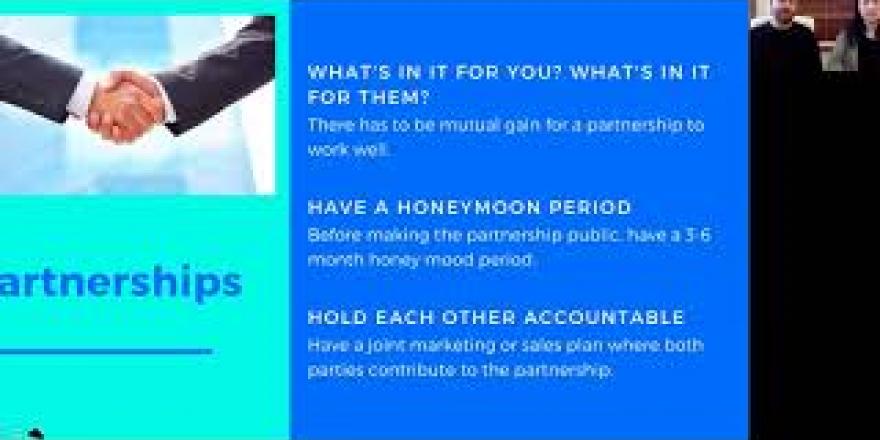
Sharon: Right. Partnerships. At the start of our journey, which was about a year ago, we were excited to sort of get our product out there in any way possible, and we would do a lot of partnerships. And what we found is that the partnerships can sometimes be a one-way street where we would be doing all the promotion for them, we'd be sending them leads, and we wouldn't receive anything in return. So, if done right, partnerships can be a very powerful and obviously very inexpensive tool for a marketing strategy. What you need to consider is what's in it for you and what's in it for them, making sure that there is mutual gain in that partnership.

We recommend having a honeymoon period before making it public. Maybe have three to six months where you're sending each other leads. You may send the partner to your select few trusted customers and get feedback from them, making sure you're providing the same sort of service and you've got the same mission. And another thing is hold each other accountable. So, have a joint marketing or sales or distribution plan where you're both contributing to growing each other's brand. Anything you want to add to that?

Scott: Yep. You've also got to be aware that some businesses may see you as a small business and may see that as an opportunity to get more clients without rewarding you with clients or rewarding you with sponsorship or promotional brand awareness. So, we found this out and we have a very structured approach now. We have one document marketing strategy plan, which is for six months with them, which they have to agree to. We let them know upfront it's a six-month trial period if it's unsuccessful on both ends. And basically, we make sure that we hold them accountable as well as ourselves. So, it's about having a structured business arrangement. Yep.

Sharon: Alrighty, LinkedIn marketing tips. So, native sharing is better than resharing. What I mean by this is if you have a LinkedIn company page and you've posted on that, instead of resharing the company page from your personal, just literally copy and paste that exact post onto your personal page and share it that way. It will rank better. Thank people for engaging with your post. So, if someone's liked or commented on a post, just go back and go "@Scott thanks for following" or "thanks for sharing". It will promote re-engagement and revisits to that post. Thirdly, be strategic with your connections. Scott is the LinkedIn connecting guru and I think you've got some really great tips.

Scott: So, if you're working B2B or even B2C, you can target the specific customers that you want to achieve. For example, I wanted Asendium to work with BT Financial Funds Management. So, what I did was connect with over 2,000 people at BT on a daily basis, throughout over a few months period, because you have a cap on daily. And from there, what I'm doing is I'm connecting with people because not everyone may be active on LinkedIn, not everyone may be a water cooler talk in the office. So, if everyone's connected with me, when I share a post, everyone within that business will see it. And from there, when someone goes, "Hey, have you heard of Asendium?" because I've connected with someone recently, they may go, "Yeah, I actually connected with them recently." And what that does is create a talking point for those two people to go, "Wait, these people are everywhere!" And so, what I'll encourage is connect daily, connect with everyone within a business. By this I mean from the receptionist through to the CEO. If you want to access a particular company, connect with everyone so that everyone sees your content.

A small example is our advisory board. We wanted to find angel investors and PE, so I connected with over 500 PE and angel investors. And from there, I had one of them reach out to ask what can he do for me or what can I do for him, and now he's the chairperson of our advisory board. I needed a tech specialist within our business. I connected with CTOs all across Australia. I had one of those CTOs from The Star, and also handled AMP, ING and ANZ with 500 employees. He's now on board as our tech advisor. So, LinkedIn is a very powerful tool, not only to build your advisory board but your sales channel. And follow influential people. I'll let Sharon talk about some of the people that you should follow for free templates.

Sharon: Yeah, so there's some really great people on LinkedIn that offer free templates, whether it be financial modelling templates or cash flow analysis templates, or even right down to information about SaaS metrics that you should be collecting. Follow those people because that content is fantastic and it's free. One person that I follow in particular is Dan Martell. He gives away fantastic templates, and it's not templates he creates. It's templates that he's gotten from VC funds and successful SaaS businesses that he coaches.

Scott: I'd also suggest Neil Patel for marketing strategies on YouTube. And if you're new to sales as you're trying to sell your product and you're just starting out, I would suggest following Dan Lok on YouTube. Great introductory sales tip, and then you can evolve and build upon those tips as well.

Sharon: Alrighty, so just some random tools and tips. So, a free way to create product demo videos is through Zoom screen share and record. So, what we did was we would log into our website, we'd screen share that and go through as if we were the customer. We then export that as a media file and put it into iMovie. Then I put in a Canva banner, did some fade in fade outs, exported that as a video file and then put that on our website. From that, and from Scott connecting with the entirety of a business, once we posted that, about two months later we got an email from the operational manager of a mid-tier licensee who wanted to find out more about Asendium. And in that meeting, she told us that planners had seen the video via LinkedIn and were pushing it up the chain for her to have a look at.

Secondly, if you want to access free images, there's Pixabay and Unsplash. There are some really great ones there. We also recommend doing Google Search Console. So, that's just a code that you can get from HubSpot. There are two codes: one you put at the top of the header of each web page and then a second code you put at the top of the body of each web page. It gives you a monthly report on your top performing queries and how people find your site. And this will help if you want to embed those keywords into your website and use it as article content.

Next is create short animations. So, you can do this by downloading icons from Canva with a transparent background, putting it into PowerPoint and animating it, exporting that as a media file, drop it to iMovie and add some fade in fade outs, whatever you want to do and you've got a short animation.

There are some really great free iPhone apps. We recommend using Bitmoji, emojis, memojis to create fun and light-hearted content. It's a great way to soften the salesy approach if you're doing call to action banners. Also, Enhance is an iPhone app where you can change the sizing of your image to suit Facebook and Instagram or Twitter, and you can add wording on there. So, if you're on the go, you can definitely use that.

Lastly, it's to tag your article. So, make sure you put in short tags, short tail and long tail tags at the bottom of your article so that when people search these terms, your articles pop up and that's how they'll find you.

And lastly, if there's any Q&A.

Dave: All right. Far out. Emma, have you got any questions at this point? I'm just going to search the chat.

Emma: Mine's more of a statement. It's not even a one-dollar marketing budget. That's a zero-dollar marketing budget. Because that was a zero-dollar, but this was just overwhelmingly exceptional. If you had to, of all of the things that you have shared, just choose one. If you could only do one of those things tomorrow, which one would you prioritise? Which one would you do? I know which one I'll do.

Sharon: I'd do case studies. 100 percent. It's a great way to show, firstly, the customer segment and how you are solving the problem and the value that you add to your customers.

Scott: My one thing would be LinkedIn. I've spent the last year and a half connecting maximum daily. I'm just over 10,200 connections and of those connections, 7,000 are our exact target market, and there's 21,000 financial planners in this country. So, whenever I do a post or share the case study, it reaches one third of our entire target market.

Dave: You're really leveraging all of these tools and playing to the limits that they set so that it works for you, which is fantastic. How much time do you guys dedicate to the whole strategy side of your marketing plan?

Scott: We have multiple areas. Sharon does a lot of the content creation and I'm focusing mainly on the LinkedIn side of it. On average, I spend probably one to two hours a day on LinkedIn. That's replying to comments, engaging, connecting, replying to messages and sharing content. Sharon's full-time job is Google reviews, content creation, short tail, long tail, researching hashtags for relevant posts. Hers is a full-time job. The LinkedIn is about two hours a day max.

Dave: Wow, that is so cool. Going back to when you guys first started Asendium, I know that you pivoted out of a different idea, right? Or like you were sort of doing different things and then you saw the opportunity for Asendium. When it was in the early days and it was still just a concept, how did you find the motivation to just cold sell and get out there?

Sharon: Oh, you'd be a good one to answer that.

Scott: So, being an ex-financial planner myself, I knew the time burden to deliver a single piece of advice had gone from 10 to 20 hours all the way up to 40 to 60. So, basically planners could only see one client a week. So, I knew that there had to be an easier solution on the market. And after speaking to all our competitors over three and a half years ago, they all said they weren't going to focus on the pain points. They were just going to focus on the financial data collection, which is not the pain point for the planner. So, we actually, on the back of Sharon's suggestion from the MBAe, pivoted our existing manual processes into a tech solution. Then we spent a year developing content, interviewing planners, auditors, product providers, clients, underwriters, financial planners to understand how they convey information, document information and receive information, because that's just as important. Then we built that content library into a tech solution with code and logic. And now we've made it so that this code and logic is easily replicatable so we can customise to any individual planner or company.

Sharon: In terms of your question about how hard was it to get out and start cold selling, I think from our financial planning experience, we had a lot of friendlies already that we knew. So, it wasn't like we were starting from scratch in a market that we didn't know and we had no sort of connections. So, we definitely had a couple of friendlies that saw our vision, were on board and they were able to speak to people in their network and that's how we sort of grew. Also, with financial planning and I think a lot of B2B, incoming or inbound customers is better than if you go out and cold call. You'll get a much warmer response that way. So, we focused heavily on acquiring customers and getting them to reach out to us, and that was through relationships and making sure we gave exceptional customer service and we answered all the objections and assumptions before they even get to the salesperson.

Scott: So, 73% of tech adoption within the financial planning industry is from peer-to-peer referral. So, given that is the biggest source of getting new clients, we focused on our early adopters. Basically, the first seven months of operation, it was very slow—we only hit like 10 businesses over that time—but since May this year, we've had a month-on-month growth of 25% each month. And with this trajectory, we're looking to capture our market share that we wanted to achieve by the end of the year. And that's just from peer-to-peer and the content that Sharon's created to answer all the questions.

Dave: That's incredible. I mean, at this point, I think what we just got from you guys for free in the last 30 minutes is just... I mean, you've really given us the roadmap of how to start a business, which is so valuable and we're so appreciative. I know that you guys do a lot to give back to the UTS Startups community. And again, we always have grown and learned a lot. I mean, even when you were talking, I was just slacking my co-founders about like a bunch of stuff and we're going to have a lot to go back over.

All right, as there are a lot of people on this chat, I think we should say thank you on the outset for just delivering so much value in that short amount of time. Emma, have you got any other?

Emma: Just a big, another thank you. Round of applause, everyone—digital, physical, otherwise in the chat. Next Thursday, because they are incredible finalists in the Best UTS Startup Established Stage category. Did I get that right, Sharon?

Sharon: Yeah.

Dave: And when is that day? What are the details?

It's exactly a week from now. We're going to be setting up and we're going to be almost there. So, in a week's time. And I don't think it really matters whether Asendium win that startup award or not. But yeah, guys, I wouldn't hate for you to miss Thursday night Startups Awards. It's going to be very, very cool. And again, all of the stuff that's happening in the festival and including this talk and everything that we're going to record and post is going to be at startupsfestival.uts.edu.au. So, jump in there.

But again, Scott and Sharon, do you have any last little tidbits of advice for everyone listening? A lot of our founders we've seen, you know, early stage. Have you got any advice for those sorts of people?

Scott: Yeah, so just a couple of tips. When it comes to case studies and Google reviews, it's always going to be no unless you ask. So, just ask every single one of your customers because the worst they can say is no. And if they say yes, then they're very happy with your product and they're more likely to support it. I would encourage you to get on LinkedIn on a daily basis and maximise your connections in the specific target market that you want to achieve. And I'd also encourage you to go look at what type of message you want to convey from your website because that's your online selling point before they even speak with yourself.

Sharon: Yeah, I definitely think it's a great place to start is with friendlies, because they're going to be a little bit nicer and it's not going to be as harsh so you won't get as disheartened right at the start. But they will also have your best intentions at heart and they'll provide really valuable feedback and they'll be the most patient with you to go back and forth as you grow.

Scott: Beautiful. I just noticed one question came up about do we offer incentives for case study? We offer zero incentives for case study and zero incentives for referrals. About 50% of new signups come from existing customers who referred to us. And they do that because they want to do something good for their fellow business within the industry. So, we make sure that all our partnerships are zero-dollar referrals. Same with our case studies and any time they spend with us to review our product.

Dave: You guys are definitely delivering value. That's for sure. It's incredible. And again, thank you. If people want to know more about Asendium or reach out to you guys, what's the best way to do that?

Scott: I'd just contact myself on email scott.miller@asendium.com. A-s-e-n-d-i-u-m without the 'c'.

Our guests

UTS Business Alumni Sharon Lee and Scott Miller founded Asendium in 2019 and have seen transformative growth through leveraging free (or near-free) tools which are available online, to market their product. Hear how they began their marketing efforts with memes, LinkedIn stalking and free stock photos.

Part of the first ever UTS Startups Festival 2020

START YOUR JOURNEY
Join UTS Startups today


Share