

- Posted on 23 Sep 2020
- 4-minute read
Like many other Australians with a disability, Oliver Morton-Evans struggled to gain employment even after graduating with a business degree. So he created his own job – and employment for others.
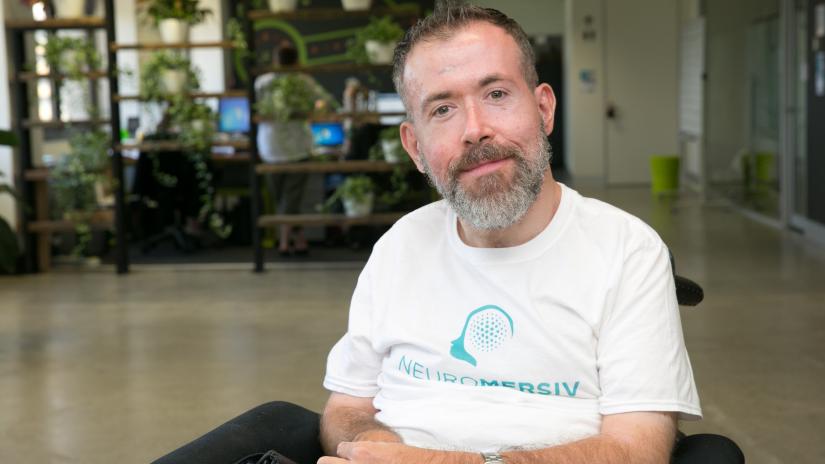
Like many other Australians with a disability, Oliver Morton-Evans struggled to gain employment even after graduating with a business degree. So he created his own job – and employment for others.
Two businesses on, he’s now co-founder of a startup working on a virtual reality (VR) solution to assist people with stroke and spinal injury.
It was the early 2000s when Oliver, who has cerebral palsy, completed a Bachelor of Business at the University of Technology Sydney (UTS), majoring in marketing and with a sub-major in entrepreneurship.
“I found it quite hard to find work afterwards so I started my own business in web design and graphic design,” Oliver says. That business operated successfully for seven years, with clients including one of the world’s most successful children’s acts, The Wiggles.
He returned to full-time study in 2010 to add animation and visual effects to his skill set. After two years employed in the field, he again applied his business skills – this time in his own digital content studio. Big Cookie Studios, and its eventual rebranding to pic4, brought together storytellers, filmmakers and technologists, creating immersive and engaging content using virtual reality, augmented reality and mixed reality.
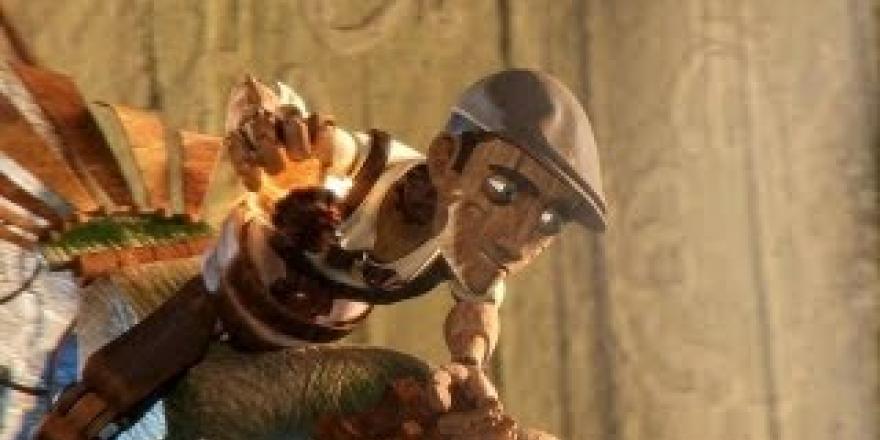
The music video for The Secret City's single Little Darling was produced by Big Cookie Studios.
It was at this time that Oliver met Anshul Dayal and Rohan O’Reilly, who were to become his business partners in the medical technology startup Neuromersiv.
Oliver and his partners want to help therapists and medical professionals make brain rehabilitation therapy more fun and engaging. Neuromersiv has developed a therapy solution that gamifies daily living tasks. It combines a consumer VR headset with proprietary hand and arm wearable technology.
The team believes such a solution will encourage people to follow their rehabilitation program more closely, leading to better outcomes. The technology recently received a $1 million grant from the Australian Government’s BioMedTech Horizons Fund.
I found it quite hard to find work afterwards so I started my own business.
Oliver says his lived experience of cerebral palsy has been an advantage in launching Neuromersiv, “knowing the challenges of living an independent life and how important mobility is for greater independence”.
He encourages people with a disability to consider the university path, and welcomes initiatives that help them fulfill that aspiration.
“From a social point of view, university was massively beneficial because it was a great opportunity to connect with others,” he says. Despite the initial hurdles, “having a business degree under my belt has helped a lot along the way,” particularly one with a tilt to entrepreneurship.
UTS Business School researcher Professor Simon Darcy, himself a power wheelchair user, says rates of entrepreneurship among people with disability are much higher than for non-disabled Australians.
Analysis of official data for the Entrepreneurs with Disability report – the first study of its kind in Australia, which he co-authored – found people with disability are on average more than 40 per cent more likely to be self-employed.
Many people with disability interviewed for the study found it made sense to work for themselves rather than to hit their heads against a “brick wall” of negative misconceptions. The study also highlighted a drive to help others through their own business ventures.
Professor Darcy is keen to see greater support for people with disability who have aspirations for higher education and his research has supported design of the IgniteAbility program to support them in their entrepreneurship goals.
If you’d like to contribute to the success of students with disability at UTS Business School, please contact Hannah Brunskill, Advancement Officer.
Byline: Lesley Parker