

• Posted on 1 Sep 2020
  • 38-minute read

"Children with everything to live for. A community betrayed. A whistleblower priestwho paid the ultimate price."

The Altar Boys is the debut book by multi-award winning investigative journalist Suzanne Smith, on the abuses and cover ups of the Australian Catholic Church.

It looks into the lives of Glen Walsh and Steven Alward, two childhood friends from Newcastle, New South Wales, and the ramifications of truth telling against the Australian Catholic Church.

Ahead of the book’s launch, Suzanne Smith, David Marr, and Verity Firth discussed truth telling, censorship, and civil rights in Australia.
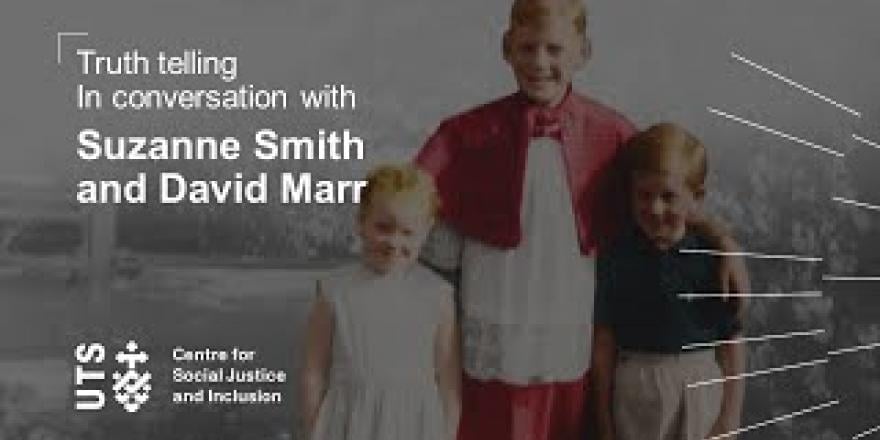
r20DxmTa48A

Descriptive transcript

Firstly, thank you, everyone, for joining us for today's event.

Before I begin, I'd like to acknowledge that we're meeting today on the land of the Gadigal people of the Eora Nation. I'd like to pay respect to Elders past and present and acknowledge them as the traditional custodians of knowledge upon the land this university is built. I know that other people across this webinar will be meeting on the lands of other Indigenous nations, and please acknowledge them as well and pay respect to their Elders.

My name is Verity Firth. I'm Executive Director of Social Justice here at UTS, where I lead up the Centre for Social Justice and Inclusion. I'm delighted to be joined today by Suzanne Smith, author of a new book, The Altar Boys, which we'll talk about today, and David Marr.

Before we begin, a little housekeeping. First, this event is being live captioned. To view the captions, you need to click on the link that is in the chat. You can find it at the bottom of your screen in the Zoom control panel. The captions will open on a separate window.

We'd also like to acknowledge that today's event includes content that is upsetting and can cause distress or be triggering. It's normal to be upset by the things that have happened and that we are going to discuss. If, however, you feel yourself becoming overwhelmed or distressed, please take a break from the webinar. Turn off the speaker, stand up, stretch, get yourself a glass of water. If you feel like it, you can rejoin when you feel better, but please don't force yourself to endure distress.

If you do feel overwhelmed or distressed in any way, speak to somebody you trust or contact Lifeline on 13 11 14. We are posting those contact details in the chat box, which you can also find in your Zoom control panel.

There will be an opportunity for you to ask questions. If you've got a question, please type it into the Q&A box. Again, you'll see that Q&A box in your Zoom control panel. You can then upvote questions that others have asked. Please try to keep them as relevant as possible to the topics, and I'll have time to then put these questions to David and Suzanne.

It's an online event, so there may be some technical issues. We ask you to be patient with us, and if that happens, we'll do our best to resolve them quickly.

So it's my pleasure today to welcome Suzanne and David to join us in discussion on truth-telling and censorship.

Suzanne Smith is a six-time Walkley Award winner and a two-time Logie Award-winning journalist. Her 27-year career in journalism includes senior editorial roles at the Australian Broadcasting Corporation, including on Foreign Correspondent, Background Briefing, Radio National, ABC News and Radio Current Affairs. She was the senior investigative reporter and producer at Lateline on ABC TV, reporting stories on the cover-up of clerical abuse, which helped trigger the Royal Commission into Institutional Responses to Child Sexual Abuse in Australia.

Suzanne's debut book, The Altar Boys – a compelling read, and I urge you to buy and read it – looks into the lives of Glen Walsh and Steven Alward, two childhood friends from Newcastle, and the ramifications of truth-telling against the Australian Catholic Church. The Altar Boys is an explosive exposé of widespread and organised clerical abuse of children and how the cover-up in Newcastle extended from parish priests to every echelon of the organisation. It details a deliberate church strategy of using psychological warfare against witnesses in key trials involving paedophile priests. Welcome, Suzanne.

David Marr probably needs no introduction, but he is the multi-award-winning author of Patrick White: A Life, Panic, The High Price of Heaven and Dark Victory. In 2014, David published The Prince: Faith, Abuse and George Pell, the first of three updated editions. He has written for the Sydney Morning Herald, The Age, the Saturday Paper, The Guardian and The Monthly, has been editor of the National Times, a reporter for Four Corners and presenter of ABC TV's Media Watch. He is the author of five best-selling Quarterly Essays. Welcome, David.

Now, to begin. Suzie, in the very beginning of your book, you say that you never expected to write a book about the clerical abuse scandal in the Maitland-Newcastle Catholic Diocese, although you spent about eight years covering the issue for the ABC. Can you tell us the story of how you came to be here today with a published book on this subject and why you ended up concentrating on the Newcastle-Maitland diocese?

SUZANNE SMITH: Well, it all came about when a dear friend of mine and journalist I'd worked with at the ABC for many years, Steven Alward, contacted me after the death of Father Glen Walsh. I didn't know much about Father Glen Walsh. I'd covered a lot of stories up there, about 40, and his name came up, but I didn't know a lot about him. But curiously, he suicided two weeks before he was to be a crown prosecution witness in the trial of cover-up of Archbishop Philip Wilson. After he died, Steven got in touch with me and said, "Suzie, he was my childhood friend, we grew up from the age of 2, and you need to investigate his death." He actually inferred to me he'd been bullied to death and he named a cleric, Monsignor Allan Hart, who's dead. They'd both been altar boys to Allan Hart. I knew Steven had grown up in Newcastle, gone to St Pius X, a bad school back in the day, but that's all I knew. The issue, Verity, is that I'd left Lateline three years before, I was at Foreign Correspondent, and I'd had vicarious trauma myself after covering those 40 stories and thought I don't want to go back to it, but I thought Steven had the most incredible editorial nous and I trusted him and thought, okay, I'll go back and do this story. It was November, I was heading off for a holiday, he was heading off to Chile with Mark, and we agreed to meet in January. When January came around and I went to contact him about our meeting, Steven had suicided, and after he died, we found out that he'd been abused by a really terrible paedophile by the name of Father John Denham – this is Steven – and I suppose I felt that I owed it to him. This was his last commission as editor, as I write, and Steven wouldn't have said – he was such a great journalist – he wouldn't have said those things if there wasn't any truth to it. So I embarked on this journey and really the book is about what happened to Glen Walsh, but it also weaves into what happened to Steven as we go on that journey.

VERITY FIRTH: Yes. And part of the problem, of course, is the pontifical secret. So at the very beginning of the book, you start talking about why is it that this was able to happen in the way that it did? How was the cover-up actually able to happen? You describe how in 1974 Pope John Paul VI renamed "The Secret of the Holy Office" "The Pontifical Secret", and what this did was decree that any allegation or investigation of sexual abuse against a cleric or religious was to be kept secret, and any bishop or clergy that defied this decree and went to the local state authorities could be excommunicated from the church. Now, I thought I'd ask you, David, to talk a bit about the pontifical secret, because you know about it. Tell us about it. Does it still exist? What is going on?

DAVID MARR: A lot of clerics never knew about the pontifical secret. It was one of those edicts which is chilling to see set out on paper, but in a way it was unnecessary because the idea of going to the cops and actually saying to a policeman, "This priest I know is raping children" was entirely anathema to the culture of the church. What the Pope was doing was making absolutely explicit a deep cultural understanding in the church, and to have done so is shaming forever, but it was reasserting a cultural norm. What happened after that is incredibly interesting, because as this story began to break in the 1980s, politically the cover the church had always had not to report to the police, to stand aside from the processes of the law in the countries in which it operated, to see itself and to be seen as a kind of separate realm where it could look after its own affairs began to break down. It broke down first in the United States, and then it broke down extraordinarily dramatically in the first years of this century in Ireland, and the bishops of the United States and the bishops of Ireland begged the Vatican to amend the pontifical secret so that where the law in those countries decreed, mandated reporting of crimes, they could do so. Otherwise they were going to go to prison. The Vatican refused for some years, and then finally saw that there would be no public applause for martyred bishops going to prison to hide and shelter paedophile priests, and so the pontifical secret began to withdraw a little, and lately, even in the last couple of months, Pope Francis has withdrawn it even a little more, but the basic rule remains in the church that where the local law does not mandate reporting crimes, the clerics of the Catholic Church must not under fear of excommunication.

VERITY FIRTH: So, Suzanne, in New South Wales it went actually even further than that, and listening to David then just talk about America and Ireland leading the way, it makes us look particularly bad, because one of the things that you note in your book is that there was in fact a memorandum of understanding developed between the New South Wales Police Service and the Catholic Church that operated unofficially, because it was later discovered that it had never officially been signed, but it was an understanding, an MOU, that operated in New South Wales from 2000 to 2013. So, tell us about this MOU and tell us about the impact that it had on our police investigations.

SUZANNE SMITH: So, around 1996, you'll remember, Verity, the Wood Royal Commission, and things were getting disturbing for the Catholic Church because that Wood Royal Commission discovered there was paedophilia in the church. Then you had Troy Grant, the former Deputy Premier of New South Wales, and he was the first to prosecute a priest called Ryan up in the diocese. He wanted to go further and use a tricky law that exists on the New South Wales statutes called misprision of felony – New South Wales is quite unique with this. That law says if you know a crime has happened and you don't report it to the police, then that's a criminal act. Now, the church was absolutely worried about this because imagine the decades of obfuscation and cover-up in their files. When Troy Grant prosecuted this priest in 1996 when he was a constable, he did raids on the archives and just found so many documents, which I have in my book. Father Brian Lucas curiously thought, well, what's coming with this Wood Royal Commission, because they were tightening all the laws around child protection. So Lucas and Cardinal Pell and all the senior clergy came up with this idea: let's sign a memorandum of understanding with the police. But what it actually did was create a situation where the church was the agent between the victims and the police. So they got Lucas to come up with this idea, and essentially it also included this notion of blind reporting. What the church did was they created all these forms, and these poor victims and survivors would be coming into the church asking for a bit of money for their medication, they were traumatised, this paltry bit of compensation they were going to get, and the people negotiating for the church would hand these victims a blind reporting form. On it they could put the priest's name or the brother's name, but they were anonymised, they weren't on there, and that form was then sent to the police. Now, thousands, we believe, of those forms were sent to the police, and none were investigated. But what that did was it meant that these poor, traumatised victims were dealing with the church when it came to reporting crime to the police; there was actually information withheld from the police. And interestingly, in my book – I want to thank this police lawyer because this whole memorandum of understanding went to the lawyers in the Police Department, and there's a lawyer called Treadwell, which is great, and he basically said, "If the draft MOU is settled, there would be prima facie a conflict between the requirements of the MOU and the law in the circumstances where a serious offence is reported to the Catholic Church." The Police Integrity Commission only like five years ago, due to this reporting on Lateline, did Operation Protea, and they found this whole scheme to be illegal. But what it said to me in 2002 was how powerful was the Catholic Church. They had former Labor Attorney-General Lander involved, they had all sorts of people coming up with these schemes, and just the entitlement that they could do these sorts of deals with the police. And then I have in the book that Brian Lucas was also advising people never to keep documents after this point, to rip them up. He was part of a scheme to get a serving police officer to sit on an internal Catholic group called the Professional Standards Resource Group, and that police person sat there for over a year listening to all their investigations, and the police agreed that she would never keep any notes. The state abrogated its responsibility to survivors and victims. It wasn't just the Catholic Church, we all did it. But the police lawyers did try to stop it, and yes, it was never signed.

VERITY FIRTH: That was probably one of the most shocking things your book revealed to me – that complicity of the state and that close connection between the church and the police force at that time. But David, I wanted to ask you a bit about the culture of policing in New South Wales, because there has been a shift and there was a shift in the force's relationship with the church. How do you think this culture began to change, and when did that happen?

DAVID MARR: This story, particularly in Australia, turns on the new policeman, the new policewoman. This was a new breed of police – they'd been to police colleges, they'd been trained, and they came into police stations without the old baggage of a police service. Across Australia, the police services were divided between the Catholics and the rest, and they were known to be places of great sectarian division. This was in the context of a society – you're probably not old enough to remember it, Verity, I remember it very well – which was highly polarised on sectarian issues. Various branches of the public service were known to be Catholic branches, Protestant branches, all of that died down at the same time when a new kind of police person was being trained, and they have been the heroes and heroines of so many of these stories. In the old days, a parent would go – perhaps a very brave, very rare parent – would go to the police station and say, "A priest has raped my son," and in the old days the police would ring the bishop and say, "Take care of this." But under the new culture of the Police Force and the new culture of our society, the police took those complaints seriously and began to investigate them. I can't overestimate, I can't overemphasise how important that has been in the uncovering of what's gone on – a new, proper, professional policing.

VERITY FIRTH: So what also shocked me, which it shouldn't have because I know that this is the way it's been, was the way that time and time again Suzanne quotes and documents supervising priests and bishops prioritising the welfare of the clerics above the welfare of children. It's almost automatic, that's just what they do. There's a particularly shocking quote that Suzanne writes from Monsignor Patrick Cotter when he's writing to the treating doctor of one of the paedophile priests, Father Ryan, and he writes, "Father Ryan has been my assistant," blah, blah, "the problem which now brings him under your care became known to me about one year ago. The circumstances were such that he knew that I was aware of what had happened, and thinking the embarrassment he suffered from knowing, so knowing, would have been more eloquent than any possible advice of mine, so I decided to say nothing."

SUZANNE SMITH: It really sums it up, doesn't it?

VERITY FIRTH: I can barely believe it. I'll throw first to you, David. What creates this culture of cult-like collegiality? And does celibacy mean these men are incapable of understanding the impact of child sexual abuse, or is it something more sinister than that? What is it?

DAVID MARR: Let's, for the sake of everybody, not go to the bigger issues of whether there is a God, whether there's an afterlife, whether the church itself is based on a huge lie. Let's not go there. Let's go to a little lie, and that is that celibacy is possible. Now, it's not. Priests are men, men have sex, priests have sex, and the church, for a thousand years since it imposed the celibacy rule, has been dealing with the absolutely ordinary fact that their priests and brothers are in sexual relations frequently, and indeed some recent studies suggest that most priests are in sexual relationships most of the time, and that the actually successful celibate priest or brother is something much less than 10% of the clergy, much less than 10%. So the church for a thousand years has had to find ways of hiding this very ordinary fact because they have put forward this idea that the authority of the priests and the brothers rests on the peculiar holiness and discipline and dedication to the church of giving up sex lives, giving up this fundamental drive of a human being and turning themselves into something holy and wonderful. And it's bullshit. And the church has dealt with a thousand years of bullshit on this issue. Now, it really doesn't matter much whether the priest is having a relationship with another priest, with an adult woman, or with a child, because it presents the same fundamental challenge to the prestige of the church. And also, by the way, though I promised not to go into the bigger issues, whether things like prayer work. And so it's hidden. The church has been magnificently, magnificently adroit at hiding this. It's not just about the prestige of the institution. That's something that comes to bear when child abusers within the Boy Scouts or Protestant schools or state-run orphanages – all of those are the ordinary and contemptible reasons for hiding what is happening. But for the church, it gets to the very heart of the magic of the institution, and they're terribly good at hiding things. They're terribly good at getting witnesses to be ignored, they're terribly good at shaming and pressuring witnesses to be silent, they're terribly good at getting civil authorities to connive with them, as with the MOU, in not policing properly what is going on. They're terribly good at shifting priests around from parish to parish in order to try to contain scandal. They're really, really good at it. But it began to break down, as I said, in the 1980s and 1990s when the society tolerance of the abuse of children began to fray. That's what's happened. Society has turned on this institution and said, "This is completely inexcusable." And they're still dealing with that. They're still doing their best to maintain the prestige of their priesthood and the brothers in the face of that.

VERITY FIRTH: So, Suzanne, the book as you described at the beginning is about two men fundamentally, but it's about Glen Walsh, the priest who was essentially a whistleblower priest, and his decision to give evidence regarding the cover-up of clerical abuse at a landmark trial ended in tragedy. So can you tell us a little bit about Glen's story, talk about what we can do better to protect and support whistleblowers, and there's also some interesting news that has just been announced today in relation to this matter as well.

SUZANNE SMITH: So Glen Walsh was always a bit of an outsider because he was a principal and a teacher first and he went into the seminary late. When he became a parish priest in the Maitland-Newcastle diocese, he found himself being moved from parish to parish and replacing a paedophile priest every time. What he found was this community that was traumatised; he got very close to the victims. What I also found out about Glen was he was an adult – a vulnerable adult victim himself. When he was 18, he used to go on retreats to Mittagong with the Marist Brothers. He went to Marist Brothers Hamilton. The Marist Brothers had a scheme called the Better Boys, and all the Better Boys were singled out and approached to be Marist Brothers, and he was one of them. He was sexually assaulted 100 times by Brother Coman Sykes in that year that he was 18. What that did to Glen was he understood what it was like to be a victim. When he was a parish priest in about 1998, he put in a claim against this brother to the Marist Brothers, and the Marist Brothers said it was unsustained, they said it wasn't true. In the book, I've got his writing and he said he's just appalled. But from that moment on, he wasn't just a priest in a cult-like organisation, he was also a survivor. Then what happens in 2004 is two young men that he was very close to, when they were young boys, they were sexually abused by a priest called Father Fletcher, and he finds out about that and he calls the bishop and says, "I'm going to the police, I'm going to dob in this priest," and the bishop allegedly says, "You can fuck off out of my diocese." The bishop denies that, but it's part of the Kinneen Inquiry if anyone wants to look at it. From that moment on, Glen is a pariah. He has to leave the diocese. Interestingly, a lot of the paedophile priests are getting stipends and houses and being looked after, but poor Glen doesn't get much. He asks the bishop for a cheque for $20,000. When you're an incardinated priest in a diocese, you're supposed to be looked after, you're supposed to have accommodation and meals, but that wasn't afforded to Glen. He ends up living in his car straight after that. Anyway, his evidence to the police in 2004 is brought up at the Kinneen Inquiry, which was the state inquiry in 2012–13, and he has to give evidence at that inquiry and the legal counsel for Bishop Malone and Bishop Wright and Archbishop Philip Wilson tear into him. He's already very unwell. From that moment on, Kinneen has a confidential volume of her inquiry which includes the charging of Archbishop Philip Wilson with misprision of felony, the cover-up, section 316, and Glen becomes a crown prosecution witness against an archbishop. Verity, this is so rare. I actually haven't found another example of a priest doing this. Luckily for Glen at that point, the Royal Commission is on and he has a little bit of reprieve from the bullying. So February 2015, he becomes a crown prosecution witness. February 2016, he's recalled to meet the Pope. He has a meeting with the Pope. He tells four or five of his closest confidants and former lawyers that the Pope asked him why was he suing an archbishop, what was he going to say. In fact, he calls two of his former lawyers from the Vatican after the meeting and he says to them, "Gee, it was interesting after I met Pope Francis because when I came outside, Cardinal Pell was waiting there," and Cardinal Pell allegedly says to him, "Look what I've done for you, you've met the Pope," and he holds up – Glen tells his lawyers he holds up his hand and says, "Kiss my ring," which Glen says he doesn't do. The pressure on Glen mounts about a month or two before he's to give evidence. He's set down to give evidence against Archbishop Philip Wilson about the 20th of November 2017. Two months before, the Marist Brothers, former Assistant Police Commissioner Norm Maroney calls him up: "Oh, we've reversed your claim, we're going to mediate, we're going to do it two weeks before you give evidence in this massive trial." The media is all over it, the pressure is building, which brings up terrible trauma, and Glen tells his closest confidants and former lawyers that he feels they're trying to intimidate him. He's so paranoid now by this point he doesn't understand the reversal by the Marist Brothers, and curiously he says, is it normal for a former Assistant Police Commissioner to ring victims about their mediation? Then late October he emails a friend and says, "I've just had a visit from Bishop Bill Wright, the Bishop of Newcastle, he's told me I'm no longer welcome in the diocese, the priests won't tolerate me here and they want me to leave, he'll try and find me a position overseas," and Glen says, "Maybe I'll work in a leper colony." His neighbour confirms he sees Bill Wright on that day, and today in the Sydney Morning Herald we have his neighbour for that whole period talking to Harriet Alexander in the Sydney Morning Herald saying that Glen told him that the message from the Vatican was, "You will be a hostile witness." All this happens in the lead-up to this trial. On the day he's supposed to have mediation with the Marist Brothers, the night before he suicides, but before he suicides he sends every document about that mediation to his former lawyer and says, "Keep it safe." When the police arrive at his house, every document in his house is shredded, he's lying in his bed in the full priestly uniform. I think he was making a statement. He tried to buck the system. What I try to do is show what happens when someone inside tries to change the culture and that's what they do to him, and Steven was right, Steven was right.

VERITY FIRTH: It's just horrific, and it's horrific reading too. You're right, it's just so cruel, so cruel.

SUZANNE SMITH: I can let everyone know today that Greens Senator David Shoebridge has referred Glen's death and 71 deaths from three Catholic schools in the Maitland-Newcastle Diocese to the Coroner and to the Attorney-General today asking for an inquest. I really believe there needs to be a police investigation into the last two years of Glen Walsh's life because I'm not saying there was witness tampering, but we need to get to the bottom of whether there was or not.

VERITY FIRTH: So we've now got some time for questions and there have been some questions coming up. If you do have a question, please, that Q&A button in your control panel, you can click on that and write in your question. It also gives other people an opportunity to vote for your question. I'll ask them according to popularity, if people don't mind. The first question is from Chrissie Foster.

DAVID MARR: G'day, Chrissie. This woman – I want to say something about this woman. This woman is an absolute heroine. She has been through hell. Two of her daughters were abused. The church dealt with her appallingly. She and her husband stayed sane, they stayed sane, they stayed on message. They were intelligent and thoughtful and wonderful. This is a good woman. This is a very good woman, and unfortunately her husband has died, very unfortunately, but she survives and she's a powerful force. G'day, Chrissie.

VERITY FIRTH: Hello, Chrissie. Thank you for your question and thank you for everything you've done. Her question is: "Do you know of any other priest suicides due to being turned against by the priesthood after supporting victims other than Father Walsh and Father Crocker?"

SUZANNE SMITH: I've been contacted by a woman in Buffalo, New York, who says her twin brother was a priest who suicided before giving evidence, but that's as far as I've got. I'm sure there are more.

VERITY FIRTH: Do you know of any, David?

DAVID MARR: No, I don't, I don't, but the subtlety and the unending talent for putting pressure on people is part of this story and one of the reasons that I think this book is so wonderful, and one of the reasons to read it is not just to once again experience the horror of these events, but to see the pattern, to see how we can see through the pattern. And it's one of those reading experiences where you read this book and you say, "Ah, that makes me understand that and that." It has that power. I don't know of any other priests who've been in this – who have taken that way out, so very, very, very few of them of course have ever been willing to give evidence against, which of course is why. If you're a paedophile, why not go into the Catholic Church? I mean, there's an endless supply of children and they will protect you, or they used to. I think we shouldn't be – we shouldn't take on their word alone, the claim that all of this has stopped, but why not go into the Catholic Church? No wonder it was a pool of paedophiles, safest place in the world to get hold of kids and be protected.

VERITY FIRTH: There's a comment here from John Walsh – hello, John, thank you so much for joining us today: "Nobody silenced my brother Glen Walsh. Even though he is no longer alive and living on this earth, his voice still can be heard louder and with more purpose through the voices of good people who believe in the wellbeing of children, both past, present and in future." That's totally right, John. This book is a total tribute to the bravery and just amazingness of your brother. Is there anything you'd like to add, Suzanne?

SUZANNE SMITH: I just think I want to say it was an honour to have the trust of John Walsh, what an incredible brother he was to Glen as well and Glen is a hero. He's one of our – he is a hero. I think we need to mark his bravery and I hope I've done that.

VERITY FIRTH: I think the whole book is a tribute to him. An anonymous attendee asks, "Is there any chance a discussion on your book will go to a wider audience on the ABC or SBS or further?"

SUZANNE SMITH: I hope so. I hope so. If any ABC and SBS people are listening out there, we are willing and able.

VERITY FIRTH: Clearly with the Sydney Morning Herald picking up the stories, and so forth, it is generating interest that hopefully will be pursued by other journalists. David, you wanted to say something?

DAVID MARR: There's the book. You don't need our discussion. There's the book. Go to the book.

VERITY FIRTH: Yes, buy the book. Another anonymous – it's a comment really that she "grew up with Emma Foster and saw the effects of child sexual abuse firsthand until her death. I'm happy these educative programs are being put out into society now."

Ruth Jordan asks: "What do you think will prompt a sincere and genuine response from the Catholic Church regarding these issues? Should Catholics refuse to attend church and send their children to Catholic schools – i.e., stop giving oxygen to this institution?"

SUZANNE SMITH: Can I explain, Ruth Jordan is also a very courageous woman. She was the character in my Griffith Review essay. Her husband, Bernie O'Brien, suicided suddenly back in I think 2010. When Bernie was 18, he lived for a year with these paedophile priests at St Pius X, even though it wasn't a boarding school, when he was 18 back in the 80s. And Ruth is a tremendous woman. Ruth, I just hope that if this book can strike a nerve and clergy can read it and people will get angry because I can't get Bishop Wright to do an interview with me, I can't get any of the clerics to respond. They're hoping that it all goes away, but we mustn't allow these men's deaths, including your husband, Bernie, to be in vain. We just have to keep going. That's why I hope the Attorney-General or the Coroner and the police respond to this. We have to get to the bottom of this or it could be repeated.

VERITY FIRTH: Which is why it's so good seeing the action that's already happening after the publishing of this book. It's already having an impact. Peter Alward has also written a comment, which again thank you, Peter, for being involved today: "We can see the congregation numbers for the Anglican and Catholic Churches declining significantly over the past 10 years mainly because of the Royal Commission and the sexual abuse of the innocent children. 700,000 less attendees from 2011 to 2016. When are they going to realise they need a change in culture and full disclosure to bring back the congregations? Otherwise they will disappear." David or Suzanne?

DAVID MARR: Well, this is always – this is a question that really fascinates me. Religions are always changing their beliefs because they have to accommodate their beliefs to the society. They claim not to be, and the

The book is an explosive exposé of widespread and organised clerical abuse of children and how the cover up in Newcastle extended from parish priests to every echelon of the organisation, detailing a deliberate church strategy of using psychological warfare against witnesses in key trials involving paedophile priests

One of the most shocking revelations in the book is the complicity of the state and that close connection between the church and the police force at that time.

‘The state abrogated its responsibility to survivors and victims. It wasn't just the Catholic Church, we all did it.

‘What [the Police Integrity Commission] said to me in 2002 was how powerful was the Catholic Church. They had former Labor Attorney General Lander involved, they had all sorts of people coming up with these schemes, and just the entitlement that they could do these sorts of deals with the police.’ – Suzanne Smith.

‘For the church it gets to the very heart of the magic of the institution and they're terribly good at hiding things.

‘They're terribly good at getting witnesses to be ignored, they're terribly good at shaming and pressuring witnesses to be silent. They're terribly good at getting civil authorities to connive with them.’ – David Marr.

Suzanne Smith is a six-time Walkley Award and two-time Logie award-winning journalist. As the senior investigative reporter and producer at Lateline on ABC, her reports on the cover up of clerical abuse helped trigger the Royal Commission into Institutional Responses to Child Sexual Abuse in Australia.

David Marr is a multi-award winning author and journalist. In 2014, David published The Prince: Faith, Abuse and George Pell - the first of three updated editions. He has written for the Sydney Morning Herald, the Age, the Saturday Paper, the Guardian and the Monthly, and been editor of the National Times, a reporter for Four Corners and presenter of ABC TV’s Media Watch.

Byline: Laura Oxley, External Communication Officer, Centre for Social Justice and Inclusion

Share