

• Posted on 30 Jun 2020
  • 43-minute read

Millions of Australians are protesting violence and systemic racism. But with more than 500 deaths of First Nations Australians in police custody since 1980, why has it taken tragedies played out on foreign soil to confront our own issues?

When it comes to Australia’s history and race struggles, there is still ignorance throughout white Australia, all the way up to our Prime Minister. Are we seeing the catalyst for real recognition and reform, or will the moment pass?

Our panel

  • The Hon. Linda Burney MP, Shadow Minister for Families and Social Services, Shadow Minister for Indigenous Australians 
  • Alison Whittaker, Research Fellow at UTS Jumbunna Institute for Indigenous Education and Research and author, BLAKWORK
  • Prof. Thalia Anthony, Professor of Law at UTS (and proud Cypriot woman)
  • Facilitated by The Hon. Verity Firth, Executive Director of Social Justice at UTS.

Presented by UTS Jumbunna Institute for Indigenous Education and Research and Centre for Social Justice and Inclusion.
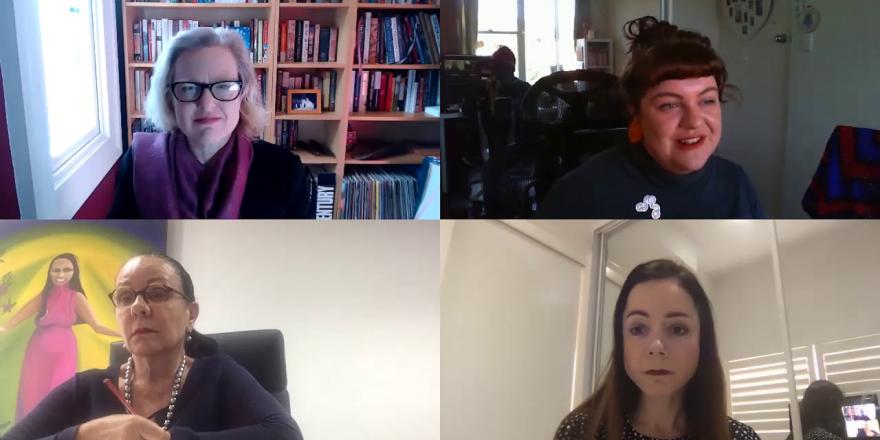
zu0xk-EkqUY

Descriptive transcript

So, firstly, I'd just like to thank you all for joining us for today's event. Of course, I want to begin the session by acknowledging the Gadigal people of the Eora nation, which is the ancestral lands that the UTS campus sits upon. We want to pay respect to Elders past, present and emerging, and also really acknowledge them as the traditional custodians of knowledge. So, we build a university, but they are our custodians of knowledge, so thank you.

My name is Verity Firth. I'm the Executive Director of Social Justice and Inclusion here at UTS, where I lead up the Centre for Social Justice and Inclusion. I'm really excited to be joined here today by Linda Burney, Alison Whittaker and Professor Thalia Anthony, who I'll properly introduce shortly, but we'll just do a little bit of housekeeping.

Firstly, this event is being live captioned. To view the captions, you need to click on the link that is in the chat, and you'll find it at the bottom of your screen in the Zoom control panel. The captions will open up in a separate window. If you have any questions at all during today's event, you can type them into the Q&A box that is also down there in the Zoom control panel, and you can also upvote questions that others have asked. Please try to keep it relevant to the topic that we're discussing here today, and I'll have some time later to then put your questions to the panel. So, it's a really good opportunity to have your voice heard.

Being an online event, do bear with us if we have any technical issues. We will work to resolve them quickly, but it's not unheard of that there will be technical issues. Cross fingers.

So, I'd now like to welcome each of our panellists here today. The first, I'm very excited to have here with us Linda Burney. Linda Burney probably needs no introduction, but for those who would like to hear her bio, she is currently the Shadow Minister for Family and Social Services and the Shadow Minister for Indigenous Australians. She has been the Federal Member for Barton since 2016, following a 13-year career in the New South Wales Parliament. Linda's commitment to Indigenous issues spans more than 30 years and includes time as the Director-General of Aboriginal Affairs New South Wales and in other senior positions in the non-government sector, including with SBS, the New South Wales Anti-Discrimination Board and the New South Wales Board of Studies. Welcome Linda.

Thank you, Verity.

Alison Whittaker is a legal researcher with the UTS Jumbunna Institute for Indigenous Education and Research. She's also a poet, penning the award-winning book Lemons in the Chicken Wire, released in 2016, and Blakwork, released in 2018. Between 2017 and 2018, she was a Fulbright Scholar at Harvard Law School, where she was named the Dean's Scholar in Race, Gender and Criminal Law. Welcome Alison.

Thank you, Verity.

Professor Thalia Anthony is a professor with the UTS Law Faculty. She's an expert in criminal law and procedure and Indigenous people in the law, specialising in Indigenous criminalisation and Indigenous community justice mechanisms. Thalia has provided advice and research to the High Court, the United Nations, the Attorney-General's Indigenous Justice Clearinghouse, as well as to Royal Commissions, Parliamentary Inquiries, Criminal Justice Agreements and Coronial Inquests. Thalia also regularly writes articles in The Conversation, some of which we'll be quoting from today, which I highly recommend that you go and read. Welcome Thalia.

So, I'm going to begin my first question by quoting, in fact, from one of Thalia's articles. It begins:

"I can't breathe, please let me up, please, I can't breathe, I can't breathe." These words are not the words of George Floyd or Eric Garner; they weren't uttered on the streets of Minneapolis or New York. These are the final words of a 26-year-old Dunghutti man who died in a prison in south-eastern Sydney, David Dungay Jr.

Worldwide, the Black Lives Matter protests are at a scale many young people haven't experienced before. It's galvanised Australians to join ranks with First Nations people who have been calling out issues around policing and deaths in custody in Australia for decades. But why does it take an instance in America to galvanise the broader public to fight for justice for Aboriginal Australians? I thought we'd start with you, Linda.

Thank you, Verity, and hello, Thalia and Alison, and like Verity, and hello to the many people that have joined us today, and like Verity, I join in recognising that UTS is on the land of the Gadigal people. I am in downtown sunny Kogarah at my electorate office, which is the land of the Bidjigal people, also of the Eora Nation. The question posed, and thank you, Thalia, for the work that you've done in giving us that perspective about David Dungay, and I noticed his mother and brother and sister played a very important role in terms of the first Black Lives Matter protest and the subsequent Q&A program after that, and I think their generosity and grace is a lesson to us all, but also their persistence in wanting to know what happened to their son and their brother.

The question on why does it take something in America to galvanise Australia is something I can't answer, except I think that what's happened in America is that the death of George Floyd, the public nature of it, the fact that we all saw that murder for what it was in real time, I also think that America is just a land where inequity is so obvious, and it seemed to me that the death of George Floyd was more like the straw that broke the camel's back than the catalyst for what really took place. There was a lot of previous deaths, police violence and brutality was pretty much out of control. I think it's difficult for us in Australia to understand the American constitution. I think it's Article 2 that is about the right to bear arms, and for me it really is in Australia a remarkable movement, perhaps in solidarity with the Floyd family and Americans, but it is really about what is terribly unfinished business in this country.

The fact that we had the Royal Commission, and I remember it really well, between '87 and '91 in Australia, investigating 99 deaths, no convictions, and since then we've had over 340 deaths since '91. Some of them very recent, including last November in Yuendumu, and the two shocking deaths from clear neglect and police violence in WA of women, the death of a woman in Victoria, which should never have happened. So it seems to me that people have seized the moment, and I think what's really interesting about Australia is that it's been so many young people. I'm older than all of you, and remember very well the Vietnam moratoriums as a young teenager, and the civil rights movements around protesting the Bicentennial, and of course the end of the reconciliation process.

But what's taken place in Australia is about seizing the moment, in my view, and I am not so worried about what the catalyst is. I think the concern is about what it will deliver, and that it doesn't just go off into the distance, like the issues around racism that we saw in 2005, and again last year with Adam Goodes. I'm not sure that answers the question, Verity, except to say that we have seen a movement across the globe, and Australia has a particular reason to be part of that movement.

Yes. Alison, do you have anything you want to add to that? Why has this happened?

Yeah, I think I've been around long enough now, which is actually not that long at all, to remember a very similar conversation happening around 2014 with the death of Michael Brown, the kind of launch of the Black Lives Matter movement, and articulating these very legitimate and foundational racial grievances, and the tension that existed between this burgeoning social movement being taken up quite seriously in Australia, and mob who have been here pushing for justice for their loved ones for such a long time, who found it difficult to achieve airtime or justice if they couldn't somehow relate their loved one to that movement, or somehow couldn't generate media attention from that.

And so that's a really foundational problem, where it's easy for us to point, I say "us", it's easy for white Australia to point at America and say, "That's really terrible, what's happening over there could never happen over here", and as a result, only become attentive to the kind of police violence that happens in the US, which is less common here. But part of that also disguises the very, very serious foundational problem of policing in this country, and its attention towards Aboriginal and Torres Strait Islander people. And as a result, it kind of can make Australia look really blameless in its violence.

And then there's, from my perspective as a legal researcher, there's also an ancillary problem, kind of related to what you were speaking about, Linda, in that the visibility, through the sharing of footage on social media of these murders really brings home the brutality of them. Whereas here, families really have to fight quite hard to release the footage of the death of their loved one, as we've seen a really, really long fight with the family of Dunghutti man, David Dungay Jr, to release footage related to his death. And even then, with the identities of the officers involved being completely obscured, and similar to the struggle of the family of Ms Dhu, to get footage of her death released. And they've learned from social movements in the US about how important it is to be able to make this violence visible. But at the same time, it's also an indignity that no family should have to endure. These are not easy choices to make.

And so obviously, it's a really, really wide, complicated racial problem that's only going to be addressed once we actually tackle colonisation, this kind of big behemoth. But that's kind of two aspects of it, in my view, that explain why it's much easier for us to see what's happening in the US and respond to it, rather than actually deal with difficult questions happening here.

Yeah. And Thalia?

Yeah, thank you, to both Alison and Linda. All I want to contribute really is to say, not why now, but why not before? Why didn't, you know, especially white, or particularly white Australians come forward when David Dungay Jr died, screaming, "I can't breathe"? Why didn't they come forward when Aunty Tanya Day was picked up sleeping on a train carriage, and that night effectively killed in a police station? Why didn't they come forward when we saw the shooting of Ms Clarke or Kumanjayi Walker? There's a real silence, and I know Alison's spoken about this, and that silence goes to the highest levels.

We saw, you know, with these deaths in custody, hundreds and hundreds in recent years, not one comment from a Prime Minister, not one expression of shame. And I think it's really problematic that, you know, now, as inadequate as it is, the Prime Minister's finally speaking, and it related to the death in custody of someone in the United States. And so we can't rely on the goodwill of politicians. We have to demand that they respond. We have to do that collectively, and we have to, I think, speak out to almost deafen the silence that we've come to accept because we like to be comfortable in our perception that we live in this bubble that does not exist upon layers and centuries of oppression, exploitation and violence of First Nations people.

So I think, yes, now we have to start rewriting the narratives and mobilising, but we have to accept that there's a lot of work to be done.

Yeah. Now, that's a really perfect segue into the next question that I wanted to talk about. So your question around why not before, and all of you have actually talked about this idea that it's the lack of capacity for most non-Indigenous Australians to actually deal with the history of Australia. And in a recent radio interview, I'm sure everybody knows this, it's now famous, Scott Morrison commented about the George Floyd murder, saying, quote, "As upsetting and terrible as the murder that took place, and it is shocking. I just think to myself how wonderful a country is Australia." So there's the Prime Minister's opinion. And then in a later interview, he said there was no slavery in Australia. And he followed that up by saying, you know, "I've always said we have to be honest about our history."

So, you know, that level of denial about the real history of Australia's invasion and colonisation, that is pretty spectacular, but it's actually not that unusual. So Thalia, I'm going to go to you first, because you've written about this. Can you talk to us about the history of slavery in Australia?

Yeah, and just to also add to that, that we saw this very overt denial of our history, as far as it concerned First Nations people and colonisation with John Howard and the so-called culture wars. Again, now, and we're seeing it, including on the attack on universities, which I'm sure we'll discuss later. But in terms of slavery, these were very widespread practices that spanned over a century in Australia and affected up to 200,000 people.

Just to clarify, slavery is a practice where the employer not only owns the labour, but owns the person's whole being. So they control their movements, their relationships, their money, their children. And this effectively happened in Australia from the early 19th century, in terms of Aboriginal and Torres Strait Islander people in the pearling industry, where they were kidnapped and brought into this industry to work as slaves. It happened to up to 70,000 Melanesian people brought to Australia to work in the cane fields. And then this practice took on new proportions in the pastoral industry from the late 19th century up until the mid 20th century, at least across Northern Territory, Queensland and Western Australia.

And in this industry, which was hugely profitable, tens of thousands of Aboriginal people were brought in from very young ages to work on stations and to live on the stations under the control of the pastoralist. And often the police would be involved in recruiting Aboriginal workers, Aboriginal families, and that recruitment could be very violent. And yet Aboriginal people were hugely skilled. They took a lot of pride in their work and they had a really strong work ethic. This counters so many stereotypes that we now hear. And I think that legacy and that contribution was really valuable to our entire economy and to where our nation is today.

We not only stole their land, we stole labour, we stole their lives and we profit from this. And Aboriginal people in the main did not receive wages, did not receive cash wages. They lived in humpies. They received meagre rations to live off. And so they have enduring poverty because they weren't paid and they continue. I mean, I was speaking to Gurindji and Warlpiri people who worked on some of these stations a few years back, and they continue to talk about this injustice and they continue to fight for their stolen wages.

So I think it's really important we both remember and acknowledge this history of slavery. But equally important is that we do something to ensure that there's reparations and justice and truth telling.

So, Linda, that's my next question, which is, what can we do as citizens, you know, all of us to force a greater acceptance and acknowledgement of our nation's history? And what can we do to start these reparations?

I actually think, and thank you, Thalia, for that amazing answer. And I think that you saw a grudging kind of apology from the Prime Minister that maybe he got it wrong. But that was after a fair bit of criticism from...

Look, I have spent, as you know, Verity, my entire life almost in the pursuit of truth telling. And I just think that we've got to recognise that we're not at the beginning of that journey, that your two girls will grow up and come through an education system that tells the truth. They go to a school that has great cultural practices and so forth. I can't remember in the last two years, and I've been to hundreds of schools, where the flag's not flying, where there's not an acknowledgement of country at the beginning of assembly. Now, they might seem like symbolic things, but they're important things. And symbols, I think, are very important on how a nation reflects itself.

It just stuns me in the last two days that we've seen this discussion about, you know, the New South Wales government's thought bubble in relation to revamping the curriculum. All that really hard curriculum work on Aboriginal studies and Aboriginal perspectives and Aboriginal studies for years 11, 12, being an elective took place some time ago. I can say that because I was part of it. I think a lot of it's been wound back. But I think universities have, and Jumbunna does an amazing job, have a really important role in educating truth to all of its graduates, in particular its education graduates, and giving teachers the confidence to be able to go out into schools and have a crack at that truth.

But essentially, and I'll finish on this point. If you look at the political debate at the moment on where things are at in terms of the Uluru Statement, and the fact that Ken Wyatt's three advisory groups on chartering a way forward have been expressly told that they're not to deal with the Uluru Statement. And I know that because I've seen the terms of reference and one of those wonderful off the back of the truck experiences.

So it seems to me that the third element of the Uluru Statement was about a national process of truth telling. And that is so powerful in terms of what's been said about decolonisation, about knowing what the actual truth of this country is, seems to me to be a very important thing to pursue.

And we can all do that as citizens through our local members, through writing to the Prime Minister, through writing to the Minister, but also demonstrating in the work that you all do, that this is what academics and professors and people writing more scholarly papers than I will ever begin to think about. That's a very important thing.

Alison, do you have anything to add to that?

Yeah, only brief reflection that there's a big focus in this space on truth and knowledge deficits as a way to kind of move forward. And that's a really, really important first step. But if we kind of go through this process of acknowledging slavery as a practice here and as a foundational practice of Australia as a colony and then do nothing about it, then that is not only a wasted opportunity, it's its own kind of violence and betrayal. The knowledge should drive us to do something. So often as people in universities, we are kind of told to pursue the truth and to pursue knowledge to a particular end. And we can just become obsessed with that as the end goal and forget that that's actually the start. And that should include things like redress schemes for stolen wages. But it should also include a really, really broad conversation around reparations, which universities in the United States are beginning to take seriously as well.

Actually, I might use that as a good link to one of the questions I was going to ask around exactly that, the transformative power of education. So we always talk about the transformative power of education as a great equaliser, a great liberator, that simply producing the facts will make the justice happen. But our own academics have highlighted that just because they have a PhD or just because they're a professor, that doesn't actually exclude them from being followed by security guards in supermarkets.

So what role can educational institutions play to make a real change? And how do universities own up to their own sort of colonial practices? I mean, there's a lot of stuff around the culture of universities that's pretty elitist and pretty colonial in outlook, including the ideas around the sorts of things we teach in the curriculum. So who wants to have a first bang at that? Why don't you go, Alison? What do you think about that?

Sure. So if we had the answer, I think we'd all be out of a job. Universities are not uniquely colonial institutions, but they have an enormous amount of influence, not only over how people are educated, and in the case of teachers who are educated to go on to educate other people, but uniquely in producing knowledge that then goes out to industry and to the community.

The very unsexy and disappointing answer I'm sure for any academics watching is that we can't research our way out of that hole. Actually, what has to happen is the reversal of the relationship that we're used to, where we give up our designation as experts. For me, even mob in the academy have to do this sometimes, and work on becoming resources to the community instead, and to be able to think about how universities can be useful in terms of the knowledge that we produce, the resources that we have, but also the ends that we put them towards can be something that is a really, really powerful way of going forward.

And principally, that's through relationships. If you want to decolonise as an institution, especially with the really entrenched racist history of universities on this continent, then by design, you can't lead that project yourself. And it also means fundamentally rethinking what universities are and do. So it may mean that people like Thalia and I have become redundant in the process. But ultimately, I have to say, I think that's not necessarily a bad thing.

We want to do institutional change. And that's what's so unglamorous about this work, is that it stops being about what individuals can do by themselves, and becomes about the transformation that we can do together with a little bit of humility, and also with a willingness to shake up everything that we think we know from this education system.

Wow, I love that answer, Alison. That's brilliant. Thalia, do you have some points you want to add?

Yeah, it's funny what Alison says about us becoming redundant. Sometimes when I'm feeling very starry-eyed, I start planning my career for when there's justice. And so I've decided I'm going to be a schoolteacher when I don't need to be calling out racism in my career.

So I think we have to be realistic that, you know, universities are built on ideologies and reproducing those ideologies that feed into the system of elites, the system that enables people to be oppressed in hierarchies. And we have to take responsibility that we reproduce these ideologies, that we produce graduates that go into corporations, that go into institutions that cause harm. So as long as there's deaths in custody, as long as there's racist police violence, as long as there's the stealing of children, we have to accept that we're not doing enough, that our institution, that our universities need to do more.

We can never pat ourselves on the back and say that we're doing this right while all of that exists in society.

Having said that, I really do have to give a shout out to the work of Jumbunna and UTS in supporting Jumbunna's work. It really is, I think, a leading example in how they work in a space of self-determination. They work with communities, they work with First Nations families, they work on the front line of protests. And I think that that's where you see the barriers being broken down, especially between the academy and the ivory tower and communities. And it makes me really grateful to be at a place where that work happens, but it doesn't happen easily. And I know Jumbunna has come under criticism for that work and they've stood strong in face of that criticism.

And I just want to bring it back to the point I made earlier about the reinvigoration of the culture wars. I feel like with this new funding model for higher education and what I see is an attack on the humanities and the critical humanities, there's going to be, I think, a resilencing of some of these issues that we've been speaking about today.

The government's made it pretty clear in its denialist approach. And I think this funding model is going to make it harder for the humanities to speak up. I don't think that will be any excuse for them not taking a stand. But the message is definitely there and we absolutely have to resist these proposed changes to higher education.

I agree. They keep telling us they want complex thinking and critical thinking skills. And what better to teach that than arts degrees and social science degrees and the things that actually teach people to question.

Linda, you were at a university. What would you do? Or you could just answer the general conversation.

Well, I just think that's really useful. And I'm kind of in awe of my panel members just how incredibly sophisticated everyone is. But I remember, Verity, when the only Aboriginal education program, and I think it was like the late 70s, early 80s, was the AEA program, the Aboriginal Education Assistance Program at Sydney University. And I remember the first program in a university apart from that was a thing called the AREP program, the Aboriginal Rural Education Program at the University of Western Sydney, that really were just groundbreaking in producing Aboriginal people to work in schools across New South Wales.

And now every single university in the country has an Aboriginal education program of some sort. So let's not think that there hasn't been extraordinary movement, extraordinary gains, and where we are now is a result of work that began back in the late 70s, early 80s.

But I do think both Alison and Thalia are correct, is essentially some of the issues that beset people back then are still around. You think, well, how the hell is that the case? And this issue of decolonization, the issue of institutional racism, structural racism, which is really what I see much of the discussion about now.

But, you know, I know what it's like to have kids and have them come home and say that they got strip searched or, you know, they had to spread eagle on a bloody railway station because they're black and they happened to be in the wrong place at the time the cops were around. So we've still got those issues. And I think that Australia is a deeply racist place. And the problem is that we haven't faced up to it very well. We're being made to face up to it now because of the work of people like Thalia and Alison and yourself.

And, you know, there are still so many people that have never met an Aboriginal person. And kids do get followed in supermarkets and H&M and wherever you go. And, you know, even I've even experienced in the last 12 months, people getting served in shops before I do, even though it's clearly the front of the line. I mean, these things still happen and you've got to ask, well, how can it possibly be?

And can I just finish up on this story? So I went back to my 150th school anniversary a few years ago. I was looking pretty flash, you know, as a cabinet minister. And it was a small country town and one of the, he would have been an older kid at the school I was at. He's probably in his, he would have been in his 60s. He still felt it was okay to say to me, "The day you were born was the darkest day in this town's history." And I was so shocked. I just, I couldn't even respond. I just stood up and walked away.

So I'm not sure what that all means, except to say there is still, as Alison said, so much work to do. And I feel really encouraged by people working in the university sector now, both Aboriginal and non-Aboriginal. They're saying, no, this is over. We're going to change it.

So I'm now going to go to some of the audience questions because there's so many good ones. And so let's get into it. So people can, as I said before, if you want to ask a question, go to the Q&A box, but you can also upvote people's questions. I'll ask the ones that are at the top of the list.

So the first is from Chelsea Honeysett. What role does the media play in keeping Australians informed? Often we hear of cases in the US, but local media neglects to report on cases of abuse to Aboriginal people. So the role of the media. Who wants to have a first go at this one? I'm going to ask you, Linda, because you have to deal with the media all the time. And then I'll pass over to the others. So what do you reckon about the role of the media?

There was a time where the National Council for Aboriginal Reconciliation ran, for want of a better term, programs for the very senior A-grade media people, where we'd take them out to Brewarrina or somewhere for two days and it was an immersion. And I think there was a time when the senior people in the media, and when I say senior, I don't mean old. I mean, you know, the really serious journalist actually understood. I don't think there's anything like that anymore. And I think the media is under enormous pressure. Quite often the media will just, you'll give them a press release and they just don't have the time to do anything except go off that press release.

But I do also think that the media ownership in Australia is so concentrated and so bloody right wing that sometimes you just feel like pulling your hair out. And the other thing that annoys me with the media in Australia is that they've got their couple of Aboriginal people that they'll go to for comment all the time. And you think there are just so many other people you should be talking to. And they say, well, tell us who they are and we give them lists, but they don't use them. I mean, you know, Thalia, for example.

So I also think that we should celebrate the Indigenous media that's come along as well. But the media is under the pump and it's very difficult. But I am also really pissed off that the media do not pursue the issues that Miss Honeysett's identified and that's injustice in this country.

Alison and Thalia, do you have anything you want to add on the media?

Yeah, I just wanted to add, I guess, two points. One is, as Linda highlighted, the real need to resource black media in this country that have institutional support for the kind of stories that we want to be telling, in addition to supporting black journalists in mainstream media organisations. There's a two-pronged approach that needs to happen there. And the other thing, there's a conversation article that I wrote recently that might be useful for, I'm sorry, I don't know who asked this question. But there are a number of, I guess, legal systems in place that incentivise silence on deaths in custody in particular that will, are not themselves the fundamental problem, but do definitely impact what families are able to do in terms of their advocacy and go some way in just illustrating the vast institutional complicity of deaths in custody on this continent. It's, in some ways, the silence is enshrined into the law.

Thalia, I think we've currently lost Linda, but we'll try to get her back. We'll work on that while Thalia, you talk about the media too.

It is absolutely a situation of silence. But we also need to, I think, understand that the media actively defend police and actively demonise Aboriginal people, especially young Aboriginal boys. There have been studies that show that the media often reproduce verbatim press releases coming from police forces and police unions. And so they're giving the police pretty much a blank check to write and represent their side of the story as they like.

By contrast, we consistently see stories, you know, in Sydney, but you go into other places like the Northern Territory and Western Australia where kids are named and shamed, Aboriginal kids. And so it creates this culture where Aboriginal kids are treated as a problem, are treated as a risk, and that feeds into police violence being legitimised against them and kids being tortured in custody.

So I think, you know, the media is absolutely complicit in this violence.

I want to say, by contrast, though, I'll just keep speaking a bit longer. I'm hoping Linda will come back. But I just want to say, by contrast, that we have a role on social media to really rewrite these stories. I want to acknowledge, obviously, there's been a strong presence of black tiles

A transcript of the conversation is also available.

‘The protests are really powerful for two reasons. There's the physical demonstration but they're also really important for the people that participate to understand that there is broad support, that there are many fellow travellers, for whatever the issue is, and in particular with Black Lives Matter and what has flown out of that has been so powerful. You just look across the world to see how it's been – it's changing things, it's changing curriculum, it's changing practice, it's changing physical space. None of those things would have happened had there not been the physical demonstration that we have seen.’

The Hon. Linda Burney

‘There is a big focus in this space on truth and knowledge deficits as a way to move forward. That's a really important first step, but if we go through this process of acknowledging slavery as a practice here and as a foundational practice of Australia as a colony, and then do nothing about it, then that is not only a wasted opportunity. It's its own kind of violence and betrayal. The knowledge should drive us to do something.

'Often, as people in universities, we are kind of told to pursue the truth and to pursue knowledge to a particular thing, and we can become obsessed with that as the end goal and forget that is actually the start, and that should include redress schemes for stolen wages but it should also include a really broadened conversation around recreations, which universities in the United States are beginning to take seriously as well.’

Alison Whittaker

‘We need to understand that the media actively defend police and actively demonise Aboriginal people, especially young Aboriginal boys.

‘There have been studies that show that the media often reproduce verbatim press releases coming from police forces and police unions, and so they're giving the police pretty much a blank cheque to represent their side as they like. By contrast, we consistently see stories where kids are named and shamed, Aboriginal kids, and so it creates this culture where Aboriginal kids are treated as a problem, are treated as a risk, and that feeds into police violence being legitimised against them and kids being tortured in custody.

‘So I think the media is absolutely complicit in this violence. By contrast, though we have a role on social media to really rewrite these stories. I want to acknowledge there has been a strong presence of black tiles coming from the United States, but I want to acknowledge the work of First Nations families in running campaigns around say their names and our responsibility to support those campaigns, and they also manifest in campaigns like justice for Dungay or justice for Ms Dhu. That campaign around saying their name is really important in humanising those people who have been lost, who have been killed by this system.’

Prof. Thalia Anthony

Byline: Laura Oxley, External Communication Officer, Centre for Social Justice and Inclusion


Share