

- Posted on 6 Nov 2019
- 6-minute read
For Catriona Fisk, the moment that inspired her PhD came while watching TV.

“I saw a character in a period drama who was pregnant and wearing an adaptation of the day dress of the period and I thought, what on earth is she wearing?’” Fisk says.
A passionate historian, Fisk started digging into the question of what pregnant women wore prior to the advent of modern maternity fashion. To her surprise, she found very little information in the public domain. But her curiosity persisted, eventually leading her to enrol in a PhD in the Imagining Fashion Futures Lab in the UTS School of Design.
Led by Distinguished Professor Peter McNeil, one of the leading voices in global fashion research, the Imagining Fashion Futures Lab is dedicated to the study of the past, present and future of critical fashion, among other topics. Fisk’s PhD project, ‘Confined by History: Dress and the Maternal Body 1750-1900’ was a perfect fit.
“I knew there was one guy in Australia whose work aligned most with what I wanted to do. I knew his name, I knew his work, and so it was always going to be Peter,” she says.
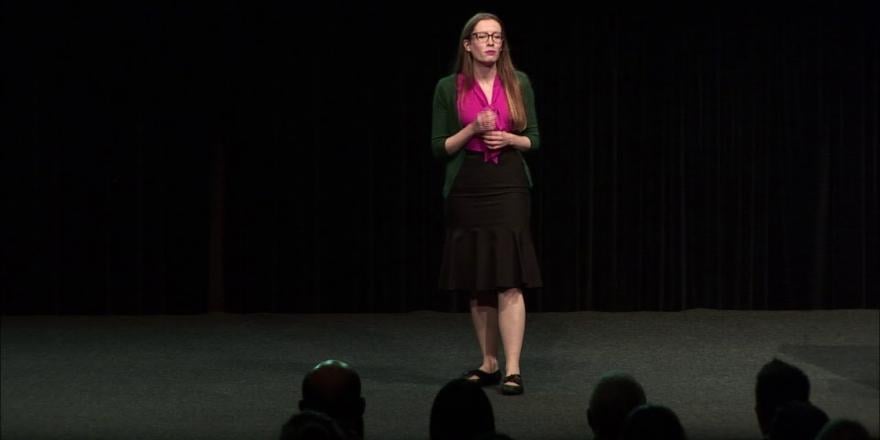
Though her research was based at UTS, Fisk travelled extensively throughout her PhD. Much of her work was collections based, taking place in museums where she hunted through existing dress collections for clues about 18th and 19th century maternity clothing.
She’d originally set herself a goal of looking at roughly 150 pieces, but after visiting more than 50 museums in four countries, she wound up viewing more than 300 garments, all of which reflected the realities of pregnancy and breastfeeding in this era.
“Not all of them are what I would call ‘official’ maternity wear that I can prove were 100 per cent worn by a pregnant woman, but they all contained some trace of how women dressed while they were pregnant,” she says.
“For example, there’s a particular way of constructing an informal dress from the mid-19th century that’s really easily adaptable to pregnancy, and I found a lot of them in collections as possible maternity wear.
“A few of those examples had modifications like laces or drawstrings at the waist of the dress that would allow it to expand around a changing figure. To my mind, it seemed likely that these were maternity garments.”
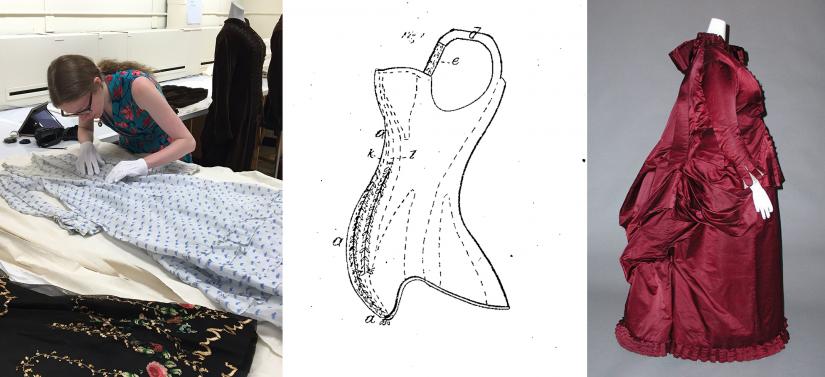
Left: Catriona Fisk examining a potential maternity dress in the Fashion Research Collection at Ryerson University, Toronto, 2016. Image via @Ingrid_Mida (twitter). Centre: Corset, 1841. Illustration, Elizabeth Adams, U.S. Patent Office US1940A. Right: Maternity Dress, c. 1882. The Metropolitan Museum of Art, 1985.363.9. Gift of Mrs Nathaniel D. Clapp.
Fisk also completed archival research in libraries and record offices. At one library, she came across a collection of letters sent between two female friends; much of the content revolved around the pregnancy of one of the letter writers, including questions about maternity attire. Another letter from a staymaker – someone who made corsets and other undergarments – contained detailed information about how such things could be adapted for pregnant clients.
At the core of Fisk’s discoveries was the finding that, despite contemporary beliefs that pregnant women in bygone times were completely hidden away, the reality was that maternity fashion was alive and well long before the present day.
“Though there were some exceptions, the main thing I discovered was that any assumption that women were unilaterally concealing or ashamed or anti-fashion about their bodies wasn’t accurate, but that equally their experience varied by individual status and circumstance,” she says.
How women dress may be the literal story of her PhD, but Fisk’s findings reveal much about the realities of how these women lived, as well as how our perceptions of their lives have shaped contemporary understanding of what a pregnant woman is and how she should present herself.
This research is presenting a great body of new work about the experience of pregnancy, which is a big gap in dress historical work.
“Within the immediate field I work in, this research is presenting a great body of new work about the experience of pregnancy, which is a big gap in dress historical work,” she says.
“But outside the world of fashion history, I think it’s interesting, because it confounds a lot of people’s expectations about women in the past – it presents a more diverse, more complex picture.
“These things matter because we formulate how we do things based on a sense or perception of how things were in the past, and if they’re wrong, it creates an uneven ground for when we talk about pregnant bodies today.”
Learn more about UTS DAB Research and the Imagining Futures Fashion Lab.
Byline: Claire Thompson