

- Posted on 12 Nov 2015
- 6-minute read
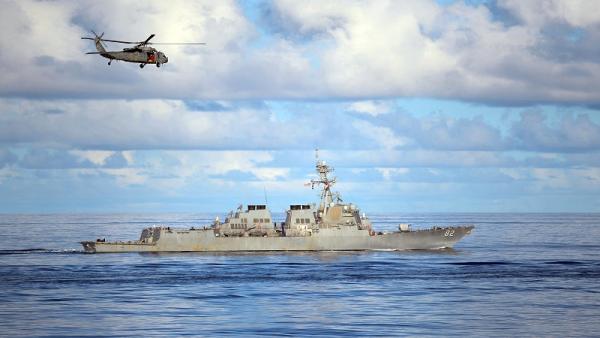
On October 27 a United States navy guided-missile destroyer, the USS Lassen, sailed within a 12 nautical mile zone of a Chinese-built formation in the Spratly Islands. The US is reportedly calling on allies to join such freedom of navigation operations (FONOPS). This survey shows that if Australia responded it would probably be alone.
Japan
On October 29 2015 Professor of International Politics at Keio University, Yuichi Hosoya, said “the biggest demand coming from the US government is [for Japan] to do some ISR [intelligence, surveillance, and reconnaissance] operations in the South China Sea … this is not that probable”.[1]
Analysts say that Japan lacks both public support and military capacity for patrols in the South China Sea. Director of Defence Policy in Japan’s Ministry of Defence Koji Kano said, “From the viewpoint of pure military affairs, what we really can do [in the South China Sea] is very modest”.[2]
On October 30 2015 Japanese Defence Minister Gen Nakatani “reiterated that Tokyo had no plan to take part in US-led ‘freedom of navigation patrols’ in the South China Sea”.[3]
India
On October 19 2015 The Telegraph Calcutta reported that the US invited Prime Minister Narendra Modi to board the USS Theodore Roosevelt aircraft carrier but “his diary was full and the visit could not be accommodated”.[4]
US officials briefed their Indian counterparts on freedom of navigation operations in the South China Sea but “stopped short of an invitation to India to join with a US fleet”.
On November 4 2015 at an ASEAN Plus meeting in Kuala Lumpur Indian Defence Minister Manohar Parrikar called for “peaceful resolution of disputes” and an early conclusion of the Code of Conduct in the South China Sea.[5] India has made no official statement on US patrols.
Singapore
On November 6 2015 Prime Minister Lee Hsien Loong said regarding the South China Sea “Singapore is not a claimant state. We do not take sides”.
The Prime Minister stated that as an ASEAN member “Singapore will be a fair and objective coordinator, in order to help China and ASEAN reach a consensus, and continue supporting peaceful development in the region”.[6]
Canada
Canada has refrained from issuing any official statement regarding patrols in the South China Sea. According to The Diplomat, expect little action from Canada in the South China Sea under new Prime Minister Justin Trudeau.[7]
On October 25 2015 the Vancouver Sun reported that unofficial lobbying was taking place at the University of British Colombia’s Institute of Asian Research from representatives of the Philippines to give territorial disputes “higher visibility in Canada”.[8]
Despite this Canada is reluctant to weigh in on the issue of FONOPS with reports saying that Canada “does not want to support the US in Asia and risk hurting its Northwest Passage claim”.[9]
United Kingdom
On September 20 2015 Chancellor of the Exchequer George Osborne called on the UK to become “China’s best partner in the west”.[10]
On October 20 2015 the Financial Times ran the headline ‘US takes stern line on UK’s shift to China’. The report stated that experts in Washington say the US and UK “have diverged” in China policies. Examples cited include Britain joining the AIIB without consulting Washington and differences in approach to the South China Sea.[11]
The Nikkei Asian Review states that in regard to disputed islands the UK would most likely “dutifully make the right noises, but [do] little”.[12] In Forbes Asia Stephen Harner argues that “Brits would see little or no positive purspose our outcome in lecturing others – least of all China”.[13]
New Zealand
New Zealand has aimed for the “lowest possible profile on this issue” of disputed territory in the South China Sea.[14]
On September 28 2015 New Zealand’s Gerry Brownlee visited China for the first time as Defence Minister. He reiterated his earlier comments made at the Shangri-La Dialogue in May stating, “While we take no position on the various claims in the South China Sea, New Zealand opposes actions that undermine peace and erode trust”.[15]
South Korea
On November 2 2015 the Wall Street Journal reported that South Korean Defence Minister Han Min-Koo made ‘guarded’ remarks during US Defence Minister Ash Carter’s visit to Seoul.
Defence Minister Min-Koo stated, “It is our stance that freedom of navigation and freedom of flight should be ensured in this area, and that any conflicts be resolved according to relevant agreements and established international norms”.[16]
Defence analysts say that “South Korea’s unwillingness to come out more forcefully against Chinese assertiveness has persistently disappointed US alliance managers”.[17]
Further Reading
Bob Carr, 'South China Sea would be a lonely patrol for Australia', Australian Financial Review, November 12 2015
Endnotes
[1] S Tiezzi, 2015 ‘ Why Japan Won't Get Too Involved in the South China Sea’ The Diplomat, October 29 http://thediplomat.com/2015/10/why-japan-wont-get-too-involved-in-the-south-china-sea/
[2] Ibid
[3] Japan Today, 2015, ‘Abe seeks U.S., S Korean cooperation over South China Sea’, November 3 http://www.japantoday.com/category/politics/view/abe-seeks-u-s-s-korean-cooperation-over-south-china-sea
[4] S Dutta, 2015 ‘US updates India on China sea ‘navigation’ plans’, The Telegraph Calcutta, October 20 http://www.telegraphindia.com/1151020/jsp/nation/story_49001.jsp#.Vjw-L9IrJD8
[5] The Indian Express, 2015 ‘India calls for early conclusion of S China Sea code of conduct’, November 5 http://indianexpress.com/article/india/india-news-india/india-calls-for-early-conclusion-of-south-china-sea-code-of-conduct/
[6] L Hsien Loong, 2015 ‘Conditions for partnership even better now’, November 6 http://www.straitstimes.com/singapore/conditions-for-partnership-even-better-now
[7] B Han, 2015 ‘What Canada's Leadership Change Means for Asia’, The Diplomat, October 26 http://thediplomat.com/2015/10/what-canadas-leadership-change-means-for-asia/
[8] C Chiang, 2015 ‘Asia-Pacific: Unofficial lobbying in Canada highlights battle over South China Sea’, Vancouver Sun, October 25
[9] N VanderKlippe, 2015 ‘US challenges China’s sovereignty claim to artificial islands’, The Globe and Mail, October 27
[10] G Osborne and J O’Neill, 2015 ‘It’s in Britain’s interests to bond with China now’, The Guardian, September 20, http://www.theguardian.com/commentisfree/2015/sep/19/george-osborne-britain-should-bond-china-now
[11] D Sevastopulo, 2015 ‘US takes stern line on UK’s shift to China’, Financial Times, October 20 http://www.ft.com/intl/cms/s/2/69c2c230-76dd-11e5-a95a-27d368e1ddf7.html
[12] P Tasker, 2015 ‘Britain’s China pivot spells opportunity for Japan’, Nikkei Asian Review, October 27 http://asia.nikkei.com/Politics-Economy/International-Relations/Britain-s-China-pivot-spells-opportunity-for-Japan
[13] S Harner, 2015 ‘China straining US-UK relations; South China Sea at center?’ Forbes Asia, October 21 http://www.forbes.com/sites/stephenharner/2015/10/21/china-straining-u-s-u-k-relations-south-china-sea-at-center/
[14] D Capie 2015 ‘Is New Zealand inching towards a tougher position on the South China Sea?’ Incline, August 5 http://www.incline.org.nz/home/is-new-zealand-inching-towards-a-tougher-position-on-the-south-china-sea
[15] G Brownlee, 2015 ‘New Zealand and security in the Asia-Pacific Century’, Speech to China’s National Defence University, September 28 https://www.beehive.govt.nz/speech/new-zealand-and-security-asia-pacific-century
[16] J Cheng & G Lubold, 2015 ‘South Korea Calls for South China Sea Rights’, The Wall Street Journal, November 2 http://www.wsj.com/articles/south-korea-calls-for-south-china-sea-rights-1446461006
[17] J Douglas, 2015 ‘How the rest of Asia reacted to US navy patrol near China’s man-made island’, The Diplomat, October 28 http://thediplomat.com/2015/10/how-the-rest-of-asia-reacted-to-us-navy-patrol-near-chinas-man-made-island/