

• Posted on 19 Apr 2023
  • 10-minute read

As the three-year community energy project draws to a close, a new film captures one town’s journey to find their preferred local energy solution and provide lessons for other communities.
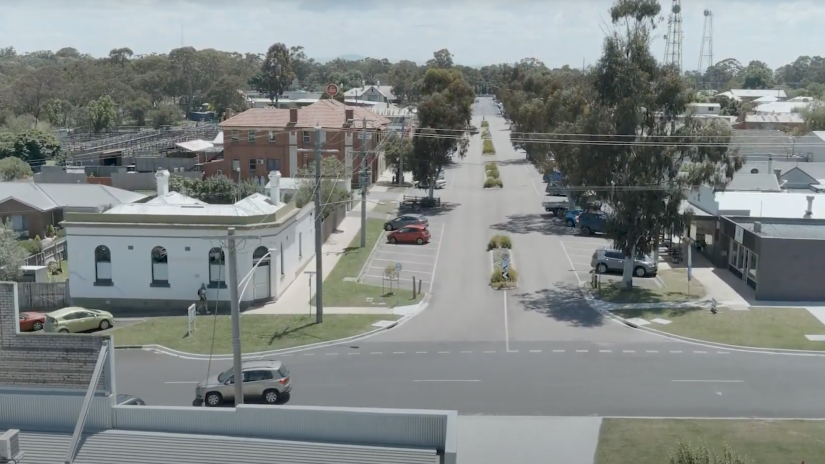
Three years ago, the town of Heyfield in Victoria’s Wellington Shire region embarked on an ambitious undertaking to come up with a solution to their unreliable electricity supply, while taking full advantage of the town’s many solar systems.

Thus the MyTown Microgrid project was born – an innovative collaboration between the Heyfield Community Resource Centre, the UTS Institute for Sustainable Futures and smart tech company Wattwatchers.

Since 2019, MyTown Microgrid has tested the feasibility of a microgrid as one possible way Heyfield could manage their own electricity supply. In tandem, the town participated in a data-driven energy literacy program, in which they tracked their energy use and learned how they could ‘flex’ their energy supply and maximise the benefits from their solar systems.

Local businesses and residents and even the kids at the local primary school got involved and now understand how electricity can be used to benefit the town and the environment.

Heyfield’s experience has provided valuable lessons for other communities and informed the MyTown online decision support tool. The tool walks communities through the process of deciding on the right energy solution for them and is based on lessons from the journey that Heyfield has been on.

Hear more from members of the Heyfield community and the MyTown partners in our short documentary film.
ppeaHU3jzW8

Descriptive transcript

MyTown was originally an idea that I had. I went to the community, to different businesses, and asked if I could get a grant for solar to put solar on their roofs, and they would buy from us, pre the meter. Everyone that I approached said yes, and Scott and Fran helped us along our journey. We did apply for one grant, but we weren't successful. Then UTS helped us do a second grant, and this is the MyTown Microgrid. So, it's been a fantastic journey.

Across Gippsland, there are lots of different energy programs taking place. There are lots of communities rising up and actually wanting to empower their communities with energy.

Heyfield is different because it's being collectively owned and driven from the grassroots, and that makes a massive, massive difference. It's also ambitious—it's aiming to deliver an entire solution from generation to distribution, and it's a solution at multiple levels: households, businesses, small businesses, and also industry as well.

We've been helping to support the Heyfield community to develop a business plan throughout this process, really trying to translate the technical analysis into what that means for getting their hands dirty and actually delivering projects. That includes setting up an entity or institution to take the activities forward, understanding what kind of scale of investments and community participation might be required, and the kind of activities and key partnerships they'll need to make the project work.

So, it's different in terms of its ambition, its complexity, but most importantly because a large part of the community is engaged, there is a community vision, and there is real ambition there.

The most important part about any community energy project is collecting data, and you're going to need a lot of it. It might be from the electricity network, from people's smart meters, or even from the consumers themselves. We've installed 100 Wattwatchers energy monitoring devices just like this in people's homes and businesses so we can capture this data directly.

I do have a Wattwatchers monitor—I think I was actually the first person to get one—and it's been really interesting to watch the graphs and see how my power is being used during the day.

That data is available to the community at the displays we've installed at the post office, the community resource centre, and one of the schools. The research team can also access the same data through the Wattwatchers cloud and our APIs.

The MyTown Microgrid is a really good program that helps the school and our students understand more of the benefits of the solar panels, and also with the links to the community of Heyfield. What we're hoping is to really use the graphs and the MyTown Grid program to educate our students so they are aware of energy efficiency.

Teacher: Now, can you tell me, do you know how the solar panels work? Student 1: So, the sunlight comes down and generates some electricity to power the laptops, phones, fridges and microwaves. Teacher: What happens to the electricity we don't use? Student 2: It gets shared around the town for other people to use. Student 3: It goes to the grid. Teacher: It goes to the grid, and other people can use that electricity too.

It's fantastic to be able to see the curves and the graphs showing how much we generate, how much we use, and how much we share with the rest of the community.

Energy data alone is not enough, so we had all the participants complete a survey about the type of their house, how they use their major appliances like heating and cooling, so that we had a complete picture of how they're using their energy, and we bring this together for all of the community devices.

Using my Wattwatchers app, I can optimise the use of my solar system by seeing what I'm consuming, seeing what I'm putting back into the grid. For example, if I can see that it's producing a lot of solar, I turn the dishwasher on or put a load of washing on. But if it's not producing enough to cover that, then I'll just wait for the middle of the day to turn those things on.

It's really important to involve all of the different sectors throughout the engagement process—from residents to small businesses to larger businesses like the mill—because without any one of those, you really don't have a full picture of what's happening within the town, and you can only tap a portion of the opportunities if you don't engage with them.

ASH, being such a large user of electricity, means that we've got to be considered in how we use our electricity and how the microgrid may feed in, or in fact how our own electricity generation feeds out and into the Heyfield microgrid. It's very important that we are part of that equation, particularly because of our size, our energy needs, and our potential to generate large amounts of electricity in times when solar is not operating.

On a community level, I'd like to see the creation of our own retail group, which would be able to generate our own electricity, and we would be able to buy back the electricity.

If Heyfield just went down with an autonomous retail setup, I think that would be sufficient. At least you get value from spending the dollars putting the solar on the roof, and then giving the opportunity for the locals on that same retail setup to buy their power at a cheaper rate.

This would be good, especially for people who can't afford to put solar panels or batteries or things like that in their homes. The whole community would actually benefit from the generation and use of our own electricity.

Solar would work for us with solar batteries, because what we need is a constant supply of electricity. We can't afford for power to fluctuate in its supply to us. So, in order to put a solar capacity in to help us with our generation, we also need to put in a large battery store, and at the moment that doesn't stack up for us.

I think the most important things for a community to consider with a business plan are, at first, their capability, and what are the skills and resources that exist within the local community, and how can they mobilise those in the given business model that you choose.

Perhaps the most important thing of a community energy solution is that all of the value stays in the local community—the money stays in the local community, it gets recycled into local businesses and spent locally—so value is really important for the community. Also, in terms of building community resilience and engagement, it's wonderful. There are so many flow-on benefits, but if it's driven from the ground up by the community, owned by the community, and the value retained in the community, then it's absolutely perfect.

The other element that we've been taking them through really carefully is their appetite for risk, because there are certain things that communities can and can't do, or do want to do and don't want to do, and don't want to expose themselves to. So, it's really understanding that balance between capability and risk, and what kind of roles they can undertake to be able to achieve the community goals.

For Heyfield itself, it's really the creation, I hope, of an ongoing community energy group who can actually take the findings of the feasibility study forward and begin lobbying for additional funding to actually make some of their goals a reality.

Heyfield's journey is going to be very similar, I think, to a lot of other communities. While they're at the very beginning, it makes it a lot more difficult, because they're looking for other communities to say, "Well, who can we learn from? Who is out there who has been through the same experience?" And there's not that many. Heyfield are, again, right at the bleeding edge. So really, the next communities that come along will be looking for our project to make it easier, quicker, faster for them to understand what makes sense for them and how to make energy work better for their towns.

So, one of the big outcomes of this project is an online decision support tool that we'll be making publicly available, so other communities can actually get a kickstart on their own project. It's going to have really important information about different types of energy sources and how you might structure community energy projects, as well as distil all the important lessons and learning that we've had here in Heyfield. Everything that we have learnt to date encapsulated in a really user-friendly online tool for other communities.

There's a lot of data that you need to get for a project like this, and it's important to know up front for those new communities what data they will need, and some of the data that they might not necessarily need, and how they can go about getting that. Ultimately, a tool like this is going to help other communities accelerate their projects a lot faster.

Over 85% of the people in this town would actually want to see Heyfield be 100% renewable, and I think we have very much the foundations to actually make that change and to ensure that everybody benefits from renewable energy in the future.


Share