

ISF hosted two panels for Climate Action Week Sydney 2024, contributing to the event's week-long focus on climate.

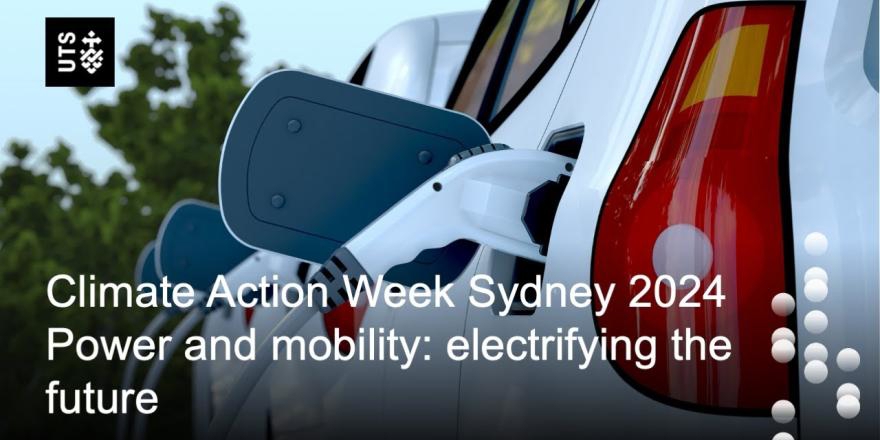
The Institute for Sustainable Futures (ISF) hosted two insightful panels during Climate Action Week Sydney: "Power and Mobility – Electrifying the Future" and "AI – Sustainable Fashion: Scoundrel or Saviour?"

Over the course of a week, a diverse group of academics, professionals, and creatives gathered at the Sydney Start-Up Hub. They shared the latest advancements in sustainability and envisioned futures that are not only sustainable but also regenerative and equitable.

Power and Mobility – Electrifying the Future 

After years of lagging behind, Australia is finally catching up on electric vehicles. Last year we saw 8% of all new cars sold being electric – By 2030, we expect this to be 50%. 

ISF's Dr Scott Dwyer and Kriti Nagrath, along with NRMA's Head of Strategy and ESG, Emma Cowan, and Integrate to Zero's DER Specialist, Dr Gabrielle Kuiper, discuss how bidirectional EV charging is set to revolutionise energy use, storage, and networks.

View the panel recording
XJrUJXVr9-M

Descriptive transcript

Hi everybody, welcome to our Climate Action Week where we'll be talking about power and mobility: electrifying the future.

I'm Dr Scott Dwyer, Research Director at the Institute for Sustainable Futures at the University of Technology Sydney.

Before we start, I'd like to acknowledge the Traditional Owners of the land where we're meeting today, the Gadigal people of the Eora Nation, and pay our respects to Elders past, present and emerging. We acknowledge them as the traditional custodians of knowledge for these lands, which is especially important given the challenges and opportunities we're facing in the transition of the energy and transport sectors with decarbonisation and electrification. With the impacts of climate change becoming starker every day, and the need for our communities and the land to be resilient in the face of a rapidly changing climate, First Nations people really need to be part of these discussions. If we want a fair and just transition, we must ensure the opportunities do not pass them by, through empowerment, self-determination and recognition of Indigenous knowledges.

So, the purpose of today is to talk about power, mobility and electrification. We know the transport system and energy grid may be combined in new ways we haven't previously imagined. Could parked EVs act as solar sponges, supporting the grid and bringing benefits to consumers and householders? Australia is extremely well placed, given our vast natural resources, the huge uptake of solar PV, and the growing uptake of electric vehicles as well.

Today we'll be hearing what this means for motorists, consumers, the grid, and our climate targets. The format for today: we have three fantastic speakers, each with five minutes to talk about the challenges and opportunities they see in the electrification of power and mobility. There'll be time for questions at the end. For housekeeping, please switch your phones off. You can raise your hand at the end for questions; we'll have a roving mic, and there are no fire drills planned, so exits are on your left.

I'd like to introduce our speakers for this session. I'll ask each of you to introduce your name, your role and organisation, and give a brief statement on why you think this topic deserves a panel session at Climate Action Week Sydney 2024. So, Emma.

Hi everyone, my name's Emma Cowan. I'm the Head of Strategy and ESG at the NRMA.

I think this topic of power and mobility deserves a slot at this event for a couple of reasons. Firstly, transport represents 20% of Australia's emissions, so it's a vital piece of the decarbonisation puzzle. Secondly, it presents a lot of opportunities, like vehicle-to-grid, to really democratise energy and put power back in the hands of consumers, while providing resiliency benefits and decarbonisation. So it's a multi-faceted topic. Thanks.

Thanks Emma. Kriti?

Hi everyone, I'm Kriti Nagarath. I'm a Research Principal at the Institute for Sustainable Futures at the University of Technology Sydney.

I think it's exciting to talk about power and mobility because this is one of those areas where individual action and institutional action can come together to create change. That's exciting because neither side feels like they have to do everything, but neither feels powerless to do anything. That's my take.

Thanks Kriti. Gabrielle?

Good morning all, thanks for coming along. My name is Gabrielle Kuiper. I work in distributed energy resources (DER)—rooftop solar, battery storage, smart appliances and the like. Today I'm speaking on behalf of an international NGO focused on getting more DER in countries around the world, called Integrate to Zero.

I think this topic is fascinating because people talk about the energy transition and how we're moving from pure energy to the digitalisation of energy—people might talk about energy tech—but electric vehicles add transport into that mix. So we're at the intersection of energy, transport and digitisation. I think electric vehicles are probably the most exciting and interesting part of that mix because of their potential.

Excellent. So you can see why we've got these three speakers here today.

I'm now going to pass over and we'll hear five-minute presentations from each of our speakers in turn, starting with Emma.

[Emma moves to the lectern.] I hope I don't get in trouble from Scott—my presentation might be slightly longer than five minutes, but it's only because I'm so excited to be here. Thanks for having me.

[Emma checks microphone.] Does this work? Yes. Excellent.

I'll start by explaining a bit about what NRMA does and how that's related to electrification. NRMA is Australia's largest mutual, with three million members. Our activities span roadside assistance, parks and resorts, SIXT car rental, Manly Fast Ferry, Fantasea Cruising, and EV charging.

We have an NRMA EV charging network, and we also own Chargefox, which is Australia's largest EV charging platform, along with the other motoring clubs in Australia.

We're here and excited about electrification because, as a 100-year-old motoring club, the decarbonisation of transport is obviously important to us.

That's why we've partnered with the federal government to build Australia's national backbone EV charging network. We're rolling out the capability to service EVs in our roadside fleet, including with mobile EV charging. We're installing EV chargers across all our holiday parks, electrifying our SIXT fleet (currently about 10%), we put the first EV ferry on Sydney Harbour in 2021, and we do a lot of education for our members around EVs through our Open Road magazine, drive days with the NSW Government, and online resources like our EV Hub. We also do a lot of EV policy and advocacy and are on our own decarbonisation journey.

What's so exciting about distributed energy resources—solar, batteries, EVs—that we're now seeing more and more in our community?

Australia has the highest rate of rooftop solar in the world—about one third of homes have it. However, we're seeing a challenge with both grid-scale and rooftop solar: output is being curtailed because during peak production times the grid can't handle that much solar.

Batteries would be a great solution—soak up the extra solar and use it later—but unfortunately, batteries are still quite expensive. For home batteries, the finances just don't stack up for most households. We're still only at about 2% household penetration for batteries.

This is where EVs come in. After years of being behind, Australia is finally catching up on electric vehicles. Last year, 8% of all new cars sold were electric; by 2030, we expect this to be 50%. Within categories where there are a range of EVs available, EVs are dominating. In the medium and large car categories, over half of cars sold in the first quarter this year were EVs. Australians want EVs—they just need more options and lower costs, and we'll see this continue to pick up.

Why is this a game changer for sustainability? EVs are essentially big mobile batteries. They're idle, like all cars, for about 94% of the time—so why not use them for something positive while they're sitting there? The batteries are much bigger than a home Powerwall—five to six times bigger—and the cost is actually lower because you've bought the car to be a car; the incremental cost is just the bidirectional charger, which is expensive now but will come down.

There's potential to use our cars as a big distributed battery. Studies have shown that by 2050, all the cars added up will be equivalent to four times the total storage needed in the National Electricity Market. They're a game changer for sustainability.

Quick show of hands—how many people work in energy or know a lot about V2G already? [Some hands go up.] Okay, about half. I'll race through this for those new to it.

In terms of terminology: unidirectional charging is regular manual EV charging—you plug it in, it charges. Smart charging is when charging kicks in when it makes sense, for example, when there's a lot of solar or the cost is low. Bidirectional charging, or V2X collectively, has a few variants: vehicle-to-load (using the car to power tools or camping appliances), vehicle-to-home (using the car battery to power your home), and vehicle-to-grid (electricity flows back into the grid to earn money when prices are high).

Stretch your memories to two recent instances: the February storms in Melbourne that left 700,000 homes without power, and the Boxing Day storms in southeast Queensland when hundreds of thousands of homes were without power for days. Not everyone was hit hard—early adopters of V2X were able to use their vehicles to do some pretty cool things. For example, one person used his Ioniq 5 to power home appliances when neighbours were without, and another powered her son's dialysis machine using her BYD. Imagine the potential if this was deployed at scale.

Aside from resilience, V2G also offers affordability—putting money back in the hands of the community and households. Early studies show V2G owners could save between $1,000 and $2,000 per year; one study showed up to $12,000. There are three key value streams: providing grid services like frequency regulation (discharging a small amount of the car's battery to stabilise the grid, usually via a third-party aggregator creating a virtual power plant), energy arbitrage (selling electricity to the grid when wholesale prices are high, if your retailer exposes you to wholesale prices), and increasing your self-supply of energy (using more of your solar and buying less from the grid).

There's a lot of potential with vehicle-to-grid—not just for sustainability, but for the stability and affordability of our energy system. We're excited about it at NRMA, but it's far from a done deal. There are barriers to make it a reality, which my fellow panellists will talk to, but it's important that as a sector we come together to ensure Australia seizes this significant opportunity. Thank you.

Thanks Emma. Some really exciting use cases for bidirectional and V2G as well. Our next speaker is Kriti from UTS.

Hi everyone. Today I'm going to talk a little about the opportunity we have from electrification of transport, specifically from electric vehicles, and how we can unlock these opportunities to create value for everyone involved. EVs are no longer a novelty. Although they're currently about 1% of the passenger fleet in Australia, in Sydney especially you've probably seen more and more EVs on the streets. We set a new record earlier this year where 10% of all cars delivered were EVs. We're moving in the right direction—still away from mass adoption, but it's a positive sign.

It's expected that the new vehicle emission standard the federal government hopes to introduce next year will enforce car manufacturers to offer a wider range of EV models, so the onus is no longer on drivers—there's more variety, which should help encourage uptake. Early research we've conducted on EV owners shows that one big motivation is sustainability or climate-related concerns. If we look at global climate finance trends, about half comes from private finance—about $600 billion USD—and a third of that is households, much of it driven by rising EV sales. So there's a global movement, and for good reason.

We often talk about EVs as something in the future, but the future is here—it's just unevenly distributed. Technology can't grow in a vacuum; it needs a nurturing environment, and that's the uneven part. To ensure the advantages of EVs are open to everyone, we need to nurture this environment, and things have started happening.

Multiple retailers now offer EV-specific tariffs, ranging from simple time-based rates (like plugging in at certain times for the best rates, e.g. weekends when the sun is high and electricity is free), to smart charging tariffs where you plug your car in, set boundary conditions, and let the retailer decide when to charge at the best rates, helping the grid in the process. There's a spectrum from vehicle-to-load to vehicle-to-grid, and benefits can be availed along the way.

How do we get to bidirectional or V2G charging? South Australia has already given permission for cars to do this—to interact with grids. They're the first jurisdiction in Australia to do so, but there have been exceptions in NSW. For example, our director's home charging network was able to make $100 over the weekend while he was on holiday—his car was plugged in, helped the grid, and everyone was happy. But this is currently an exception in NSW, so there's more work to do.

There are cars and chargers, but only a handful. There's one certified charger on the market, which is currently unavailable as they're updating the technology. So there's a gap between what can be done and what's happening. Communication is also a challenge: for this exchange to happen, the car, charger, grid and cellular all need to talk in the same language. OCPP (Open Charge Point Protocol) is commonly used globally, but V2G functionality is still under development. We're hoping in the next year this will be formalised.

How do we unlock these opportunities? There are two avenues: infrastructure (charging infrastructure and chargers), and value. For infrastructure, it's not always workable for everyone to buy a car and charger—there are space, time and money constraints. Other charging networks are needed, and local government plays a key role. Councils are developing strategies and policies for EV charging—deciding their role (facilitator, provider), locations, public access, and commercial arrangements. Change management is also important—how to encourage existing and potential EV drivers to make the change. Drive days and EV champions have worked well for corporates transitioning fleets.

Early movers are fleets—local governments and employers have their own fleets, and they're well poised to bring about change. It's happening slowly, but legislated net zero targets and sustainability policies are pushing government and private fleets to electrify. NSW, Victoria and South Australia offer grants to companies electrifying their fleets.

The other thing we need is to understand value. Value is not just money—it's comfort, convenience, risk reduction, resilience, and sustainability commitments. For EV owners, it's about comfort and convenience, but also the perception of running out of charge, which research shows is not a technical risk. The value of being independent of the grid or having backup is significant for Australians.

How do we translate this value along the chain? At one end, the EV owner—whose EV sits with solar, battery and other loads at home—needs holistic orchestration. Our work at the Institute is about orchestrating these loads for homeowner benefit and grid benefit. At the other end, the grid can benefit from FCAS services and energy arbitrage, avoiding billions in grid upgrades by using distributed resources. In between are aggregators—retailers, fleet owners, or new market participants—who can create new business models.

How do we do this? Partnerships. For example, NRMA and ISF are starting a research project to unlock V2G possibilities and create a service offering exciting for everyone in the value chain. There have been some interesting V2G trials in Australia: Flinders University has a virtual power plant with 10 V2G chargers; the ACT REVS trial was a large-scale attempt to understand the process; and the RACE project brings together over 30 organisations to answer how to make EVs profitable for everyone along the value chain. It's an exciting space to be in. Thank you.

Thanks, Kriti. Some amazing insights—those numbers around private household investment and the jump due to EVs are eye-opening. Passing to Gabrielle.

Fortunately, I don't have to say much about what V2G is and how it works—Emma and Kriti have done a fantastic job. What I can emphasise is that the potential of V2X and vehicle-to-grid is huge, and for the half of the room who aren't energy nerds, I want to explain why that's so important in the energy transition.

Historically, we've had a coal-fired-based electricity system. Coal-fired power stations are hard to ramp up and down—they generally have steady output. We're moving to a system—hopefully 82% by 2030—of variable renewables. That means our electricity supply is dependent on the weather, going up and down, especially in the middle of the day when the sun's shining.

Because supply varies so much, the most efficient way to run the system is to vary our demand and storage along with supply. We want EVs to be charging preferably off solar in the middle of the day, or sometimes when there's a lot of wind at night. We want demand flexibility—hot water systems, for example. It's the flexibility in demand and storage that's so important, especially when the sun's not shining and the wind's not blowing. Previously, we've relied on gas-fired power stations for those peaking periods, but we want to get off gas as soon as possible.

Hot water is the cheapest way to go, but after that, electric vehicles will be the cheapest and fastest way of getting a huge amount of storage into the grid.

We have 19 million passenger vehicles in Australia. We don't necessarily want 19 million EVs—preferably 10 million—because we don't need cars for the vast majority of our trips. NSW Government data shows that in Greater Sydney, 64% of weekday trips are less than two kilometres—less than a half-hour walk, or 10 minutes on a bike, faster on an e-bike, and probably longer to drive once you factor in parking.

Alongside large electric vehicles—including trucks, which we haven't really talked about today—we need a lot of electric bikes. People love e-bikes because they're fun. Stats from the US show e-bikes are 20 to 35 times more efficient than EVs, because you're not carrying a large heavy battery. EV batteries can weigh up to 550 kilos; an EV can weigh up to 2,500 kilos. E-bikes are more efficient and healthier. Interestingly, people ride further on e-bikes and get almost as much health benefit as from pedal-powered bikes.

In several European countries, they've had "cash for clunkers"—trade in your old car and get up to $4,000 to buy an e-bike. In a country with high car ownership like Australia, this is a fantastic policy worth considering. There's no reason why you can't have bidirectional charging on any electric vehicle—e-bikes, scooters, motorbikes, rickshaws. There are more electric bikes than electric vehicles in the world. Recently, a company in Ho Chi Minh City launched a service where, if a small business loses power, they drive an electric scooter out and plug it in to keep the lights and freezers running for a few hours.

This is the other dimension of the transition: we have to prepare for the massive disruption of climate change. Batteries on wheels provide enormous resilience. For people dependent on electricity for health, EVs are fantastic. What do we need? First, boring but necessary: you can't have EVs providing to the grid without standards. We've been waiting almost four years for DER technical standards. The Clean Energy Regulator could do this job.

Second, rebates for e-bikes, batteries, and V2G chargers (currently about $10,000, but costs will come down fast). There's a company converting vehicle-to-load cars like BYD Seal into vehicle-to-home for $1,000. Costs are coming down, especially with Chinese, Taiwanese and Korean manufacturers. Third, tariffs—people need to get paid for exports. Some distributors propose charging for solar exports, which is nonsensical. We need tariffs and market access; the wholesale demand response mechanism should be available to households.

Fourth, mandates. California has mandated V2G in EVs from 2027. Australia could look at a mandate by 2030. I don't understand why anyone would buy a petrol car in 2030—there are so many advantages to EVs, especially with V2G. People don't have to use it, but could save $1,000 a year if they do. Just four ideas to think about to make this happen. Thank you.

Excellent. Thanks, Gabrielle. Good to get that sense check that EVs fit within the broader transport hierarchy as well. Now, questions from the audience. Please give your name, organisation, and who your question is for.

[Audience Q&A begins.] Chris Moore: I've got two companies—CRVort (wind turbine manufacturer) and FAST (electric motor/generator). There was no mention of neighbourhood batteries, which I think is the best way of harvesting and keeping energy, given cheaper forms of batteries are available. Also, the conversion of vehicles, and for neighbourhood batteries, conversion of school buses that spend most of the day parked—they could charge up, do their school run, come back and feed out at night. What's the reason behind not looking at conversions, and also no mention of wind turbines?

Gabrielle: I'll take the neighbourhood batteries part. Community batteries are popular, but the question is what are we trying to achieve? Rooftop solar and EVs are great because you're co-locating generation and storage with your load—behind the metre is more efficient, using less of the grid. Studies show a net present value of $10 billion by 2040 if we do that. Distribution batteries owned by networks are expensive, and because they're in front of the metre, you pay more network charges. However, they can work if they're alleviating a network constraint and used for EV charging on the street—otherwise, I'm sceptical.

Emma: On school buses, if the question is about converting them to EVs or using their used batteries as community batteries, there's probably a role for all of these in the transition. By 2030, most new vehicles will be electric, so it's hard to make a long-term business case for conversions, but in the short term, before we have enough EVs, it makes sense—it's just whether it's scalable.

Gabrielle: Most V2G trials in the US have used school buses—they're perfect because bus batteries are huge. There's a role for all sorts of transport fleets. For buses running all day, it's harder, but sometimes they have layovers. We didn't talk much about wind, but rooftop solar and EVs are a perfect partnership. People can charge at work if employers are smart—Bunnings, Coles, Woolworths are putting solar on their roofs. Fleets are the way to go, creating a secondhand market for individuals. NSW government support is helping fleets convert, with some up to 20–40% electric. Also, electric buses are being built in Western Sydney—buses are something we can build here.

Murray Hogarth (Fifth Estate): There's a lot of talk about increased demand for electricity from electrification—not just vehicles but degasification, and now AI and data centres. Gabrielle, how do you see that playing out?

Gabrielle: I'm not scared of electrification, but I am scared of computing power and AI in terms of increased demand. In a former role at ANZ Bank, we found data centre energy use kept going up. Electrification of appliances, if replaced with best-in-class efficient ones, could actually reduce demand by 53%. EVs are significant demand, but many will be charged with rooftop solar, and solar installations are increasing. Panel energy density has gone up 45% in four years, so people are putting more solar on their roofs. With more solar and smart charging, transport electrification is manageable. Data centres and AI are a bigger challenge.

Ian McGregor (IMM): In terms of DER standards, I was told Standards Australia was developing standards for V2G that all state governments could adopt. Are you aware of any progress?

Gabrielle: I'm not up to the latest, but Australian Standards have been talking with ANU about interoperability standards. Australian Standards is a for-profit enterprise, and their standards are only regulated when governments adopt them. We need a body to do forward planning and make these decisions, and decide what standards go into the national electricity rules.

Emma: The AS4777 standard applies to V2G, and has just gone through consultation and will be finalised. The next step is for distribution networks to adopt it and approve it. Timeline could be 12–18 months for V2G to be permitted outside South Australia. At the moment, it's case-by-case.

Rob (Turo): In New York City, one fear is micromobility and thermal runaways—poorly built e-bike batteries and enthusiasts tinkering. What should Australia do as we plug in more e-bikes?

Gabrielle: It's mostly electric scooters causing fires, not cars. It's a quality control problem—we need to ensure only safe scooters are sold. Happy to chat further.

Nigel Redding (Census Architecture and Design): What do we think Elon Musk is up to with his robo-taxi announcement pending in August?

Gabrielle: I'm loathe to guess what's going on in Elon Musk's mind. He's been obsessed with autonomous vehicles for years, saying they'll be mass market soon. From a V2G perspective, Tesla cars may be V2G-capable from 2025, but he's made negative comments about V2G—possibly because it would cannibalise his battery business. The technology is there for autonomous vehicles, but regulation and legislation will be harder, especially in the US. The first time someone is killed by an autonomous vehicle, it'll be front-page news. I hope it happens faster, because most road deaths are from human error. If robo-taxis enable people to be without cars and walk or cycle, and if they're an adjunct to public transport, that's brilliant. But for all this to work, we still need much better, more frequent public transport and more transit-oriented development. None of this talk about EVs should stop governments from building more public transport.

[Further audience questions.] Question: Where do networks fit in as a platform? For example, if I don't have off-street parking but there's a charger on the street provided by the network, and energy from my rooftop solar can be virtually allocated to my car via the network, but the energy is billed zero—how do we see these things and changing ownership of vehicles, subscriptions, and the utility of vehicles as both transport and power source?

Gabrielle: The biggest opportunity is the role of EVs and other devices in providing network services. Currently, if Ausgrid in the CBD has a constraint due to too many data centres, they upgrade the substation, which is expensive. In the UK, they've removed the CapEx bias, so networks can procure services from EVs, batteries, and smart appliances, saving up to £40 billion by 2050. Because you can plug EVs into different parts of the grid, there's huge potential. PG&E in California has applied to buy a fleet of EVs to provide emergency power when lines go down—most outages are from trees on lines, not supply shortages. In a few weeks, I'll have a report out on how we could change network regulations to use distributed energy resources for network services.

Kriti: Our research is tackling how to make it profitable for networks and how they can procure these services. Fleets and workplace charging are interesting spaces for this, but our research report is about 18 months away.

Scott: I think we've run out of time, but thanks to everyone for all those questions—covering wind, AI, Elon, self-driving cars, e-bikes. Thanks to our panellists, the organisers, the ISF team, and most of all, thanks to you, the audience. Thank you.

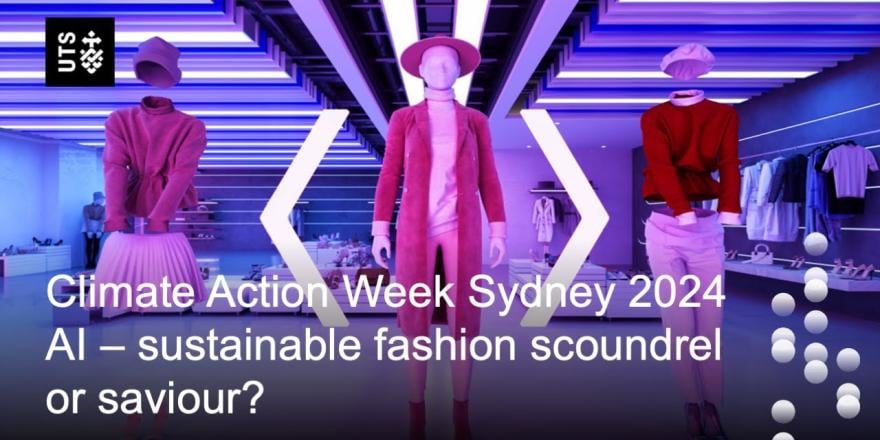
AI – sustainable fashion scoundrel or saviour?

Today, Artificial Intelligence (AI) is used in fashion to speed up unsustainable practices and sideline fashion designers. But some emerging innovators want to use AI for good: creating better, eco-friendly clothes and tackling fashion's waste problem.

In this session, Anna May Kirk, Program Curator at the Powerhouse Museum, ISF researcher Dr Taylor Brydges, ReWise founder Justin O'Sullivan, and UTS PhD candidate and fashion designer Wajiha Pervez discuss AI's role in the future of fashion. They explore AI as both an enabler of ultra-fast fashion and an innovative tool for sustainable design and purchasing.

View the panel recording
ZWc-UWjwNok

Share