

- Posted on 11 Dec 2023
- 6-minute read
Representatives from the Australian water sector join forces to plan for a sustainable water future.

Against the backdrop of a rapidly changing world, concerns about future water security, both in terms of water quantity and quality, have implications for national budgets, financial and construction planning, construction, and ultimately, the well-being of both people and the environment.
Recently, the UTS Institute for Sustainable Futures (ISF) hosted the Water Futures Forum 2023: Preparing Futures Scenarios, Their Representation, and Application’ which looks at visualising the future for effective water planning.
Making timely decisions and investments is crucial to prevent negative impacts on public health and economic stability. Scenario planning allows various stakeholders to address concerns, explore alternatives, and improve communication about potential futures for urban water.
The forum brought together practitioners from utilities, government, and academia. Attendees included water professionals from Sydney Water, the NSW Department of Planning and Environment, Urban Utilities, Hunter Water, Water NSW, Central Coast Council, and more.
Industry experts shared insights on scenario planning and creative ways to visualise the future for effective water planning. The day’s discussions focused on key challenges in the water industry and how foresight methods can help navigate future uncertainties in urban water management.
The forum highlighted the significance of translating potential water scenarios from a micro scale to a macro level of understanding – ensuring that thinking spans from entire landscapes down to individual homes.
ISF Senior Research Consultant Rachael Wakefield-Rann explains, “The second key factor is scalability. Connecting visions that might be affecting a city or an entire landscape and ensuring that our thinking goes from that scale down into the home and back out again. So, how you translate things that might happen at a micro-scale up through the meso and to the macro level of understanding of what is happening.”
Key takeaways included discussions on the role of stakeholders and how to engage with them meaningfully.
“The key points and themes that emerged from all of our discussions during the day were about the role of stakeholders,” says ISF Senior Research Consultant Varsha Sivagurunathan. “That is, who should be engaged with the process? How do we engage with different stakeholders in a meaningful way to create early good scenarios?”
The learnings from the Water Futures Forum are expected to benefit water planners and policymakers as they strategically plan for an increasingly uncertain future in the water industry. The collaborative efforts of industry experts, practitioners and policymakers will set the stage for proactive planning and decision-making in the face of evolving challenges in water.
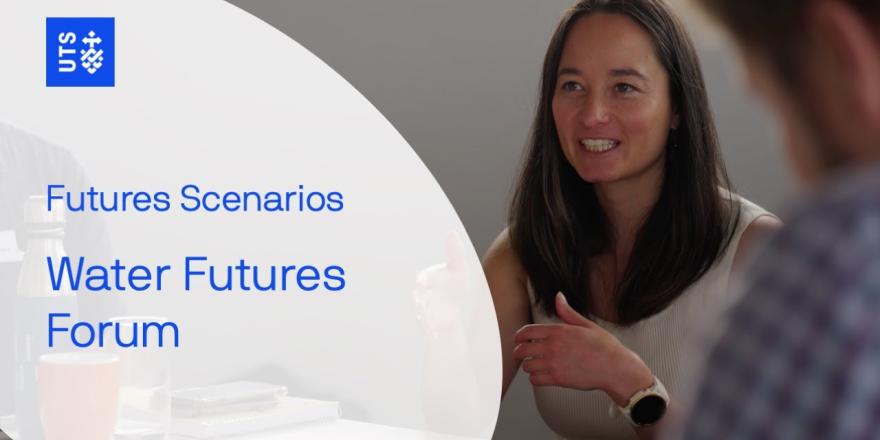
Watch the Water Futures forum
Preparing futures scenarios, their representation and application