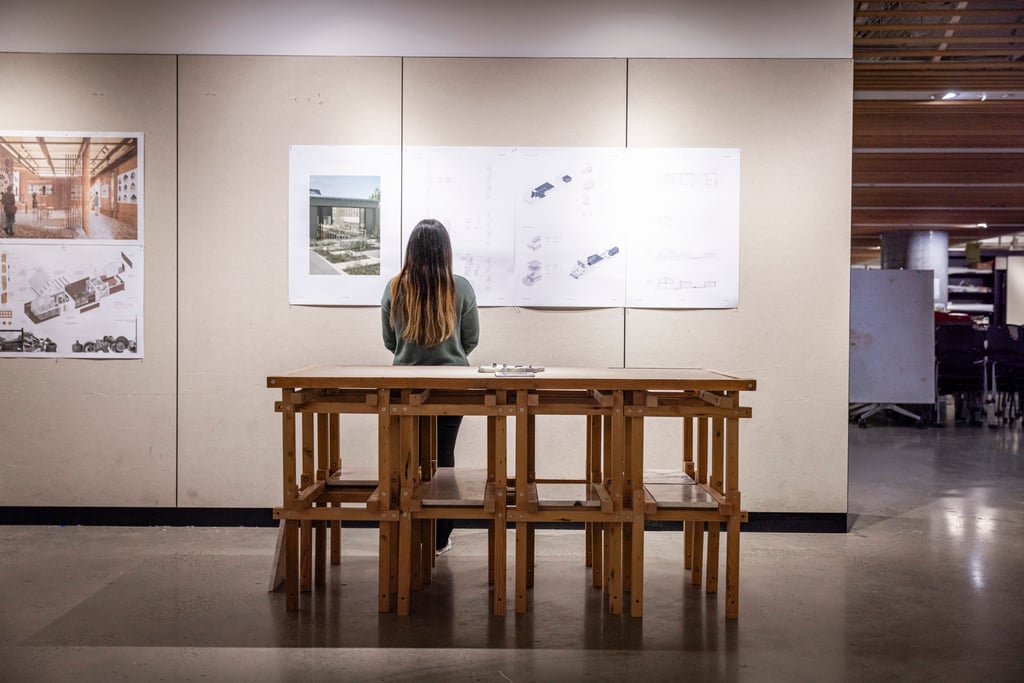

What are you mArching for? Your guide to the Master of Architecture at UTS

WHEN

On-demand


WHERE

City campus

COST

Free admission

You’re invited to an exclusive event for final-year Bachelor of Design in Architecture students from UTS and other universities as well as anyone interested in exploring our Master’s program.

Join us to discover how you can shape your academic journey beyond your undergraduate degree, with insights into pathways towards Architecture Registration.

Event highlights

  • Hear from Brooke Jackson, Director of the Master of Architecture Program: Gain invaluable insights into the program's vision, curriculum structure, and opportunities offered throughout the Master of Architecture Program.
  • Discuss your path: Engage in meaningful discussions to determine best method of study within the Master of Architecture program that aligns with your aspirations and career goals.
  • Canapés and light refreshments will be provided, offering a chance to connect with our teaching team and fellow attendees.
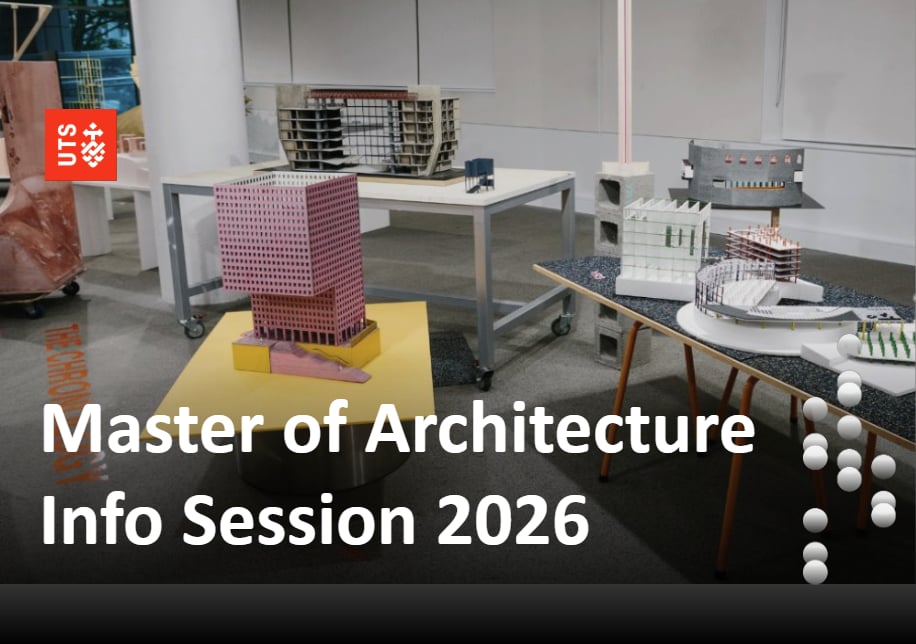
Architectural models on tables in a modern room, featuring various building designs. Text overlay reads "Master of Architecture Info Session 2026."

UTS Master of Architecture Information Session

UTS Master of Architecture Information Session transcript

00:00:00:00 - 00:00:15:14
Unknown
So welcome everybody. This is the information session for the Masters of Architecture here in the Faculty of Design and Society. For those who don't know me, I am Brooke Jackson. I'm the course director of the Masters in Architecture program here.

00:00:15:16 - 00:00:54:03
Unknown
I'm also a practicing a registered architect, and I currently serve as the academic registered board member, which is at the Architects Registration Board here in New South Wales. So before I would like to begin, we always acknowledge country. We are gathering on the traditional lands and Baghdadi people. One of the 27 tribes of your nation. And this is Lyons and have actually witnessed and have been cared for for millennia, undertaking deep ancestral knowledges and continuing care.

00:00:54:05 - 00:01:20:19
Unknown
So the important, as we gather here in these education spaces, to pay our respects, and I pay respect to what is past and present and anyone here or who is indigenous today. So what are you marching for? We'll select a wreath and start off with a bit of a pun there. You're at the end of the trajectory of probably your undergraduate studies and thinking about what do you do next?

00:01:20:21 - 00:01:48:16
Unknown
And the Masters of Architecture is something that's really something not to be taken too lightly, and something that needs to be entered in with full gusto. But it's really important to understand why we have the masters of architecture. So the Masters of Architecture is actually your fastest track to architecture. Registration. And what's quite different to the undergraduate program is that you get to cue right your learning.

00:01:48:16 - 00:02:16:12
Unknown
And I'll unpack this in just a little bit, because ultimately, what you will be doing and what we really would mark you to be undertaking is defining your nation as a future. And practitioner. And by that, we're a very interesting time in our profession. There's simultaneous learning going on between what we've been passed through. My national standard and what's going on in industry and what is playing out here in the academy.

00:02:16:14 - 00:02:39:05
Unknown
We are actually at a really momentous point of change for our profession, and you're going to be the change makers. So ultimately, we really want to think about what it means to challenge business as usual. And redefine what we're doing as a profession as a whole. And that's not pressure. That's exciting. So we can help you along the way.

00:02:39:11 - 00:03:04:10
Unknown
And we think that it's really important to define what we stand for as a school. So what is it that we're marching for? There's three key overarching themes that really stand as the lens. Some of you might have been introduced to these in the undergraduate. If you've done that here, it's the three core things that are really lending themselves to redefining how challenging business as usual.

00:03:04:12 - 00:03:32:04
Unknown
So we're definitely standing for decolonization. And through narratives and truth telling, we're interested in and having to push forward with the decarbonization projects, which also includes really key measures in thinking about biodiversity and landscape. And of course, the overarching question of urban equity and equity everywhere, where ever we build. And that ongoing pressure of the housing crisis.

00:03:32:07 - 00:03:53:23
Unknown
so what's really interesting to understand is that these things are not just things that are set the school, but they're actually set at a national level. Now, the Masters of Architecture is the accredited course that sets you up the pathway to your registration and wake up, and it's on this body called the double ACA, the Architects Accreditation Council of Australia.

00:03:54:00 - 00:04:42:22
Unknown
And they set up a series and performance criteria that you need to meet as graduates. So the performance criteria only for a number of things. They're definitely pushing forward for this rationale around understanding and respect for country. We have to be leading always with how we're thinking about connecting respectfully with community and country to self. We're also being asked for the first time to undertake carbon lifecycle analysis, which is really quite interesting because we get to understand not only measures of materiality, but we're really delving into this idea of material provenance and ethical material manufacturing, which ultimately is really driving this new wave of sustainability.

00:04:42:24 - 00:05:09:03
Unknown
And then finally, my favorite thing regulations, cards, everything that's legal about what we do. We want you to learn them implicitly. We want you to understand them so you know how to maneuver in and around them, and possibly even advocate for challenging them. And we do this through a series of line up of studios that challenge each of these things.

00:05:09:05 - 00:05:39:23
Unknown
So each semester you will have from 10 to 14 studios, which you get to choose from. So this is part of the curatorial practice and how you're thinking about really designing your own education, thinking about the people that we're bringing in to kind of recalibrate how you want to work as a practitioner, because each practitioner that we bring in has their own methods and their own contexts and their own agendas.

00:05:40:00 - 00:06:05:21
Unknown
And we're also getting you to really think about the different methodologies of how and why we're doing things. So we're talking to more than human. We're talking about how do we design with the consciousness of bio elements. We're looking at how do we design not only for our cities, but in the regions? We're also thinking about big systems and landscape systems.

00:06:05:21 - 00:06:41:04
Unknown
In our first semester, we have cross-disciplinary studios working directly with landscape architecture students. So then currently at the Hanging Slopes, we're also challenging ideas around typologies such as how to display things, how we challenge housing, and how we move and manufacture all these things we spend a lot of time curating for you each semester and each of these designs you hear, Liz, is so excited to be part of these projects because they're already testing these things in practice.

00:06:41:06 - 00:07:02:04
Unknown
So just a few of the people that we've had in the lineup this semester, of course, we've got academics within the School of Architecture, but we've also got people like crowd, gang, and that's the government architects office. BBN Hill Tower. We've got we're very closely connected with the IEA and the IAB, as we said.

00:07:02:06 - 00:07:42:12
Unknown
And of course, we also each semester run an indigenous led First Nations and knowledge studio, where you'll be getting to work first hand with First Nations knowledge holders. So this is what a Gem program looks like. So I just take you through this. Each semester you undertake your design studio so that you're 12 credit points. Subject. In addition to that, we've got a stream called Professional Practice, and that takes you through the logistics and logics and how you maneuvering towards registration pathway, but also thinking about the context around the culture and how to find the case.

00:07:42:14 - 00:08:16:00
Unknown
So these are six credit points subjects for the first time from next year, we're also undertaking and offering to new three credit points subjects as part of that sweeps quantum technology and documents. They are situated here. In your third session we are getting a demand release continuing this, and we're going to undertake documents that can be so useful for your portfolios too, and help to help you out there for your employment opportunities and how to really think through material launching and how we're doing things from an ethical perspective.

00:08:16:05 - 00:08:46:02
Unknown
So these things really delve and take you through this in your studio, because everything really comes back to that studio space where a lot of the performance criteria that I mentioned earlier said the things that we need to reach is the benchmarks you get to be can have the knowledge and really think about the real world application of the expansive thinking that you're undertaking in design studios and professional practice subjects helps supplement those things, but particularly in technology and documents.

00:08:46:04 - 00:09:06:12
Unknown
And then you've got three electives to choose from so you can choose those within the scope. I'll give you a few little hints of what's coming, and some of them involve overseas travel. And you can actually work across disciplines. You can take subjects from the landscape or if you wish, you can go into construction project management. You want to take other things from those environments.

00:09:06:12 - 00:09:35:07
Unknown
We encourage these things. We want you to have a really diverse knowledge set for you to be able to implement strategically. Once you leave the walls in the academy, we're really about setting you up for what you will be doing after your time here. It's so yes, we've got our architecture studio and we've also got this disciplinary studio each autumn semester, so we've got the postgraduate students in their honors year of landscape architecture.

00:09:35:12 - 00:09:57:00
Unknown
Joining us in the session, if you so choose to undertake a cross disciplinary studio. Now, what makes the choice available. So you can choose any single one of those design studios. We keep a measure of parity through adding to that learning through IPD. You may have seen that here in the green at the top to complement your designs.

00:09:57:00 - 00:10:34:23
Unknown
Two years each week we gather together in seminar Q&A sessions and consultancies that really help embed a deeper knowledge around First Nations and CC, which stands for the National Construction Code. You'll be undertaking. Thinking around innovation, around advanced sustainability and structures. We'll also be undertaking advanced construction detailing and also thinking about all things landscape. So yes, the IPD, which stands for an Introduction of Professional Development, correlates to what you would do as a registered architect.

00:10:35:00 - 00:11:01:02
Unknown
Because as a registered architect, you will have to undertake what's called CPD, which is a continuing professional development that you must undertake each year. So we're really setting you up to be in the rhythm of these things, to keep your knowledge expanding, to understand the way that your thinking about architecture isn't just responding specifically to the brief, that you must always keep yourself engaged with continuing knowledge.

00:11:01:04 - 00:11:24:03
Unknown
And then, of course, you will undertake a design log at the end of each semester, which just curates all the work that you've been undertaking within the design studio, so that you've got a readymade portfolio that really then becomes the knowledge and demonstrates this to your potential employers. Now, once a year at least, we'd like to also offer what is a global studio.

00:11:24:05 - 00:11:52:04
Unknown
So that still is a choice studio for 12 credit points subjects. Now there's two formats that we run. This global studio one is either during the semester, where you will continue in the same format of a semester, and then undertake a travel component, generally around the meet. Yes. To do that for about two weeks next semester we've got students going to Denmark, but we also have another format which is called a block mode.

00:11:52:04 - 00:12:22:14
Unknown
Global electives. Global studio, sorry, which is still 12 credit points. And we actually condense and consolidate the learning of the studio into about a six week period, which involves travel in a non main session calendar semester. So this actually also frees up your study plan to be a little bit more flexible. So talking about flexible program, it also shows you a very distinctive, regular way to undertake your study plan.

00:12:22:16 - 00:12:48:08
Unknown
You really can also Q8 how you unfold the program across the two years. And this is something that's really important for you to stay close contact with me as your course director. I can sit down with you and help you create your study plan to help and best serve and suit your particular, needs and the way that you need to be undertaking balance between the work life and work.

00:12:48:10 - 00:13:15:06
Unknown
So, for example, this is your typical study plan. As I mentioned earlier, traditionally you would do a studio, a professional practice and an elective a session. A lot of our studio students are actually a major to undertake their electives in block mode. So that frees you up and you're only undertaking 18 credit points in a semester. And students do like a two week elective in the summer or winter sessions.

00:13:15:08 - 00:13:45:05
Unknown
So that is you a little bit more time just to focus on those core subjects. So you have studio and professional practice. Another option is that you can actually recalibrate how you want to undertake your professional practice subjects. We do permit you to take them two at a time. You can also take them out of order. We do like you to take advocacy as, into your studies as possible, because that's one that really helps set you up to define who you want to be as a practitioner beyond the walls of this academy.

00:13:45:07 - 00:14:10:11
Unknown
But yes, there's a lot of flexibility as to how you can arrange your study plan and program. Another thing that students are really taking advantage of at the moment is going on exchange. Now, you can actually go on an exchange in any semester in your masters, including the final semester, but it's really important that you come and talk to me as soon as possible about this, so I can help you strategize.

00:14:10:11 - 00:14:32:13
Unknown
If you still wish to keep your program, contained within a two year time frame, which is absolutely doable. So we enable you to undertake one design studio and up to two electives on an exchange. And there's of course, various ways that you can structure your study plan around that. So yes, you can push all the professional practice subjects to the front end.

00:14:32:15 - 00:14:55:10
Unknown
You can, do an elective in a block mode if you wish, and then you can undertake your exchange semester, whatever you like. So we really like you to take advantage of that global mobility program here. And we think it's something that encourages you not only to be thinking about what it means to be designing here and how we're thinking about things from a global perspective.

00:14:55:12 - 00:15:18:02
Unknown
And we want to get you out and about. You are not contained within the realm of the studio space at all times. We do do a lot of fieldwork. This is a studio that I actually ran, on. It's kind of the leading lab, Northern Rivers research regarding the flood science and housing. We took a group up to managing our country, working with Michael, an architect.

00:15:18:02 - 00:15:42:23
Unknown
They jumped on Michael. This is his amazing house. But we're really looking at how to strategize, learning about the land, learning about systems and ecologies, and thinking about housing affordability and diversity. We also go to places, Mohamed Maki, who are undergraduate course director the most here in it's took students to Kuwait. Sorry. Abu Dhabi. Sorry.

00:15:43:00 - 00:16:05:22
Unknown
Last year. This is global. See work that we've undertaken in Japan in both a studio mode and an elective mode. We really try to open up your mind to how you want to think about. If you don't want to do the full exchange this semester, we really want you to get out there and take advantage of the things that we have on offer within the school that you cross the seas.

00:16:05:24 - 00:16:30:24
Unknown
What's really important is the work that was being proposed within the master studios isn't just pie in the sky thinking, we absolutely want you to be thinking expansively, and you will be innovating and you will be thinking speculatively that we also like to write everything back to real world application. So a lot of the work that you'll be doing will be directly engaging industry.

00:16:31:01 - 00:17:10:02
Unknown
So students have presented and have worked alongside local councils and policymakers. We go on exhibition. We're not just thinking about your work as being siloed and staying in the studios. We make your work public. You make your work public. The students have presented at international conferences, and this work has gone into real world policy and guidance. So we talk about being part of a change that the truth is, you really are going to be doing work that starts the momentum of making the change points happen.

00:17:10:04 - 00:17:37:05
Unknown
And we also celebrate you. We put you forward for all these awards. We were delighted to win the state medal, actually from I 1822. And we also have a really close collaboration with Steam Breath Australia. So the student awards, we have 1 in 2024 and this was the winning project last year. That is something to for you to also consider the two shout outs every year.

00:17:37:07 - 00:18:04:05
Unknown
For you to think about what type of awards you'd like to be involved with. And of course, and I was I got a special commendation, last year for Social Impact, which was a cross-disciplinary. So your, landscape and architecture with Thomas Meek coming in there. And Tyler actually then went on to win the statewide a, a New South Wales medal, which is the top accolade to graduate for graduates, for 2025.

00:18:04:07 - 00:18:34:05
Unknown
So it's really important to think about accolades. We can also assist you and what opportunities you would like to be connected to. So yes, what's really important to understand about the Masters is that you do absolutely have flexible study plan options. We do also offer some classes and nights. Two of the professional practice subjects are actually three, because the three credit points are also tailored around your design studies.

00:18:34:07 - 00:18:55:11
Unknown
We do actually offer some options to the design studios that run on an evening. If you might have more of your days cleared. We also collaborate and have a couple of studio sorry of subjects on the same day. So we've got electives and professional practice running on the same day, as well as some of the professional practice time directly into your studio.

00:18:55:11 - 00:19:15:18
Unknown
Also running on the same day as consultancies. So like we really want to try and strategize the strategic with your time so that you can make the most of your independent learning and whatever else you might be doing outside. If you're thinking about getting work in the industry to parallel your learning in the Masters, we can encourage that also.

00:19:15:20 - 00:19:37:16
Unknown
And also because we've got a media intake, you can undertake the subjects whenever you like. So you can join us to come join me here. You can take a pause or you can focus on really, getting through some of your core six point subjects and doing more of a technical semester and then pushing back one of the studios.

00:19:37:18 - 00:19:59:06
Unknown
So what's really nice to note is that you can get up to half of your hours that are required for your log book for registration whilst you our student prior to graduating, which is excellent. So I need to make, make you aware that you still need to undertake two years of work prior to sitting for your APA examinations for registration, but we'll be answering all of these questions for you.

00:19:59:06 - 00:20:20:16
Unknown
We get chatterer, who is the current APA head examined up in New South Wales. And she gives you a couple of ideas, sessions and some conversations around that. So we really are setting you up to think about how you can be the best you can be moving forward and getting towards that registration, but also be clear thinkers within the meantime.

00:20:20:18 - 00:20:47:15
Unknown
So in terms of the entry requirements, this is the one that we always get. So if you have a GPA, a size that might size, you will be guaranteed. And also we only give definitive courses if you are graduating students from UCS, in the final six undertaking capstone in the spring session, and you're hitting the 5.5, you'll be given an automatic offering is any one round of those things.

00:20:47:15 - 00:21:04:08
Unknown
But it doesn't really matter if you're sitting at a 5.5. You can apply and you will be guaranteed a place. Now, if you are sitting at a 5.0 GPA, you simply apply and submit your portfolio as well so

00:21:04:10 - 00:21:09:19
Unknown
you can come and talk to me, if you like me, to have a quick glance of your portfolio. But all of these come directly to me.

00:21:09:21 - 00:21:36:16
Unknown
Why some how a lot of people think. Well, I have undertaken three years of undergraduate study as a minimum, and we all know how much time and energy you put into that course. And it's really it's up to you. I'm happy to have a personal chat with each of you to think about what you want to do, but some of you really like to keep the momentum going because you still get another two years to really let all that really clear.

00:21:36:16 - 00:22:09:10
Unknown
Foundational knowledge incubate in new ways in the master's program, because it's not as much time coding, it's more about now. You lived on the pace, primordial language, and now you're maneuvering into really synthesizing all of that logic into pushing forward and innovating through responding to you. Just on embrace, you can also think about if you want to take a little bit of time off, if you're graduating in 2026, the semester doesn't actually start to alter, so you still get a four month pause.

00:22:09:10 - 00:22:35:08
Unknown
You're thinking about maybe try and getting work in industry or doing some travel if you decide to actually hold off and start a meet semester. So that's spring of 2027. That gives you a nice nine month break, which might be enough time for you to sort of recalibrate and jump back in. But for those of you who've already graduated, I know some of you in here today, we are still accepting intake for the spring commencing in 2026.

00:22:35:08 - 00:22:47:13
Unknown
And we've got a really, really I'm not just saying this. I promise a really, really exciting lineup of the studios in the spring 2026. So if you are interested, contact me afterwards. And I highly recommend that

00:22:47:19 - 00:23:13:18
Unknown
I think what we're doing here is particularly groundbreaking. We're going to think extremely ethically about the future of our profession. We're really here to support and guide you through the way, and we rightly want you to be excited about thinking about what this means to you, to set yourself up for your future, because time again, you've got your lifetime to be in the profession, and you get this one opportunity to undertake your studies.

00:23:13:20 - 00:23:35:23
Unknown
So we want it to be extremely dynamic, thought provoking, and rewarding for you as a process and mechanism. So I'm delighted you've come in today to listen and I'm happy to take any questions. If anyone has any.

00:23:36:00 - 00:23:39:22
Unknown
You can, you can do it. I mean, you can take a couple years off if you wish.

00:23:39:24 - 00:23:56:14
Unknown
I think there's a timeframe that we then, I think it might be four years before we kind of clicks into the next, phase of applying in a different way. But that's a good question to think about.

00:23:56:16 - 00:24:15:05
Unknown
Yeah. So, after your classes, you have to keep and maintain and around 16 students. So generally, each studio will give you the option to work individually or in groups. And, even if you're doing group work as a student individually to the level assessments, it's similar to those who are undertaking capstone.

00:24:15:07 - 00:24:38:02
Unknown
And you and I haven't done that yet. I've seen some leeway. So it's still within the agility for you to work independently. But yes, we keep the class sizes much smaller than the undergraduate classes, so we maximize around 16. Sometimes I go a bit smaller.

00:24:38:04 - 00:25:01:05
Unknown
So actually, for the one. So, the system's just changed recently, so it's really important to understand this. Also, we no longer undertake deferrals. So it's really important that you apply for the semester that you wish to be accepted into. So don't forget you can also start and you can also apply for the closest semester to you if you wish.

00:25:01:07 - 00:25:24:05
Unknown
And then, if it gets closer to the events, I would just suggest that you increase your acceptance and then apply immediately for the next semester. That is, generally once you if you've been accepted, once you've accepted for the next session. He restoreth my soul. It's an answer to your question. Yeah. Good.

00:25:24:07 - 00:25:43:00
Unknown
So first and foremost, we have my tabs over, how many students we can access. I will have to know so that we do have a CSP cap, which is government set, not university set, unfortunately. So, that's the only thing that you might be given an offer if it says that you are a full fee paying domestic student.

00:25:43:00 - 00:26:05:21
Unknown
So come and talk to me if that happens to be the case. In regards to the other question and how the ballot works. So we then calibrate the number of studios based on what our intake is going to be. So and then of course, then goes back to the question of how many students per studio. So, practically because somebody in Rome wants me to actually, we've got people in the wings that always come in and give us some studio.

00:26:05:21 - 00:26:30:19
Unknown
So that's really handy. The question answered specifically is what was your question again? Oh. The validate sorry, the Valentine. This is a big deal. This happens in the our week prior. So generally very early in the week because we have to give a bit of time to sort of hours. So you have a session, you get the prospectus two weeks prior to the commencement of the session, so you can read through.

00:26:30:21 - 00:26:50:19
Unknown
We generally run all the studios at the same time in the afternoon and the evening, so that you know how to structure and how to give and much, time to your employment plans so that you can prepare yourselves. So the building is a bit of a big deal. We get together in a big lecture hall and all of the studio leads get up and they present.

00:26:50:19 - 00:27:12:00
Unknown
So they actually then unfold a little bit more detail than what's written in the prospectus. And then we have a bit of a celebration, that's catered for you. We have an informal flow, into the studio spaces, and you get to chat specifically to the tutors that you're thinking of applying for. So then you then have looks at every single studio.

00:27:12:02 - 00:27:33:22
Unknown
And we do aim to try and get you in your top 4 to 5. But generally students get in their top three. But we do try and get top 4 to 5. And the preference goes, if you're in the final studio, you'll like more likely to get your top preference as opposed down, so that, you know, generally guaranteed your first or second preference by the final semester.

00:27:33:24 - 00:28:02:18
Unknown
I must also note that in your final semester, you can undertake something called a self-directed studio, and that's specifically with me. You will write your own brief and we'll work on that together. But this helps you set up the idea of things that you probably have been thinking percolating in your minds, and something that might not specifically make the nature way you want to address things in any of the studios on offer.

00:28:02:20 - 00:28:20:16
Unknown
So you're able to then work closely with me for a whole semester is a bit more flexible in the timetable, so we only make once a week because, you know, you are more flexible in your own learning. You set up your own methodologies of working, and it's quite a fruitful semester because that generally ties into what you're doing in advocacy also.

00:28:20:16 - 00:28:31:00
Unknown
So the entire semester can then be really around that one studio.

00:28:31:02 - 00:28:42:06
Unknown
It's very straightforward. You go through a student center for sure. Yes, yes. So you just apply to approach the student center and there'll be some instructions. There's also some instructions on the website.

00:28:42:06 - 00:29:00:18
Unknown
I generally give an announcement on canvas so that you can just press a link and get to it quickly. I would suggest because it's me and I know that it's you definitely put in your work from caps sentence to your size. And, if you want to put a few on the stick, that's what we're really looking for.

00:29:00:18 - 00:29:25:20
Unknown
And for those who are not from YouTube, that's what we're really looking for in the portfolio is evidence of your design thinking. I'm interested to see that you can design at systems level of thinking through buildings with complex building types. So if you've done like a gallery or a, housing, like a tall housing studio or something, that's a little bit more complicated, we definitely want to see that.

00:29:25:22 - 00:29:44:24
Unknown
And we definitely want to see some evidence of, technical proficiency. So if you've done any detailing and things like that, we just want to make sure that you've got the skill set that's not that's going to support you in your education of what's expected by the time you're in the masters. So just showing evidence of that is really important.

00:29:45:01 - 00:29:55:00
Unknown
And process process is also important. So the iterations

00:29:55:02 - 00:30:17:24
Unknown
it applies to. The Bachelor of Architecture is currently only called any degree that we accept in this pathway. If you've come from another discipline or another degree, then definitely come and speak to me and I will inform you of the surface pathway to be able to get you into the program.

00:30:18:01 - 00:30:30:24
Unknown
of it through a plan. So there are some opportunities that do come our way. So we're very fortunate to be given a grant from the, Penny, Grant Foundation, which we ran a global series.

00:30:30:24 - 00:30:59:16
Unknown
We were able to subsidize us some students. We've also had some new alumni plan electives, which, do kind of classify students. So and there's sometimes some grants associated. So we'll let you know precisely what packages cycle under in terms of grants and subsidies. Global mobility also have some scholarships and some funding. So now we take you all through that as well to let you know your options on sourcing.

00:30:59:16 - 00:31:06:02
Unknown
If you wish to do travel.

00:31:06:04 - 00:31:22:18
Unknown
it's pretty broad actually. And there's a few really good courses that the students have said and leaning towards. But if this is really specific degree that you're wanting to do somewhere coming out of Tasmania, sometimes the government is looking for opportunities to set up music.

00:31:22:18 - 00:31:41:05
Unknown
Other universities, I can't guarantee it. But I can say that there is a really cohesive line up for the Masters at the moment of quite, good programs, and now we've had so many students going, I think we'll also put on an event. My students can come back and talk about their specific, experiences in architecture. We do an architecture specific.

00:31:41:05 - 00:31:47:14
Unknown
Well,

00:31:47:16 - 00:32:00:09
Unknown
No it doesn't. So I don't mind, does it? I'm not actually sure whether you can elect part time as an option. I think it might just be that the way that you maneuver through your study plan means it's part time.

00:32:00:11 - 00:32:18:12
Unknown
We just monitor that check for it, because that's something that's kind of been out of my remit. We just need to monitor in terms of the time span that it takes, because it's a two year full time, a full year, part time equivalent to listening to manage to make sure that you're progressing. So that's the anything from our end.

00:32:18:13 - 00:32:37:06
Unknown
But otherwise, no, it will not be, justifiable. It's actually based on GPA, the CSP not to put pressure on you all. This is the first time there's a little bit of pressure. I'm not going to lie.

00:32:37:08 - 00:32:40:19
Unknown
I can't actually tell you because it does.

00:32:40:19 - 00:33:08:11
Unknown
There's some, but we can actually suite from on the things and it just depends each semester. So, yeah, I can't actually tell you what the definitive number is at this point, but generally based on we were able to give everybody a permanent, supportive place this year. In the end, I'm going to be disclosing at that time, if you're telling me that information.

00:33:08:13 - 00:33:38:02
Unknown
In terms of your electives, there are a swathe of subjects that are offered within the project management courses that you can undertake that will then be on your transcripts so that you've got a taste of what's going on with the project management side of things. Right. I guess it depends. I mean, you are able to possibly go into a project management master's postgraduate course if you feel like you are going to that and not maneuver towards registration as an architect.

00:33:38:04 - 00:34:00:05
Unknown
But you can also book an appointment, maybe chat about that. You can also book an appointment to chat to the director of the postgraduate offerings, the School of Business, romance, you know, everybody and architecture is merging or we have something in astronomy. So which is quite nice. So that we now formalized into one of these school. So now that means it is maybe we sit in the same corridors anyway.

00:34:00:05 - 00:34:21:03
Unknown
And you've always been undertaking subjects within that program, so, it doesn't really make a difference for you actually. It just makes it probably easier for us. So yes, there's a whole suite of subjects that you can elect to do as you wish to kind of queue, right, the electives that you're doing to be able to hone in, focus on the project management side of things.

00:34:21:05 - 00:34:38:24
Unknown
But yes, I can talk to the project management. Answer specifically because I don't on that course I don't know about and that's about it. But, you should definitely write to me as we can get you linked with that person. You may just have a discussion.

00:34:39:01 - 00:34:42:04
Unknown
No. It is completely on campus.

00:34:42:06 - 00:35:01:09
Unknown
Yes. Don't take me back to those days. That was before your time. You know. Yeah. My my memory is based together because we have to draw up,

00:35:01:11 - 00:35:08:02
Unknown
this is something else that I'm also advocating for. I cannot tell you anything further at this point.

00:35:08:04 - 00:35:19:13
Unknown
If and when that comes to light, I will certainly be communicating thoroughly to you all. Yes.

00:35:19:15 - 00:35:31:06
Unknown
Oh, what the studio is. It's similar to studio Studio four, where it's a different lens that you look at the same typology, or each of the studios have a different typology, and each of the studios themselves have different typologies as well.

00:35:31:11 - 00:35:58:04
Unknown
Yes. So it's the second one. If you didn't hear the question up the back to those scripts, the studio for composition was that as an overarching, theme. And each of the studios undertakes a different lens of that thing. That's not the case for the Masters in architecture. Each studio is distinct, is an autonomous one another. We are bound through the parity of deliverables, set the loan book and the inventory.

00:35:58:09 - 00:36:18:24
Unknown
But that's all being set up with a very clear structure that we got accredited for, for our maximum term because of the logic of how we did that. But we were really more interested in you. They had a key right in your way through the course. That's absolutely important by that stage of your learning. So yes, every single one, you're working with, the person that has written the course that lives breathes in eight set material.

00:36:18:24 - 00:36:37:07
Unknown
Mostly that's part of their own practice and methodology. And so you get that cool relationship with that studio lead who holds the contact and delivers that content and guides you through your response to that content.

00:36:37:09 - 00:36:49:01
Unknown
Yeah. Okay. That's very good questions. So first one, the structure of assessment for a studio is yes, similar to the undergrad where you have three touch points across the semester.

00:36:49:03 - 00:37:11:14
Unknown
The first assessment task is actually all of our research. And contextualizing the second assessment task really delves into your generating, final draft. And then the third assessment task is really the perfecting, you know, how we always say, if you only have three more weeks, what are you doing to set three more weeks? You get four. So that is where we like you pay.

00:37:11:14 - 00:37:33:05
Unknown
We give you a really hefty seven week period to focus on the translation and all that learning from the initial research into the design lens. And we've been running that method for quite a while, and it works successfully. The second part of your question, if my memory serves me, if I have forgotten that also, is that I have all the grades.

00:37:33:05 - 00:38:00:20
Unknown
Yes, yes, yes. So, in terms of party, we do take into consideration which triggers me and the so slightly because we know that you want to be developed. I can tell you, having witnessed for many years the translation from coming from undergraduate into the master's program, that you are ready irrespective of where you come from, because we get students coming from all different, undergraduate degrees from across the world, you know, architecture.

00:38:00:22 - 00:38:36:21
Unknown
So we, we set up the framework so that you are able to unfold and develop your own skills within a comfortable measure, even though, yes, it is elevated in terms of your learning, there is more expected of you, but you also get a little bit more autonomy to take ownership of your projects. And that's really where we want to get you in terms of your thinking and your ability to synthesize things in a more strategic by and being told how to unfold the methodology so specifically.

00:38:36:23 - 00:38:52:11
Unknown
Yeah. So I haven't seen students, like drowning and the shift from undergraduate to postgraduate. Yes. At the back. Do I have this

00:38:52:13 - 00:39:01:11
Unknown
Yes. So I will actually be holding a specific session for interior architecture students. There is a pathway which is currently the honors structure.

00:39:01:11 - 00:39:16:22
Unknown
So I'll break down what all of that means and then move myself from that. But that will be coming next semester anyway. So yes, please look out for that.

00:39:16:24 - 00:39:42:20
Unknown
I never want you to be doing things that is double barreled. You're just like, double barreling your time. Prepare your portfolio as if you would be preparing a portfolio for work, for a potential employer. And simply that to me, if you don't have time in terms of getting your portfolios in, and you want to give you swiftly, just give me work as it is laid out for your projects, just try and reduce this file size if you can.

00:39:42:22 - 00:39:58:05
Unknown
Yes, I know at this time because it is coming to me. So you don't really have to curators, however you laid it out. So your, digital uploads is perfectly fine by me.

00:39:58:07 - 00:40:20:09
Unknown
I cannot, automatic process if you're already sitting in a 5.5, I think come out even before end of semester. I will double check timing with the IPR. Do not be concerned at all if you haven't received an automatic offer, because I know a number of you are still awaiting to undertake an elective in the block mode.

00:40:20:09 - 00:40:35:24
Unknown
Summer studios. Or you might be weighing other credentials or whatever it might be somewhere along the line. But do not be. Just put in your application.

00:40:36:01 - 00:40:56:17
Unknown
No, I will international shoes anyone. So the guarantee officer only for UTS. That's huge. Yes. Exclusive. So Sorry. Yeah. So then everyone else has to put in for, portfolio application. Yeah. Even if you're above the GPA.

00:40:56:19 - 00:41:19:01
Unknown
So because now, we are maneuvering into having to produce more information for you to meet the objectives of the performance criteria. We are now running the two additional three credit point modules for the professional practice score, which means that we from 2027, when no longer running the project management stream.

00:41:19:03 - 00:41:39:10
Unknown
That doesn't mean that you can no longer do the other three subjects and still have those on your transcript. It was never in some major written on your, certificate. That was just that on the transcript only. I will also finding that a number of those classes were in block mode and conflicting with the timetabling schedule, so you can have a bit of a revamp as well for that.

00:41:39:10 - 00:41:48:19
Unknown
So yes, you can still undertake the other three.

00:41:48:21 - 00:42:09:21
Unknown
not sure how that works logistically in terms of enrollments, but whether you can I think, are you allowed to be enrolled in two different degrees at the same time? I'm not sure. This is very interesting. It would then just come down to strategising the study plan with the of the degree. But if you're looking into it, come and chat to me because I'm curious.

00:42:09:23 - 00:42:10:07
Unknown
Yeah.

Courses

Launch your creative, ethical future as a qualified architect with this career-ready degree.

Redefine urban living with architectural research.

Share

Hosted by

Brooke Jackson

Lecturer, Faculty of Design and Society

Related events

On-demand

Online

Free admission

Learn more

City campus Science Building, Building 4 CB04 Building 4, Science Area 337, Level 6, 745 Harris Street Ultimo NSW 2007

Free admission

Learn more

On-demand

Online

Free admission

Learn more