

- Posted on 20 Nov 2019
- 8-minute read
To celebrate the 40th birthday of the iconic UTS Tower on Broadway in 2019, here are 40 fabulous facts – and a little bit of fiction – about the tall poppy that some people love to cut down.
The essentials
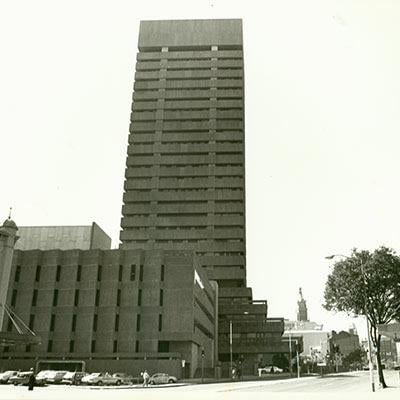
- The Tower is around 120 metres tall and has 32 levels although only levels 2–27 are occupied. The extra floors hold building services and storage.
- Brutalist in style, the Tower was initially intended as one of seven 12-storey buildings on the Broadway site. This plan was later modified to four buildings and then three. Because of budget constraints, only one and a half were completed (the half being the original 11-floor Building 2, now demolished).
- The UTS Tower cost $32 million to build, almost double the original estimate. The long-defunct Sydney Sun newspaper commented during the slow construction progress that the building was rising in costs but no other way.
- Then NSW Premier Neville Wran declared the UTS Tower open on 15 October 1979 – eight years after the start of construction. However, the podium had been occupied from 1975, prior to completion of the building.
- The Tower was originally home to the NSW Institute of Technology (precursor of UTS) engineering departments.
- The Tower was voted Sydney’s ugliest building by Sydney Morning Herald readers in 2006, while some have stated that UTS stands for the Ugliest Tower in Sydney, or have described the Tower as Sydney’s middle finger.
Architecture and construction
- The Tower was designed in 1964 by Michael Dysart from the Government Architect’s Office, who has said that integration of architecture and engineering was the key design driver, with “nothing to be concealed behind false ceilings, render or gyprock”.
- According to Michael Dysart, the building’s architecture is less a brutalist response and more a “respect for materials and economy of means” that responded to post-war austerity.
- During construction of the Tower, industrial action saw eight members of the Builders’ Labourers Federation lock themselves in two tall cranes and refuse to come down.
- Building works were supposed to proceed at the pace of one floor every three weeks, but at one point industrial disputes resulted in a single level taking 18 months.
- Architect Michael Dysart originally specified using an aggregate to coat the building from a quarry in Grafton that was similar in colour the washed Sydney sandstone of the NSW Parliament House. However, a darker colour was eventually used.
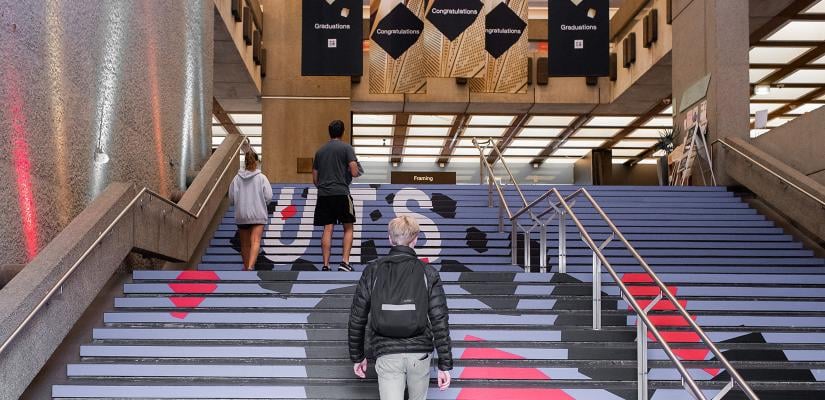
- Just eight vertical columns support the Tower, allowing the building’s podium to retain its sense of openness and grandeur.
What they said
- UTS’s first UTS Vice-Chancellor, Gus Guthrie, hit the nail on the head when he said, “We have a tower, but no one could claim it’s an ivory one.”
- Others joke that the best view of Sydney is from the UTS Tower – precisely because you can’t see the UTS Tower.
- Prominent Sydney Morning Herald columnist Elizabeth Farrelly called the Tower “conspicuous, defiant, detested”.
- Commentator Mike Carlton described it as a “menacing concrete monolith in an architectural genre that the old East German Stasi brought to perfection”.
- More recently, however, ABC Radio National opined that the UTS Tower is starting to look rather good, a striking counterpoint to the neighbouring green walls of Central Park and curved metal mesh of the Faculty of Engineering and IT building.
- Others have a foot in both camps, such as Professor James Weirick at the University of NSW, who says, “The interior of the UTS tower is magnificent. The great space under the podium is one of the great spaces of Sydney. It's just that the tower itself is terrible.”
- Even the University of Sydney’s student newspaper, Honi Soit, was somewhat impressed, saying that “the UTS Tower is a source of both beauty and mystery to those interested in design”, despite it not being to some people’s taste.
- Some would even prefer to have seen the original multi-tower plan realised. UTS academic Dr Alex Munt (FASS) wrote in Stories from the Tower, "To my mind, UTS would have been best served by more towers, not less."
Did you know ...?
- During excavation of the building site, a period of consistent rain saw the site flood, prompting journalists from the Fairfax building (now UTS Building 10) to row across it.
- Before the Tower was fitted out, level 3 housed a secret squash court, used by a small group of academics from NSWIT’s mathematics program.
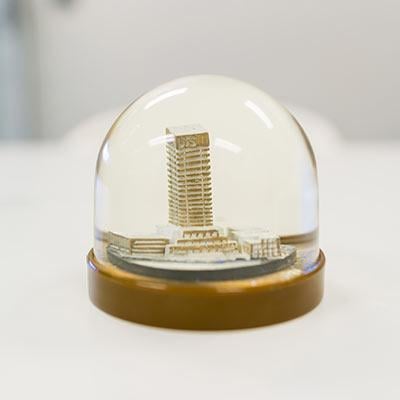
- The Tower’s distinctive form has been celebrated in a number of quirky ways, including lapel pins and snow domes, which quickly became collectors items. While academics and other staff apparently adored the snow domes, the visitors to whom they were gifted were often rather perplexed.
- The original Tower lifts were so idiosyncratic that some of them had names, including one known as the Kidnapper because of its tendency to whisk users off to random floors. The six old and often malfunctioning lifts – of which only two visited odd-numbered floors – were replaced by faster and more energy-efficient Schindler 7000 lifts as part of the City Campus Master Plan’s Tower Core Upgrade project, completed in 2014. The same project also fixed the gender imbalance in bathroom facilities, which had seen only 20% of Tower bathrooms reserved for women – and 80% for men.
- As well as the lifts in the Tower’s core, which stop at level 28, the building has a little-known lift that connects the top floors of the building to the rooftop, and another lift that services the Chancellery and Great Hall.
Fact and fiction
- At the time of the Tower’s construction, some students believed the Tower’s vertical form was designed specifically to deter student protests, following student riots in Paris and the USA during the late 1960s. In fact, the high-rise architecture is a response to UTS’s constricted urban campus.
- Rumours abound about the Tower’s windows being set high to ensure students were not distracted by the spectacular views across Sydney. In fact, the window height is a result of the building's structural system, which eliminates the need for a forest of supporting columns.
- Another rumour concerns a supposed nuclear fall-out bunker in the basement of the Tower, perhaps unsurprising as its design and construction took place during the geopolitical tension of the Cold War between the United States and Soviet Union. There is no evidence of a basement bunker.
- The arrival of an earthquake simulator in one of the Tower’s basement labs in 1994, five years after the Newcastle Earthquake, resulted in the dynamic reactive forces exerted by the ‘shaker-table’ having to be isolated from the building’s foundations to prevent computer screens throughout the building vibrating along with the shaker table.
- While the Health Sciences Department was based on level 14 of the Tower during the 1980s and 1990s, huge cockroaches from its neurotoxicology research program would regularly take the fire stairs to visit other parts of the building.
Celebrations
- When the NSWIT became UTS in 1988, celebrations saw fireworks set off from the top of the Tower – sparks raining down on unwary revellers below.
- To celebrate the Tower’s 30th birthday, 30 members of the UTS Speleological Society abseiled down the Alumni Green (northern) façade.
- Info Day 2008 at UTS was marked by students wearing UTS Tower hats to promote the university’s most recognisable feature.
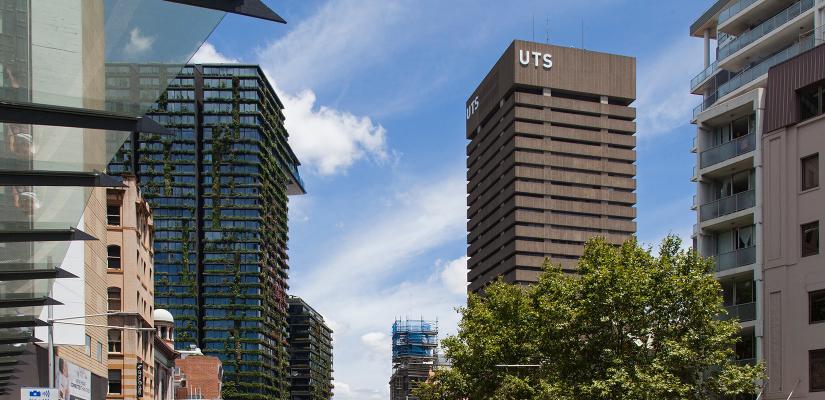
- In winter 2016, a ‘lighting-up' party celebrated the switching-on of the Tower’s first ‘sky signs’ – the illuminated branding at the top of the building that can be seen across the city at night.
Making changes
- The Tower’s confronting façade has inspired many ideas for transformation, including from the Laboratory for Visionary Architecture (LAVA) whose design proposed applying a mesh ‘skin’ with the ability to collect rainwater, save energy and generate solar power.
- In 2008, enthusiastic research students from the Faculty of Engineering and IT also explored the environmental potential of the Tower, carrying out detailed modelling, testing and analysis of the building for various uses. These included cladding the Tower with photovoltaic (solar) cells and other materials to reduce energy consumption and costs, and using wind turbines to take advantage of the high wind speeds on the Tower roof to generate power.
- Although the building was originally designed for students, the impracticality of moving thousands of students around a vertical building soon became apparent. Today, non-faculty administrative staff are accommodated in the Tower, while the more easily accessed lower podium floors are largely student and public spaces.
- In transforming the Tower into staff workspaces, the traditional office floorplan was flipped on its head. On most floors, management is located in the core, while staff in open-plan workstations around the perimeter enjoy the best of the natural light.
- Under the City Campus Master Plan, the UTS Tower’s Great Hall was transformed into a warm and dramatic space, thanks to hundreds of copper ceiling and wall panels, designed for acoustic performance.
- The last project of the City Campus Master Plan is expected to be a glass podium extension. Designed by architects Lacoste + Stevenson, it will snake out from UTS Central (Building 2) across the Broadway façade of the Tower.
Sources: Stories from the Tower: UTS 1988–2013, Unfinished Symphony, Architecture Bulletin March/April 2012; The UTS Tower: a brutalist fortress, Honi Soit 2017; Iconic Buildings of Australia: UTS Tower, ABC Radio National 2016