

• Posted on 20 Jul 2022
  • Updated on 20 Jul 2022
  • 10-minute read

Collaborating across disciplines helps our research address some of the most important challenges we face by knitting together different perspectives.

Here four UTS researchers - two from STEM fields and two from HASS fields - discuss the research projects they have worked on together and the many ways their differing expertise has combined to deliver outcomes that are bigger than the sum of their parts.

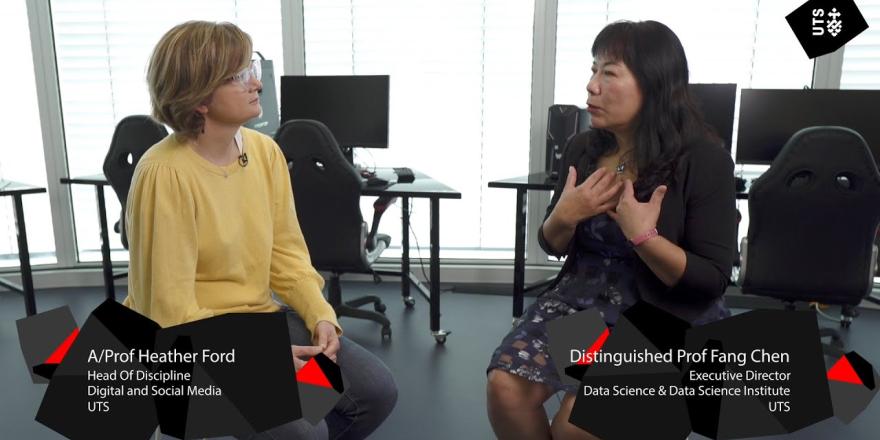
Professor Fang Chen (FEIT) and Associate Professor Heather Ford (FASS) discuss their work on uncertainty

"When we tried to find the research goal joint research goal together, it wasn't about you convincing me or me convince you. It was about how we can be jointly and complementary to each other, to fill the gaps each other has."
O_PQdOVZ0Ww

Transcript

So Fang, do you remember how we got to working on the Uncertainty Project?

Oh, absolutely. I remember. That was an exciting time when I was chatting with the faculty, the FAS, about what sort of social aspects around ethics. And of course, your name popped up, particularly around communications. And then, you know, there we go—we sat together and talked about what the joint points were, and uncertainty just popped up.

I remember maybe Jiang Long or maybe starting off by talking about uncertainty. And, you know, I'd heard this term before and obviously it's very connected to transparency. But it was really interesting because I learned there's this whole field that you are embedded in around communicating uncertainty. And I think we started off the project with this common term that we both come at in very different ways. But that was really helpful and interesting to me.

So from the AI machine learning model, one of the biggest challenges is because it's probability-based, hence you have uncertainty inherited in the model. Of course, it's inherited in the data as well, right? So this probability-based approach is clearly linked to the risk in decision making. And the missing part is coming from the human side—interpretation of those uncertainties. How to interpret the uncertainty, not just from a purely data science and modelling perspective.

Do you want to talk a little bit more about some of the things that we were doing?

Yeah. So I remember we collected 70 to 80 papers, partially from data science, partially from social science. Even looking at the word cloud of the key words that popped up from those papers, it looks so different. So from the uncertainty data science perspective, you look at the models, you look at the data, you look at the parameters. On the other side, you look at risk, you look at communications, you look at very different terms. So I was so, how can you say, nicely shocked by the difference. But that was the first discovery for me—that we were coming from a very different angle. And so glad that we sat on the same page after that.

What really struck me was that data science, because you're dealing with these really complex models and trying to predict with as much certainty as possible what the level of uncertainty is. You're really looking within the model, within the system. And as social scientists, what we do is we kind of look at everything outside. So we're looking at different kinds of people that come at the system with different kinds of belief systems. We're looking at the political economy of how these institutions work, the kind of trust that people have in those systems. So all of these external things. And so it's a really nice marriage, trying to model uncertainty really accurately and thinking about all the different ways that you can do that. But then also thinking about how ordinary people, or specific types of people depending on the system, would come at that uncertainty. How would they interpret it? What might be the problems in their interpretation? And all those kinds of factors.

Over time, how do you find working together with people coming from our group or different disciplines?

Well, it's an amazing opportunity, isn't it? Because when do you get this opportunity? You hardly ever do. I mean, there's not many times when you're able to really hear people's perspectives, especially someone who's a sociologist of technology. I mean, I study technology and I'm an ethnographer, and I tend to work with groups like Wikipedia as one of my main sites. So I work with technologies involved in Wikipedia, but in the university I haven't really had that opportunity before. So it's really great to hear data scientists' perspectives on all of these things. Generally, interdisciplinary work takes a lot more time, right?

Absolutely. I think I agree with that. It's challenging from the start, because we needed to basically step outside of our comfort zones to read different things. I have to admit that I haven't read so many of the papers from the social science perspective. I feel like I can close my eyes and read all those data science papers very quickly—just flip through. But one of the papers coming from your literature, to me, that probably takes three or four times longer than the usual time I read a paper.

The second one is the terminology. I think terminology is, of course, the foundation of the challenge coming from interdisciplinary or cross-disciplinary work, because we use different terminologies. How our professional lives shape us and trying to even think from others' perspectives—that's a challenge.

Were there any things that you thought worked really well when we were working together?

When we tried to find the joint research goal together, it's not about you convincing me or me convincing you. It's about how we can be jointly and complementarily working together to fill the gaps each other has. So I think that works well.

Thanks for joining me today, Fang. I love talking to you and we don't have that many times to do it, so thank you.

My pleasure, and I look forward to working with you more in future.

Thanks, Fang.


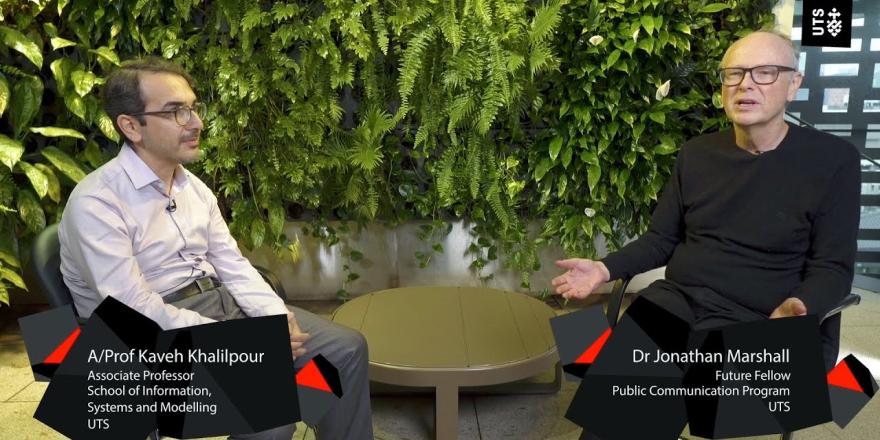
Dr Jonathan Marshall (FASS) and Associate Professor Kaveh Khalilpour (FEIT) discuss their Narrabri project

"We know that climate change is the big elephant. We know that we need to put the forces together to address that. But sometimes we are touching the elephant from different angles and we don't recognize that we are on the same topic."
kEBR7Uy1Xrc

Transcript

The point of the project was to investigate a renewable energy startup in Narrabri. They call themselves Genie Energy and they're dedicated to bringing community renewable energy to Narrabri, in the hope of freeing the town from gas and coal, and also starting up new manufacturing and other businesses there.

We also want to write a computer model that actually describes how community energy transitions occur, develop that across Australia and also into Europe, so that people can use a computer program to get recommendations about how they should work towards community energy and its primary benefits.

The beauty of this collaboration, John, in my opinion, is that just before doing this project together, we had done a few projects on community energy development, but in most of those projects, the society, the community, was not involved in our research. We had input from the community, but we were just based on our imaginations, doing our technical optimisation, data analytics, tools and everything. We were producing results, but without knowing how the community was going to use it. But this project brought things together.

Very often we are missing the social parameters. To get information from the community, you need to develop some sort of rapport, some sort of human touch, human communications—all those things. But very often we fail.

Yeah, that's difficult for everybody. Working with you and also your team, I could easily see that missing element where we connected with the society we were approaching. Like our December visit to Narrabri—it was totally different from the other visits I used to have. You brought the community with a different spirit.

I find that social scientists tend to treat technology as endlessly flexible, without the actual constraints of how the thing works. It's really useful to be with people who understand how renewable energy works.

In the long term, it's also useful because it's really hard to test your theories in the social sciences. But if you build a computer model out of it, you can actually see whether what you're getting works on the ground and whether it replicates the sort of things you've seen on the ground. I find that really exciting.

Someone was joking that the Berlin Wall fell 30 years ago, but still these cross-disciplinary walls exist in universities. Now, renewable energy and climate change—the challenge—even from an engineering perspective, just within engineering, we have electrical engineers, computer scientists, different backgrounds. Sometimes even between engineering schools, we don't collaborate enough to address the same problems. It needs to be cross-disciplinary.

So coming to cross-faculty collaboration, the same problem exists. The big elephant is there. We know that climate change is the big elephant, and we know that we need to put our forces together to address that. But sometimes we are touching the elephant from different angles, and we don't recognise that we're on the same topic. So, modelling from an engineering perspective, or from your perspective—

Yeah, no, I'd agree. One of the reasons that all of this started was we had a visiting scholar from India, Gopal Sarangi, who just wanted to talk to everybody in UTS who knew anything about renewable energy.

Because I was looking after him, I suddenly found there were all these people in the university I'd never heard of who were doing stuff on climate change and renewable energy. That's how we got to meet Alexei and Titania—simply because he didn't take our barriers seriously. That's had a major effect on subsequent life, I guess.

Jonathan, what are your tips for future collaboration for those colleagues who want to start these kinds of cross-faculty collaborations?

I guess, first of all, find your people. That's the number one problem. When I started my last fellowship, I talked to a lot of people, but everybody was very cliquey in their groups, and it was really difficult to make contact of any sort that got out of that group.

So I think the sort of thing that Gopal did—basically ringing people up and saying, "Hi, I'm from this faculty and I'm doing this kind of work, and I'd like to talk to you about your work and see if we could set anything up"—is really, really important.

Absolutely. And you just don't know who the people are that you're going to end up working with.

Jon, I have fully enjoyed working with you over the last year, and I hope that this will continue infinitely.

Yeah, so do I. It's been really great fun and a real expansion of understanding, and I don't think any researcher can ask for more than that. So yeah, I hope it goes forever too.


Find out more about how to collaborate across the disciplines with two new RES Hub modules


Share