


- Posted on 1 Jun 2023
- Updated on 1 Jun 2023
- 6-minute read
Results, including ATAR scores, are often influenced by the socio-economic circumstances of the family, the resources available to their local school and community, and whether the student is from an Aboriginal and Torres Strait Islander background or from a non-English-speaking background.
There are many factors that impact educational outcomes that are unrelated to a student’s ability.
Results, including ATAR scores, are often influenced by the socio-economic circumstances of the family, the resources available to their local school and community, and whether the student is from an Aboriginal and Torres Strait Islander background or from a non-English-speaking background.
To ensure that every student gets a shot at a university education, UTS established the U@Uni Academy to target those who would be unlikely to gain admission using traditional pathways.
“The program is designed for students who want to go to university but for a wide range of reasons, do not get the ATAR score required to access higher education,” explains Sonal Singh, Executive Manager, Student Access and Equity.
“We want to ensure the students at UTS reflect the broader population, so we need to create opportunities for students from all kinds of backgrounds. To achieve this, we work very closely with high schools, because it is within schools that ideas for higher education are planted,” Singh says.
U@Uni is a two-year program beginning at the end of Year 10. Participating students are introduced to the university experience, receive tutoring and additional support to develop the skills necessary to succeed in higher education and beyond.
The program sees selected students complete modules, tasks, Winter School (fka Summer School) and tutoring sessions throughout their stage 6 studies, preparing them for university. Students who successfully complete the program are offered a place at UTS.
A key priority for the program is for students to develop a sense of belonging in the higher education space and receive all the support they need to succeed when they get here. One such student is Micqut Ngaata, who grew up in Punchbowl and successfully completed the program before starting his degree at UTS.
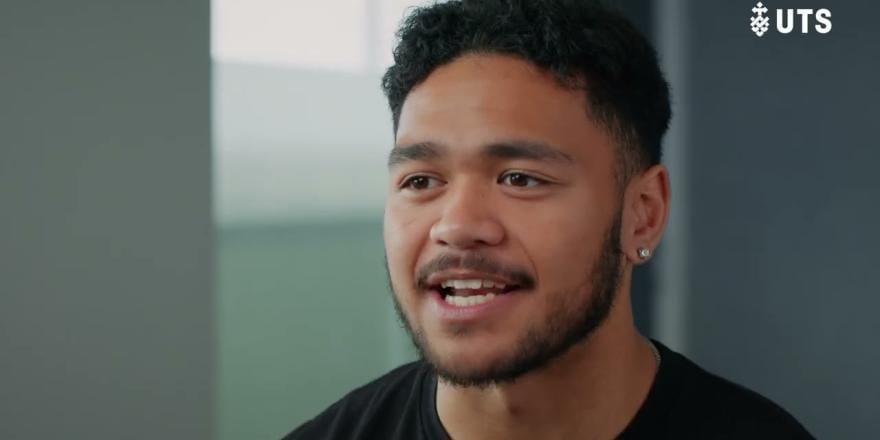
“When I found out I was going to be a part of the U@Uni Academy, I felt a bit anxious and a bit scared because university wasn’t really something that I knew a lot about,” he remembers.
In delivering the program, mentors are purposefully selected from similar backgrounds to the students so that they have accessible and relatable role models.
“It was an amazing experience and I felt very comfortable, especially because the mentors came from a background where everyone kind of had a similar upbringing. That made me comfortable and seeing them at uni was good because then I knew that we could make it as well.”
The program takes a unique, tailored approach in addressing inequality in tertiary education by pitching to students who are not on track for university and making the content and experience less daunting.
“The U@Uni Academy was really catered to us, and they made it simple for us to understand the content. I feel like at uni, a lot of learning is based on you knowing certain things but at the Academy, there wasn’t any assumed knowledge, so it was easy for us to understand things properly,” says Micqut.
“The team works with us instead of setting outcomes for us and pushing us towards them. The help we receive is always specific to the person, to us as individuals.”
The impact of the program for those who complete it cannot be understated, says Micqut.
"The Academy means a lot to me because it has opened up a lot of opportunities for me. A lot of students came together that came from similar backgrounds, and we all have the experience of coming from low SES communities.
“We all have that shared experience, we all came from the same place and yet we’re here now. We’ve accomplished a real milestone. It’s nice to know they are all here with me, and that there’s space for my community at UTS.”
| Social Impact Framework |