


- Posted on 30 Sep 2026
Microplastics and the emerging business risk
Microplastics have moved from a marginal environmental concern to an issue attracting increasing attention from regulators, investors, businesses and consumers.
Evidence suggests that microplastics are pervasive throughout the environment and supply chains, having been detected in oceans, freshwater systems, food, drinking water and human tissue. At the same time, governments around the world are introducing new restrictions, disclosure requirements and regulatory frameworks aimed at addressing plastic pollution and its impacts.
At UTS Business School, researchers from the Centre for Climate Risk and Resilience and Change for Good at UTS are examining what this transition means for organisations, industries and society.
Our research explores microplastics not only as an environmental challenge, but also as an emerging issue of business risk, governance, regulation, consumer behaviour and organisational change.
Why microplastics matter
Microplastics are small plastic particles and synthetic polymers that can enter the environment through product manufacturing, everyday consumption, industrial processes and the breakdown of larger plastic materials.
Global plastic production now exceeds 450 million tonnes annually and could reach 1.2 billion tonnes by 2060 under current trajectories. As plastic production grows, so too does the challenge of managing microplastic pollution across supply chains, products and ecosystems*.
For businesses, the implications extend beyond environmental stewardship. Microplastics are increasingly associated with:
- Emerging regulatory requirements and disclosure expectations
- Supply chain and operational risks
- Reputational and stakeholder concerns
- Product and materials innovation challenges
- Changing consumer expectations and behaviour
Our research suggests that organisations that begin understanding and managing their exposure today will be better positioned as expectations continue to evolve.

All available evidence points to both types of microplastic being pervasive and persistent. Proof is emerging they’re implicated in harm to human health and global ecosystems.
Professor Martina Linnenluecke
Our approach
Addressing microplastics requires more than technical solutions alone.
While advances in product design, recycling, waste management and materials innovation will be critical, meaningful change also depends on understanding the behavioural and organisational drivers that shape production, consumption and disposal practices. The evidence reviewed in our research indicates that technical and regulatory responses will be insufficient unless these broader behavioural influences are addressed.
By bringing together expertise in climate risk, sustainability, corporate governance, behaviour change and social marketing, our research provides organisations with practical insights into how they can prepare for future expectations and contribute to effective solutions.
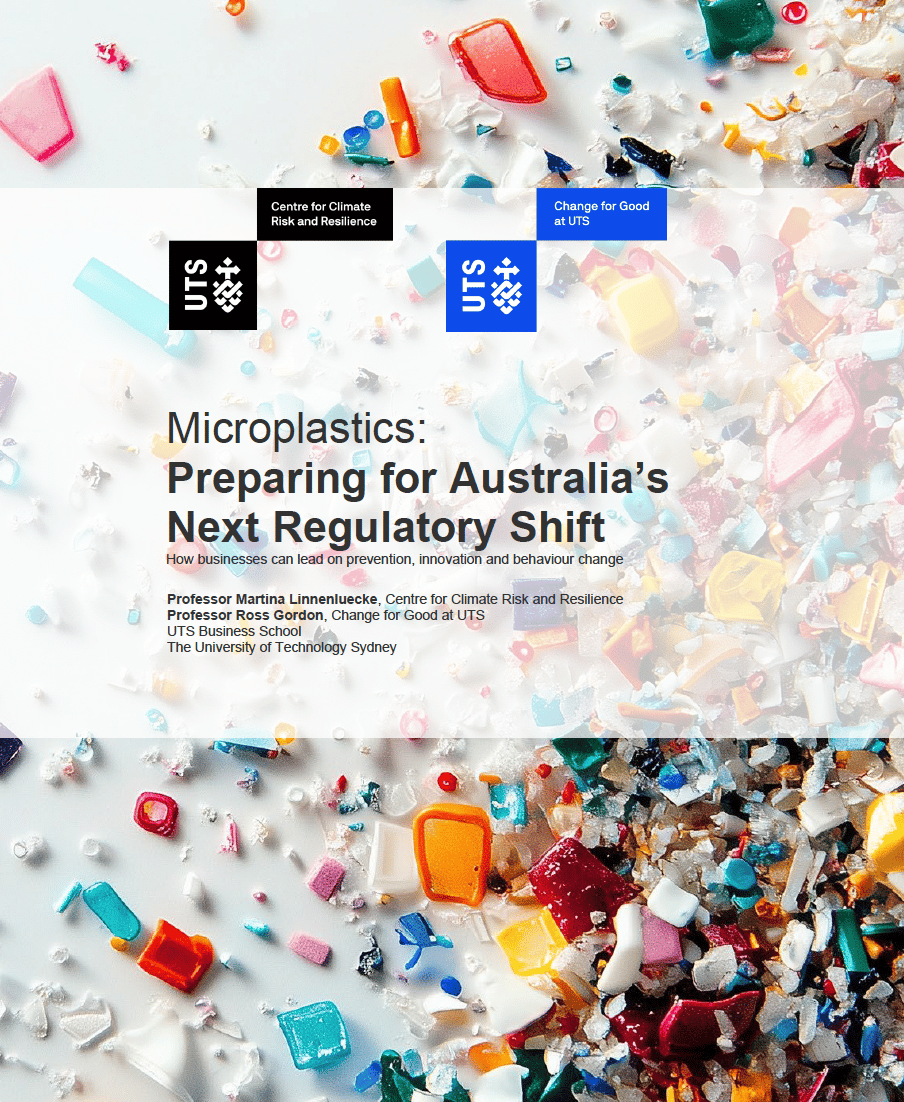
Our research
Microplastics: Preparing for Australia's Next Regulatory Shift
Our inaugural white paper examines the growing body of scientific evidence surrounding microplastics and explores the implications for Australian businesses.
The report highlights:
- The increasing prevalence of microplastics across ecosystems, supply chains and everyday products
- Emerging regulatory developments in Australia and internationally
The implications for business risk management, governance and disclosure - The behavioural factors that influence microplastic generation and mitigation
- Practical actions organisations can take to prepare for future regulatory and stakeholder expectations
The white paper argues that microplastics are not simply an environmental issue. They represent an emerging business challenge requiring organisations to consider risk management, governance, reporting, innovation and behaviour change together.

The white paper argues that microplastics are not only a technical or regulatory problem, but also a behavioural challenge shaped by how products are designed, marketed, used, maintained and disposed of across supply chains and everyday life.
Professor Ross Gordon
Our research projects
Following the publication of the groundbreaking report Microplastics: Preparing for Australia’s Next Regulatory Shift, the next stage of our research focuses on the following key projects:
Australian Microplastics Evidence and Transparency Platform
An independent picture of microplastics in products and priority exposure pathways.
Microplastics in pregnancy and the first 2,000 days
Practical, low-cost prevention support for women, pregnant people, parents and caregivers.
Comparative Microplastics Consumer Observatory
A survey of 1,500 adults across multiple countries to assess how knowledge, concern, affordability, product availability, trust and local systems shape behaviour.
Microplastics Policy and Regulatory Analysis
A comprehensive comparative analysis of policy and regulation to mitigate microplastics exposure across different jurisdiction with consideration of the implications for the Australian context.
Industry engagement
In August 2026, UTS Business School hosted Microplastics: Preparing for Australia's Next Regulatory Shift, bringing together researchers, industry leaders and sustainability practitioners for a discussion on the risks and opportunities associated with microplastics. The event explored emerging regulation, sector-specific challenges and practical actions organisations can take now to prepare.
Key themes emerging from the discussion included:
- The need for improved measurement and reporting practices.
- The role of supply chains in both contributing to and mitigating microplastic pollution.
- The importance of industry collaboration in developing practical responses.
- The growing intersection between environmental risk, regulation and business strategy.
Research leads

Professor, Business School

Professor, Business School
Collaboration opportunities
We welcome conversations with businesses seeking to better respond to the emerging microplastics challenge.
Visit research centres

Centre for Climate Risk and Resilience
At the Centre for Climate Risk and Resilience (CCRR), we’re helping businesses address the physical and transition risks bought on by climate change —...
Change for Good at UTS
At Change for Good at UTS we're addressing complex health and social problems through transdisciplinary behaviour and social change research. Our team adopt...