

- Posted on 5 Nov 2025
Energy Development Plan to decarbonise the Economy
The energy report ‘Malawi: Energy Development Plan to Decarbonise the Economy’ is the result of joint research by Power Shift Africa (PSA) and the University of Technology Sydney – Institute for Sustainable Futures (UTS-ISF) conducted between January 2023 and April 2024. The reports also form part of a contribution by PSA to a broader partnership with the Least Developed Countries Renewable Energy and Energy Efficiency Initiative for Sustainable Development (LDC REEEI) in an effort to kick-start African leadership on renewable energy progress and ambitions.
The task was to develop comprehensive energy scenarios for Malawi which challenge outdated assumptions about renewable energy and ‘business as usual’ approaches to energy systems and development by providing new scientific input for future policies. A focus of this work lies on the development of a 100% Renewable Energy Pathway to provide data for future National Determined Contribution (NDC) reports for the United Nations Framework Convention on Climate Change.
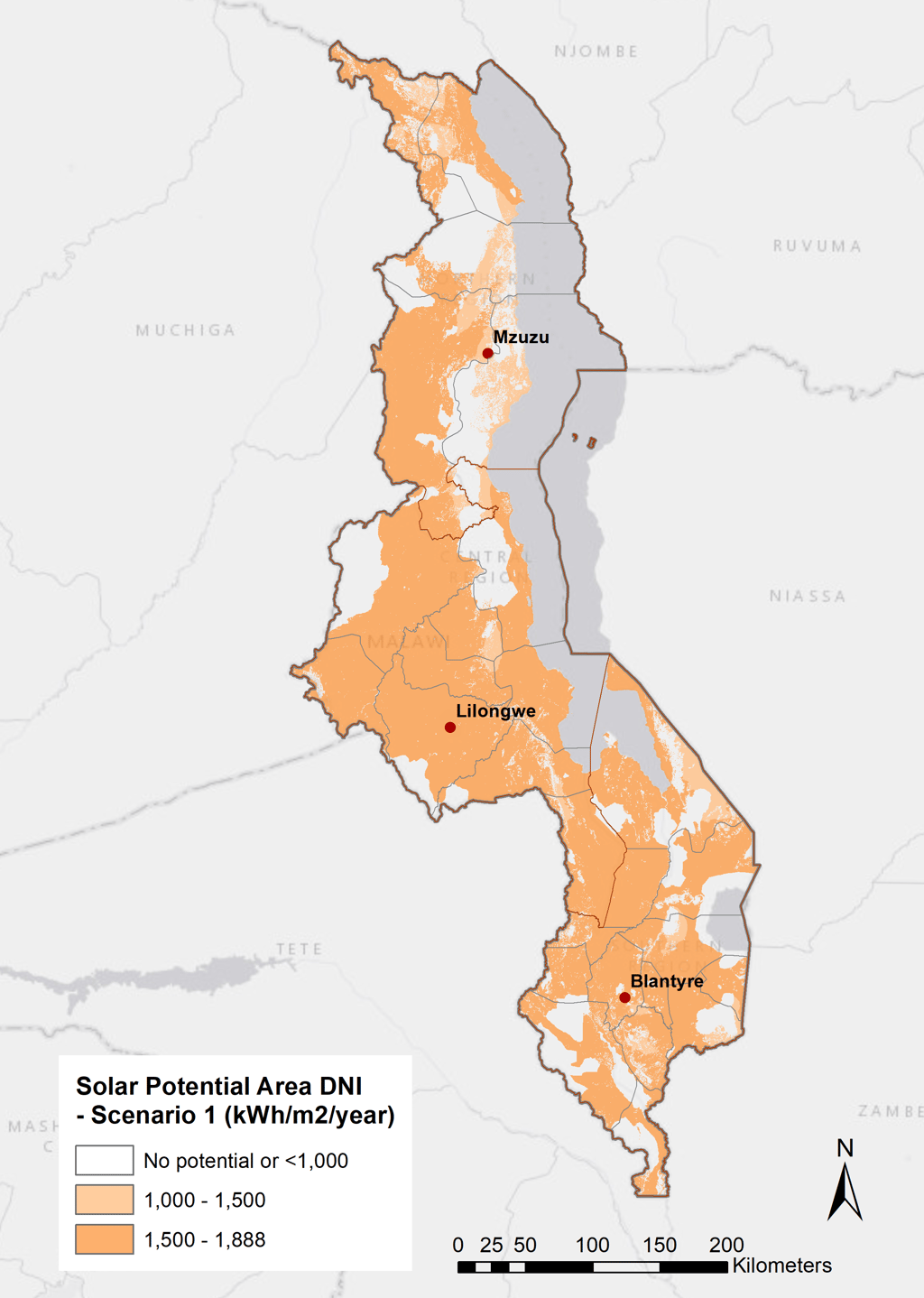
Malawi has significant solar power resources – detailed solar and wind potential assessment conducted by ISF. The solar and wind analysis maps are accessible here: Solar Potential Map, Onshore Wind Potential Map
The 100% Renewable Energy pathways are developed as robust, reliable, and cost-effective energy plans and based on GIS-based renewable energy potential analysis for solar and wind energy, hourly simulation to determine a high-level analysis of the required storage and grid expansion requirements.
The energy pathways aim to phase-out energy-related CO2 emissions as fast as possible while implementing fast and ambitious energy access programs.
The energy demand analysis is based on the following assumptions:
- economic growth high enough to develop toward middle-income country levels
- increased energy demand for services and industries
- growth and decarbonisation in the transport sector
- access to reliable and affordable energy services for all households to achieve OECD household standards by 2050.
A comprehensive energy plan for Malawi
Malawi submitted an updated Nation Determined Contribution (NDC) report to the United Nations Framework Convention on Climate Change (UNFCCC) in July 2021. The new NDC sets a target to reduce greenhouse gas (GHG) emissions by 2030 by 2030 compared with the ‘business-as-usual’ (BAU) scenario.
The NDC provided a detailed assessment of the identified GHG mitigation options for Malawi, and estimated the total emissions reduction potential of around 17.7 million tonnes of CO2 equivalents (tCO2e) in 2040 against the BAU scenario emissions in the same year (34.6 million tCO2e), a reduction of 51%.
The One Earth Climate Model for Malawi consists of two scenarios: The 1.5˚C Paris aligned pathway that was developed to provide input for Malawi’s future National Determined Contribution (NDC) submission. A reference case shows the impact of a 15-year delay of the 1.5˚C scenario.
Malawi: Cost analysis
Finally, the fuel costs for the power, heating and transport sectors are presented. All three sectors will reduce fuel cost over time because electricity generation is based renewables – with significant shares of solar and wind power. However, increased electrification will lead to higher investment costs in power generation and higher overall electricity supply costs for Malawi.
The M-1.5°C scenario requires an investment of 57 trillion Malawian kwacha (MWK; US$33.5 billion) in power generation and 29 trillion MWK (US$41 billion) in heat generation. Therefore, the total investment in power and heat generation capacities will add up to MWK 86 trillion (US$74 billion).
Additional power generation investments will be compensated by fuel cost savings in the decade in which they are made. Across the entire scenario period, fuel cost savings under the M-1.5°C scenario – relative to the REFERENCE case – will be MWK 322.4 trillion (US$189.7 billion). Additional investment in power and heat generation (including cooking) under the M-1.5°C scenario will pay-off the entire investment in comparison of the M-1.5˚C pathway.
Energy System analysis for Malawi
Malawi’s energy plan not only provides a comprehensive renewable energy assessment and a detailed energy demand projection for residential buildings, the service sector, industry and mining and transport, but also includes a detailed electricity system analysis.
In the analysis, the yearly electricity demand is broken down into hourly load curves projected for 2030 and 2050. The entire power sector of the country is simulated with the generation structure and historical solar and wind data. The simulation verifies the possibility of achieving a high security of supply with 100% renewable energy generation. The consequent increased demand on the power grid transmission capacities, possible new inter-provincial connections, and/or the required expansion of energy storage facilities are all calculated.
The electricity demand projections and resulting load curves were calculated as important factors, especially for power supply concepts with high shares of variable renewable power generation. Furthermore, calculation of the required dispatch and storage capacities is vital to the development of energy electricity supply concepts that lead to high security of supply. A detailed bottom-up projection of the future power demand, based on the applications used, demand patterns, and household types, allows a detailed forecast of the demand to be made. The energy sector analysis was conducted for Malawi’s projected electricity demand and supply for 2030 and 2050 under the M-1.5°C pathway.
The report finds that 100% renewable energy is not only achievable with existing technology, but cost saving and climate friendly too.
Colin Besaans, Programme Manager for African Energy Transition at Power Shift Africa says:
“Africa sits at a crossroads where many of our countries are making pivotal decisions about the future of their energy systems and development trajectories. For too long, outdated assumptions about renewable energy have been used to justify continued investments in the fossil fuel technologies that are locking us into the systems of the past. We are incredibly excited to be launching this research which makes clear that it is already possible to achieve 100% renewable energy systems that are secure, stable, cost saving, and great for the climate. We hope this can contribute to necessary conversations about how to raise African ambitions on renewable energy and avoid the maldevelopment of further fossil fuel lock-in.”
Prof Dr Sven Teske, Scientific leader of the research says:
“Detailed energy and climate mitigation pathways are key to establish and implement both energy access targets for all residential households as well as reliable roadmaps for the energy supply for the service and manufacturing industry for economic growth.
Reliable and affordable energy supply and decarbonisation of the economy is not a contradiction but goes hand in hand.
Our ‘One Earth Climate Model’ research team provides the technical and economic basis for policymakers with a focus on least developed countries.”