


- Posted on 27 Jul 2026
- 5 min read
HDR students often face invisible barriers in academia which creates unequal access to opportunity, particulary for students from equity groups. This project sought to address these gaps.
Making the hidden visible: supporting PhD students to succeed
At the University of Technology Sydney (UTS), a project set out to change that.
Supported by a UTS Social Impact Grant, this research was designed to tackle a clear issue: unequal access to the ‘hidden curriculum’ of academia.
Led by Ivan Smirnov and Saule Bekova, the project aimed to make this invisible knowledge visible, and in doing so, create a more inclusive research environment.
The rules no one teaches
Every academic system has a hidden curriculum.
It includes the informal knowledge needed to navigate research life. How to work with a supervisor. How to interpret feedback. How to manage progress and expectations.
These things matter a lot, but they are rarely taught.
Smirnov and Bekova began with a simple observation: access to this knowledge is not equal. Some students arrive already familiar with academic norms, whilst others do not.
The project set out to address this gap.
“The issue is not that students lack ability,” says Smirnov. “It is that the system expects them to know things that were never made explicit.”
For students from equity groups, the impact is even greater. Those from low socioeconomic backgrounds, rural areas, culturally diverse communities and first-in-family researchers often have less access to this hidden knowledge.
Without it, students can feel uncertain, isolated or left behind, even when they are capable.
Listening to what students really need
Rather than assume what students needed, the research team started somewhere different.
They listened.
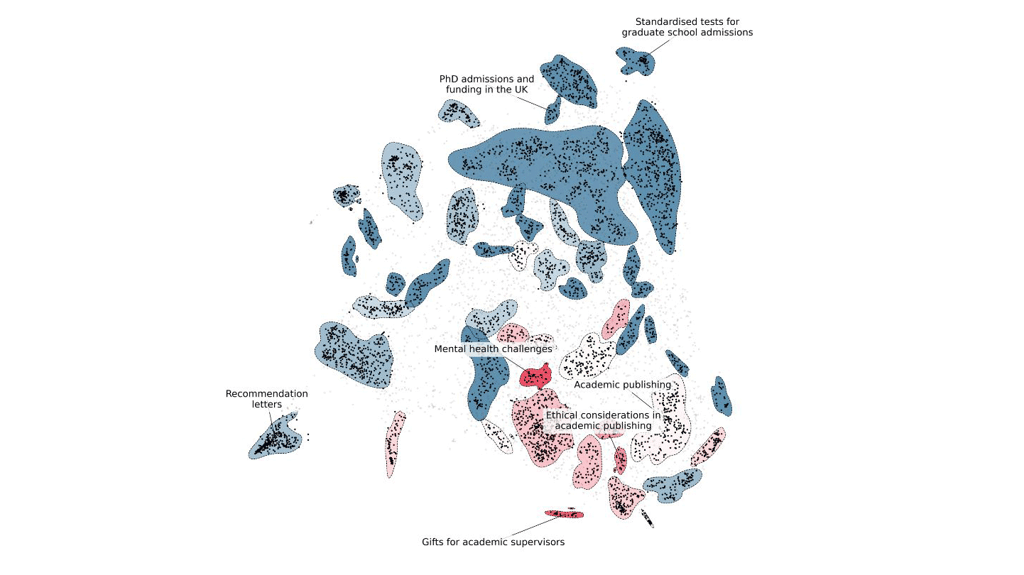
Drawing on more than 20,000 real questions asked by doctoral students online, the team analysed what students were actually struggling with.
These were not abstract issues.
They were practical, immediate questions. Often the kind students hesitate to ask a supervisor. The kind that reveal uncertainty, not lack of potential.
The findings were clear: students were not simply seeking convenience online. They were turning to these spaces because something was missing.
“It showed us that supervision alone is not enough,” says Bekova. “Students are looking elsewhere for guidance, often because they are unsure or afraid to ask.”
This insight reinforced the project’s purpose: to address hidden barriers by making expectations clear and accessible.
From this work, the team developed the ‘UnHidden Curriculum’. A structured map of what students actually need to know, based on real questions rather than institutional assumptions.
Turning insight into tools
Understanding the problem was only the first step. The next was building something that could help.
The team developed a prototype AI chatbot designed to provide 24/7, judgement-free support where students could ask questions openly, without worrying about how they might be perceive.
Alongside this, they created a different tool: a card game.
The Hidden Curriculum card game helps students and supervisors talk about expectations in a clear and structured way. It turns difficult conversations into shared discussions.
“We didn’t expect the card game to have such an impact,” says Smirnov. “But sometimes simple tools create better conversations than complex technology.”
Together, these tools respond directly to the issue the project set out to address.
They reduce uncertainty, they create access and they make the hidden curriculum easier to navigate.

A shift in thinking
One of the most important outcomes of the project is a shift in perspective.
Challenges faced by PhD students are often framed as individual shortcomings. A lack of preparation. A gap in skills.
This project challenges that idea.
“This is not a student deficit problem,” says Bekova. “It is about structural opacity. The rules exist, but they are not visible to everyone.”
It reframes the issue the project set out to address, from one of student capability to one of system design.
What has changed
The project has already begun to make an impact.
It has created a convincing evidence base showing that the hidden curriculum is real, widespread and a barrier to equity.
Students who engaged with the work recognised it immediately.
Many described the findings as ‘exactly what I was missing’ or ‘something I wish I had known earlier.’
The tools developed through the project offer practical ways forward.
The ‘UnHidden Curriculum’ can be used by universities to review and improve training programs. The chatbot and card game provide new ways to support students directly.
There is also growing interest beyond UTS, with findings shared through conferences and publications.
The work continues
Like many research projects, the path has not been straightforward.
But the core ambition remains.
“There is a real demand for this work,” says Smirnov. “Students know these gaps exist. Now we have a way to address them.”
A more inclusive future
At its heart, this project is about fairness and about addressing an issue that has long been present but rarely examined.
It is about making sure that success in higher education is not shaped by what students already know before they begin.
Because when the hidden curriculum becomes visible, students are better able to succeed.
And when systems become clearer, they become more inclusive for everyone.