• Posted on 11 Jul 2024
  • Updated on 11 Jul 2024
  • 7-minute read

Climate change is increasing the risk of extreme weather events in frequency and intensity in Australia. Regional areas are at risk of losing power due to environmental disasters such as bushfires, floods and cyclones. Without electricity there is no way to communicate, cook or cool down.

A toolkit to help communities develop action plans for climate-related disasters like bushfires, floods and cyclones.

Project summary

Climate change is increasing the risk of extreme weather events in frequency and intensity in Australia. Regional areas are at risk of losing power due to environmental disasters such as bushfires, floods and cyclones. Without electricity there is no way to communicate, cook or cool down.

Communities must prepare in advance. The Institute for Sustainable Futures, in collaboration with community engagement specialist Community Power Agency and design agency Parallel Lines, developed resources to help communities plan and ensure essential energy needs are met in an emergency.  

The result of this research is an easy to use toolkit, including seven simple steps for communities to examine the risks they face, identify shared priorities and develop a tailored plan of action.  

Being prepared for energy outages is crucial to disaster recovery. This research found that community energy resilience can be achieved through social learning, knowledge-sharing and developing local partnerships. Coming together helps communities to prepare for, respond to and recover faster from environmental disasters.  

The toolkit has been designed with codesign principles. At workshops with regional and rural communities across Australia, lived experience and concerns about future climate impacts were shared, inspiring a thorough design which simultaneously encourages community-led action.  
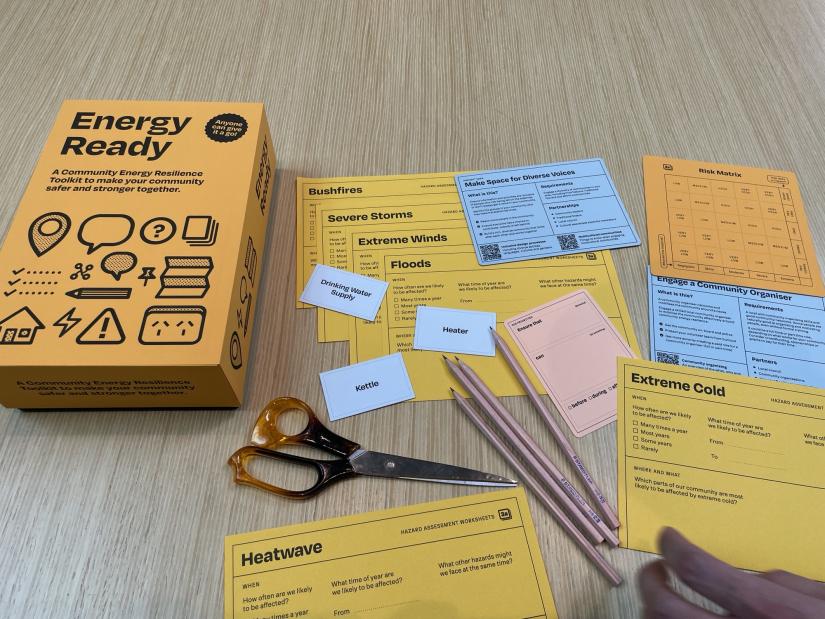
Energy ready toolkit

Social capital is essential for community-led recovery, managing trauma, and encourages decision-making for the greater good. Often trust-based social connections have been compromised. Our toolkit is designed to help communities come together and learn about their community before beginning the resilience planning.  

Communities are not alone; partnerships and trust-building are key to success. To build strong energy resilience strategies, communities must connect to other volunteer organisations, service providers, including emergency services, SES and grid operators, councils and organisations that can support, elevate and fund their vision. The Energy-Ready toolkit activates communities to make those crucial connections and think ahead. 
Read more here

UIVY9pC8W4Y

Transcript

We're proud to fund this project through our grants program as a collaboration grant. This meant we had the opportunity to work alongside the project partners, the UTS Institute for Sustainable Futures, Community Power Agency and Parallel Lines, to bring this from an inspiring idea to a ground-breaking piece of work.

The Energy Ready project aims to gather lessons and best practices on community energy resilience. So, through extensive desktop research, deep community engagement, collaboration with experts in energy resilience and disaster response, plus a human-centred visual design approach, the project team was able to translate the findings into a one-of-a-kind resource for communities.

The definition of community energy resilience, which we proposed in the literature review, says that resilient communities are communities that utilise localised energy sources in order to prepare – that's to learn and to anticipate, to respond and withstand, and to recover from disasters. They also include aspects of social connections and social learning, economic aspects related to affordability and accessibility, and of course, renewable energy technologies and any technology solutions.

As a partner, Community Power Agency brought facilitation skills and engagement skills in figuring out who the communities should be that we are talking to, who are the correct people to come along to the workshop to give their insights and experiences, what they've been through in these disaster-affected and at-risk communities, and designing an interactive process that makes communities and people in these workshops feel comfortable and able to express what they've been through and do that deep thinking to share their experiences with others.

It's really essential that things like this are actually grounded in lived experience, and the way to do that is to go and listen and hear from communities that have gone through experiences like environmental disasters such as a fire or a flood, and hear about what they've done and then ground anything that you're wanting to inform other communities to help them prepare.

Things that I'm worried about in terms of energy resiliency are the short-term emergency situations that we're finding ourselves in, whether that's bushfire or flood, but I'm also worried about the long-term energy resiliency of communities. What I learned today was about understanding how this sort of energy resiliency happens at different levels and in different locations. At the more immediate short term, it made me start thinking about how I respond to an emergency situation and what the community needs to do and what I need to do as part of a community in responding to an emergency situation.

One of the things that we thought about with this project was that resilience comes from working out what you need to do for yourself. So, we've designed a guide that isn't just about giving people information and advice, but giving them the opportunity to develop their own approach to energy resilience.

Some of the main challenges we faced, there were two really. The first is that energy resilience is quite a complex topic, so really translating something that's quite complex into something that makes sense for communities. And the other challenge is that the topic can be quite distressing for people, especially communities who have been through disasters. So, trying to really portray the information in a way that's authentic and doesn't deny the seriousness but is also very upbeat and constructive and says, "Here's what you can do."

The Energy Ready Toolkit was produced in consultation with communities, for communities, and we really want it to be used. It contains seven steps to guide and help communities leverage their unique features, examine the risks they face, identify shared priorities, and develop a plan of action for improving energy resilience.

So, we encourage communities all across Australia to access this rich resource, use it and reuse it as many times as possible, and tell us how the Energy Ready Toolkit made them a stronger, safer, and more energy-resilient community.

Project timeframe

2022 – 2023

SDG targets addressed by this project

Icon for SDG 7 Affordable and clean energy

Affordable and clean energy:

7.1 - By 2030, ensure universal access to affordable, reliable, and modern energy services.

7.a - By 2030, enhance international cooperation to facilitate access to clean energy research and technology, including renewable energy, energy efficiency and advanced and cleaner fossil-fuel technology, and promote investment in energy infrastructure and clean energy technology

Icon for SDG 11 Sustainable cities and communities

Sustainable cities and communities: 

11.a Support positive economic, social and environmental links between urban, peri-urban and rural areas by strengthening national and regional development planning

11.b By 2020, substantially increase the number of cities and human settlements adopting and implementing integrated policies and plans towards inclusion, resource efficiency, mitigation and adaptation to climate change, resilience to disasters, and develop and implement, in line with the Sendai Framework for Disaster Risk Reduction 2015–2030, holistic disaster risk management at all levels

13 Climate action white icon on green background

Climate action:

13.1 Strengthen resilience and adaptive capacity to climate-related hazards and natural disasters in all countries.


Scott Dwyer

Scott Dwyer

Research Director

DVC (Research)

Sarah Niklas

Sarah Niklas

Research Principal

DVC (Research)

Caitlin McGee

Caitlin McGee

Research Director

DVC (Research)


Share