


Project details
Wider project
-
One Earth Climate Model
Client
-
Greenpeace Spain
Sustainable Development Goals
-
7. Affordable and Clean Energy
-
13. Climate Action
- Posted on 20 Apr 2026
A sufficient, efficient and 100% renewable model for the Iberian Peninsula.
The volatility of energy markets tied to periods of geopolitical instability and conflict remind us that moving away from fossil fuels and towards renewables has many benefits beyond emission reduction. It makes a country more economically resilient and provides energy independence.
Greenpeace Spain commissioned the One Earth Climate Model research team at the UTS Institute for Sustainable Futures (ISF) to conduct a comprehensive analysis of energy transition possibilities that will phase out fossil fuels in the Iberian Peninsula.
Overall, the analysis confirmed that the Iberian Peninsula has strong renewable energy potential even when avoiding environmentally sensitive areas and agricultural land. Decarbonisation of the Iberian Peninsula is technically and economically possible, and only requires a fraction of this potential to be harnessed. By pursuing a rapid transition to an efficient 100% renewable energy system, both Spain and Portugal can phase-out the use of fossil fuels in a manner which retains strength and reliability of the electrical grid and enhances the security of supply for their future energy needs. The modelling addressed three key questions:
1. How far can energy‑related emissions be reduced to ensure the transition aligns with the 1.5°C target of the Paris Agreement?
Achieving the 1.5°C target of 2015’s Paris Climate Agreement requires the total decarbonisation of the global energy system by 2050, with an emissions peak between 2020 and 2025 and a drastic reduction in non-energy-related greenhouse gases (GHGs), including land-use-related emissions. Under the Agreement, countries regularly report their emissions and outline planned reduction measures through their Nationally Determined Contributions (NDCs).
Energy pathways for Spain and Portugal were modelled under three scenarios, with cumulative results used to assess pathways for the Iberian Peninsula as a whole:
- Business-as-usual (BAU): is based on the 2024 National Energy and Climate Plans (NECPs) for Spain and Portugal
- Energia 4.0: assumes a more ambitious carbon-reduction pathway than the NECPs and faster implementation of energy efficiency measures and renewable energy generation
- Energia 4.1: adds a stronger sufficiency component to the 4.0 scenario, to reduce carbon emissions faster and reduce the overall carbon budget for the Iberian Peninsula
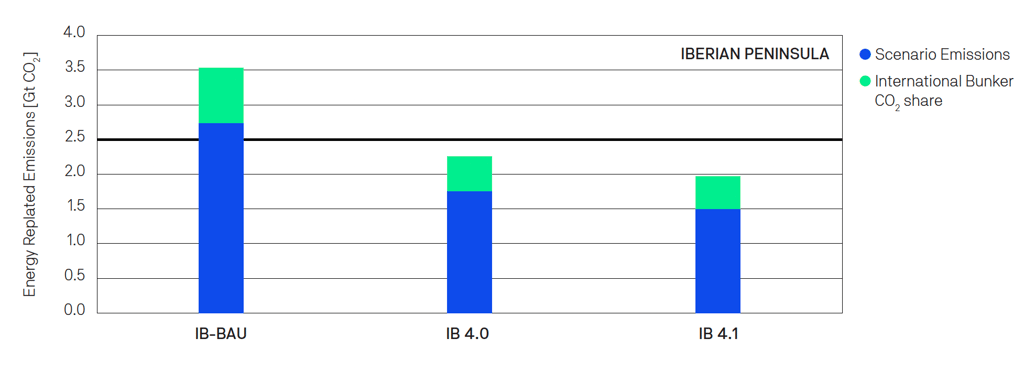
A ‘fair allocation’ of the carbon budget for the Iberian Peninsula aligns with the Paris Agreement and Greenpeace’s principles of climate justice. These principles were used in this report to calculate a fair allocation carbon budget for Spain and Portugal between 2020 and 2050, with the budgets shown in the table below.
Fair allocation carbon budget limits
| Share of the World’s Population 2020–2050 | Carbon Budget 2020–2050 (GtCO2-e) |
|
|---|---|---|
| Global | 100% | 400 |
| Spain | 0.51% | 2.04 |
| Portugal | 0.11% | 0.45 |
| Total Iberian Peninsula | 0.62% | 2.49 |
By implementing energy efficiency with existing technologies and the phase-out of fossil fuel-based energy supply, the current per capita carbon footprint across the Iberian Peninsula of 4.6 tCO2eq can decrease to near zero emissions under the Energia 4.0 and 4.1 pathways. The remaining minor emissions under the 4.1 pathway (approximately 100kg CO2 per person) originates mainly from non-energy-related industrial processes and synthetic fuel production. The absorption of CO2 by sinks was calculated using official data from EU national emission accounts, with the sinks being considered for assessing the scenarios relative to the carbon budget.
Cumulative Carbon Emission 2020 to 2050
The calculated cumulative carbon emissions between 2020 and 2050 range from 3.58 GtCO2 under the BAU scenario to 2.01 GtCO2 under the 4.1 scenario. The BAU scenario transitions more slowly, with Spain and Portugal taking up to 2050 to reach net zero emissions in their own right. However this trajectory is insufficient to meet the carbon budget, with only the Energia 4.0 and 4.1 scenarios being aligned with a 1.5°C target:
2. What level of emissions reduction is technically possible across different sectors?
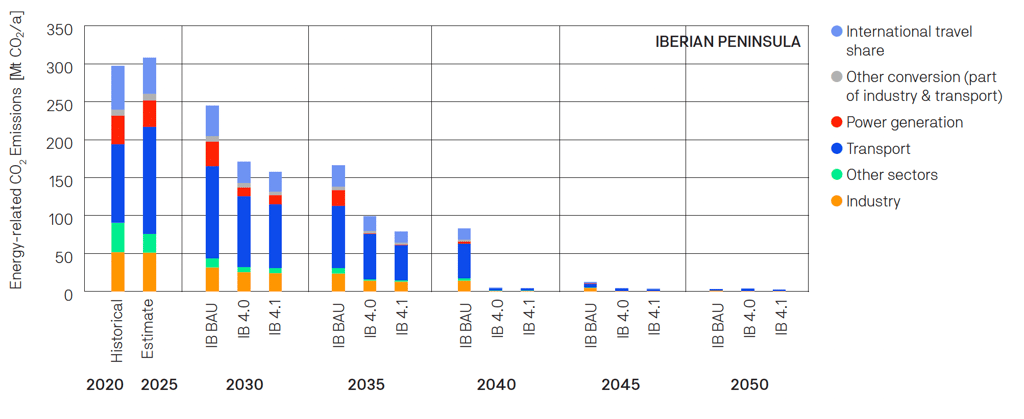
While domestic energy-related CO2 emissions for the Iberian Peninsula under the BAU scenario decrease by 72% to 65 MtCO2 annually, the Energia 4.0 and 4.1 pathways will decarbonise to 99% by 2040. The remaining 1% of CO2 emissions originate from the use of synthetic fuels for aviation and shipping as well as industry processes that cannot be electrified with currently available technologies.
Decarbonisation of the power generation and buildings sectors is technically and economically possible if policy support enables investment in clean-energy technologies. The figure below shows the emissions trajectory until 2050 for each sector:
3. What are the costs associated with phasing out fossil fuels?
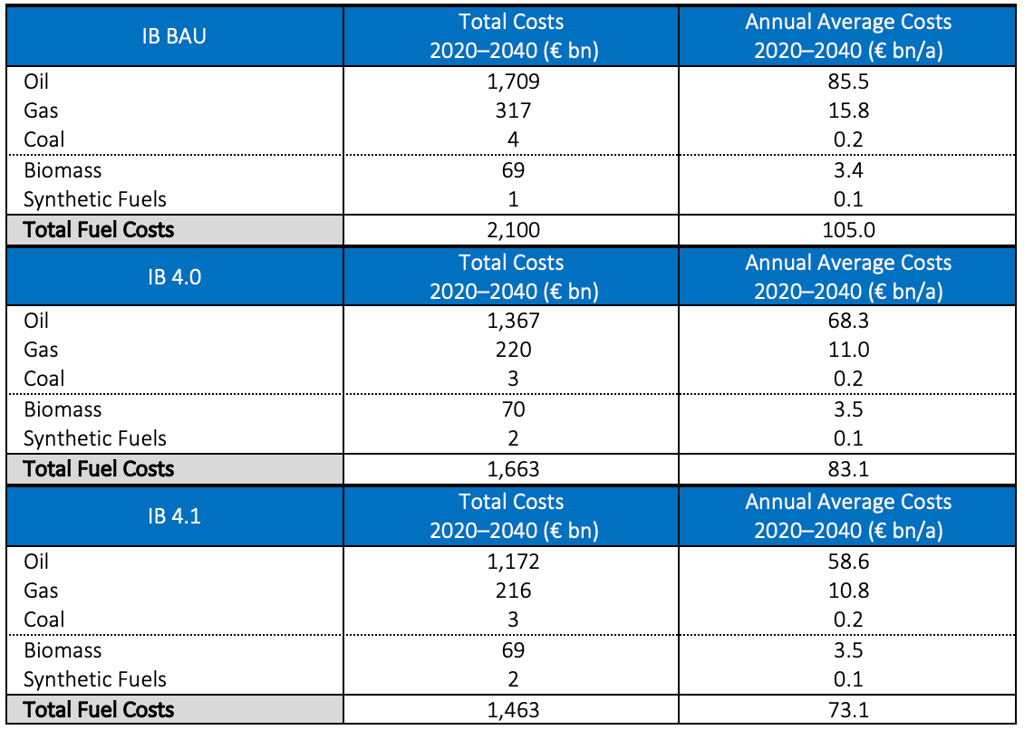
All scenarios have very low fuel costs for the power sector because generation is based mainly on solar and wind power, which need no fuels. The following results focus on the economic impact of phasing out fossil fuels by 2040 under the Energia 4.0 and 4.1 scenarios. The average annual fuel costs of the Iberian BAU scenario is up to Euro 105 billion between 2020 and 2040. The 4.0 scenario has a cost advantage of around Euro 21.9 billion per year thanks to a rapid transition to renewables alongside electrification and efficiency measures. While the 4.1 scenario achieves even greater cost advantages of Euro 31.9 billion in this period relative to the BAU scenario thanks to the implantation of sufficiency measures.
For Spain, the cumulative costs of investment in new power and heat generation and total fuel costs between 2020 and 2040 are calculated with Euro 2,233 billion Euro (94 billion/year). In comparison, the ES 4.0 scenario decreases cumulative costs for the same time span by Euro 18 billion per year to Euro 76 billion annually on average. The ES 4.1 pathway decreases costs even further to Euro 69 billion per year – a cost advantage compared to the ES 4.0 of Euro 7 billion/year and Euro 25 billion per year of ES BAU.
The results for Portugal are similar with annual savings of Euro billion for the PT 4.0 case and Euro 7 billion annually respectively for the PT 4.1 in comparison to the PT BAU case.
For the whole Iberian Peninsula, the cost advantage for the IB 4.0 pathway adds up to Euro 405 billion between 2020 and 2040 and Euro 669 billion – Euro 32 billion annually – for the IB 4.1.
The fuel-cost savings are sufficient to finance the required investment in new power generation across the whole Iberian Peninsula.