

• Posted on 14 Mar 2025
  • 62-minute read

What can businesses do when consumers are change resistant? How can companies help promote consumer behavioural change in their efforts to decarbonise supply chains? What power do consumers really have in helping society and organisations make the transition to Net Zero?

We know Australians need to urgently change the way we consume goods and services to reduce our environmental footprints and make more conscious consumption decisions. But despite the urgency of the climate crisis, how business, policymakers and consumers themselves can make the shift to green, more environmentally friendly is still posing a significant challenge.
xyJTiRqM6aQ

Descriptive transcript

Okay, so good afternoon everyone, welcome to UTS during the Climate Action Week Sydney 2025.

My name is Marco Navone. I'm the head of the Finance Department here in the UTS Business School, and I'm honoured to be here to open the event on the consumption conundrum.

Before we begin, I and the UTS Business School would like to respectfully acknowledge that we are located on the land of the Gadigal people of the Eora Nation. The Gadigal people have cared for their community, land and waters for thousands of generations, based on their deep knowledge of their country. We pay respect to their Elders and acknowledge their ongoing status as the First People of this land.

Now, I would also like to thank our industry panellists, who I will introduce properly very soon, for partnering with the UTS Business School on this event.

Engaging with industry practitioners and bodies is a cornerstone of our approach to academic excellence. These collaborations not only provide us with valuable insight to inform our research and curriculum design, but also ensure that our programs remain relevant and aligned with the latest industry trends and requirements. Additionally, our fantastic industry partners create meaningful opportunities for our students to expand their networks and horizons and enhance their employability.

Today, we are at the halfway mark of the Climate Action Week in Sydney 2025 and I understand the events so far across Sydney have been engaging and thought-provoking. We are proud here at the UTS Business School to be a socially committed business school focused on developing and sharing knowledge for an innovative, sustainable and prosperous economy in a fairer world. And we are also proud to be the home of the Centre for Climate Risk and Resilience, a group of 40 researchers who provide business and organisations with tools to take urgent and immediate collaborative action to decarbonise the economy and regenerate the country and planetary health.

Today, you will hear from the Director of the Centre, Professor Martina Linnenluecke, who I know will be more than happy to talk to you more about the Centre if you ask her after the event.

It is my pleasure and privilege now to introduce the panellists to you, starting from the left of the stage.

As I said, Professor Martina Linnenluecke, the Director of the UTS Centre for Climate Risk and Resilience. She is regarded internationally as a leader in climate risk and resilience and has pioneered two streams of interdisciplinary research around organisational strategic adaptation and resilience to global environmental change, specifically focused on climate change and environmental finance.

Katherine King is the Chief Strategy Officer at global advertising agency Leo Burnett. She has over 20 years of experience in the advertising industry with a focus on the intersection of brand building, human behaviour, culture and influence. Katherine has held leadership positions with creative, consulting, strategic, PR and digital teams across both multinationals and independent agencies in partnership with a broad range of brands. She is leading ongoing research which aims to better understand the role that brands should and could play in the areas of public interest, encompassing human, social, environmental and financial impact.

Nikki Sparshott is an experienced CEO, Board Director and Change Agent with 30 years of global experience, working in leading blue chip organisations such as Unilever, Coca-Cola and Procter & Gamble. She has lived and worked across international markets with extensive time in Asia-Pacific, the UK and Europe, and has held a variety of senior leadership roles, leading complex, multi-category businesses, multicultural teams and diverse business models. Most recently, she was the Global Chief Transformation Officer at Unilever, designing and delivering value-creating change initiatives across the enterprise with a focus on organisational design, performance culture and portfolio optimisation. Prior to that appointment, Nikki was the CEO of Unilever Australia & New Zealand and global CEO of luxury retailer T2 Tea. We are proud to include Nikki as a member of our alumni community, having graduated with a Master of International Business. Nikki also serves on many boards, including as Chair of our own Vice-Chancellor's Industry Advisory Board, Chair of Global Sisters, Non-Executive Director at WWF and for Moose Toys. In 2022, she was awarded CEO of the Year by CEO Magazine.

Siobhan Toohill is a Sustainability Advisor, having established and led sustainability functions in listed finance and property over the past 20 years. As the first Chief Sustainability Officer at a major Australian bank, she was responsible for Westpac's sustainability strategy, as well as policy and action on climate change, including net-zero transition planning, natural capital and human rights. Siobhan has led a wide range of initiatives, including customer vulnerability and problem gambling, Indigenous engagement, child safeguarding, strategic philanthropy and social impact, and is currently a trusted advisor to business and government through a range of governance roles.

And last but not least, our own moderator for this afternoon is UTS Industry Professor John Lydon, who is also Co-Chair of the Australian Climate Leaders Coalition, member of the NSW Net Zero and Clean Economy Board and Chair of Generation Australia. Previously, John was Managing Partner of McKinsey Australia and New Zealand, holding several senior roles across the global firm. John was also Economic Commissioner of the Greater Cities Commission from 2021 to 2023.

Thank you all again for coming along this afternoon. I'm sure our panel will provoke an interesting conversation, and I invite you to stick around for the discussion and the following Q&A. Now, John, over to you.

Marco, thank you so much for that welcome. And thank you all for being here.

You know, we all have roles, right? We have in this room many executives, we have advisors, we have policymakers, we have learners, professors, and we're all consumers. So by the end of this, we need to explore the opportunity we have to make a difference, an obligation, a challenge. What is it and what can we do and how should we play our part as consumers in the fast-moving system in sustainability, climate change, and the path to a better future for all of us?

So let's kick off and I will add my respects to the Traditional Owners, the Gadigal people, their Elders, and maybe start with business. That's where my comfort zone is, right, in a business school. I used to work for McKinsey. Lots of reasons to start with business.

And Martina, so in the Centre for Climate Risk and Resilience, you work with lots of businesses. And let's actually, maybe this is easier than we think. What can business do to solve this problem, regardless of how consumers act?

Martina: So what we are currently seeing through our research and also through our conversations with our industry partners is that one of the biggest challenges that we are facing at the moment is really what can we do to rapidly decarbonise? So what can be done to shift us onto this trajectory towards decarbonisation and not just, you know, by the end of the century, but how can we do this so that it happens in the next three to five years, next 10 years? How can that be accelerated? So obviously, this is a big task. It requires a lot of changes internally. It requires a lot of changes across society, as we will also explore here, to our consumption patterns, to what it is that we are doing individually, as well as as a society globally as well.

So what can be done? I think the biggest issue here is, you know, how can businesses transform quickly and also how can they embark on a decarbonisation pathway that is credible, that is rapid, and that can also be achieved in a feasible timeframe? So for many businesses, that journey really starts with exploring where the big impacts are and also understanding where changes can be made in a manner that, you know, this is also feasible for the business to actually carry through this transition. And ultimately, it's not just the climate crisis that we are worried about, right? There is a lot happening. There's biodiversity loss. There's global instability, right? There is a cost of living crisis. There's affordability issues and so on. So I think it really comes down to identifying the key priorities for the company, for each organisation, and then to see where the biggest impact is and what can be done. And sometimes it's small changes, right? It's not always the big transformation that needs to happen, but sometimes it's just small changes around product design. It's just small changes around better funding, better alternatives, better consumption patterns, and so on.

John: Well, that's encouraging, right? It seems like we're on a good pathway with those businesses. But of course, business isn't going to stay in business if it doesn't bring consumers along. And Katherine, working in advertising, you probably know what consumers are thinking and buying before they even know. So, you know, what do you think consumers' roles are in all of this?

Katherine: Consumer roles is a really interesting topic, and it can be quite convenient for us to say it's a great amount of cognitive dissonance. People are being lazy. They're saying one thing and doing another thing. But we can often look at why are people consuming, because let's face it, we're consuming more than ever, and it's accelerating instead of slowing down. So let's look at why. And there's three main factors that really come to mind. There's the fact that we're living in a sense of permacrisis, whether it is climate events, whether it's economic instability, geopolitical insecurity, the constant threat of tech and AI. The world is rolling into this sense of what's coming next.

And within this, people look at what they can control. For some people, that means that they're cutting back. For others, 29% of Aussies, they're now doing something called doom spending, where they're looking at how can I inject a sense of meaning, of pleasure, of distraction into the world that is increasingly feeling out of control.

The second factor is a sense of economic stress. And when will that end? You think of it, there's 974,000 Aussies that work more than one job. 72% of Aussies feel pessimistic about their financial future, and 70% of young Australians don't think home ownership is within their reach.

And so, when I don't have access to some of the big goals and long-term plans that I could make, there's trade-offs in terms of shorter-term things that I can look at that I then feel that I have access to. And reflecting this, half of Aussies are living in the present. When we say, are you living for the present or are you planning for the future? Half of them are just living in the present. They're not even doing a little bit of both.

And the third factor is the relentless pressure we're under culturally to have more, spend more, be more. We talk about, you know, once Aussies were worried about keeping up with the Joneses, now we're worried about keeping up with the Kardashians. It is a highly unrealistic standard where the benchmarks are always just out of reach.

And so, we can really criticise consumers. But if you look at it, if you look at all of this pressure that they're under and all of the wider factors, you can understand why we're increasingly spending. And so, we potentially need to take another view because we know that businesses will always look at growth. And on the flip side of that, we do need to look at how we're sustainably doing things. But just to tell people, spend less, consume better within this context just won't cut it.

John: Wow, I don't like that geopolitical, climate, economic, technology. I feel like I want to go out and do some of that doom spending myself. But, I mean, Nikki, you've worked in consumer businesses. I mean, are you, businesses and ones you're aware of, connecting with these consumers and maybe offering them a way out of this problem?

Nikki: Yeah, look, it's a big challenge. I like to think of it like this. You know, there was a time in business, in society where you could, it was almost like an elephant trampling through the jungle. You could see it coming. You could plan for it. You had some time to digest how you were going to react. And now it's like standing in an ocean with lots of little black jellyfish that you can't see. So, you're being attacked from all angles, as an individual, as a business, as a nation state. You know, it feels like there's a lot going on. So, it's complicated.

And look, I think in business right now, there is an inevitable challenge in how do you do the right thing for the environment, the right thing to contribute to a more socially equitable community, and simultaneously deliver the financial and fiduciary obligations that you also need to deliver. And right now, I think we're at a point in time where we're going to see three things really play out. One is conviction. What companies are going to just make a choice that this is not just the right thing to do because there's regulations, but there's the right thing to do because we have an obligation and can make some change. And we're seeing many companies opting out or certainly reducing their focus. I think it is hugely complex. So, to sort of say that there are easy solutions is somewhat naive, but as an organisation, I think it's critically important to work out for the people that you serve, for your consumers, what matters to them most and what can you focus your energies on? Because you can't do everything and not everything is equal. And I think finding competitive advantage in an organisation is around how you can deliver profit as well as purpose. So, being purpose-led doesn't mean being profit-deprived, but it does mean being super sharp around where you find competitive advantage for your business, but also for the people that you serve.

And then I think the last area is around change, is helping organisations sort of overcome change fatigue to make really difficult decisions around how you decarbonise, how you reduce plastics, how you leverage AI whilst not creating a huge groundswell of energy consumption. You know, these are complex scenarios. So, I think we have to listen to consumers, understand what matters to them most and recognise that you need to produce products and services that don't cost the earth, that don't negatively impact our environment, but equally, consumers shouldn't have to pay more for better produced products. As a business, we need to find ways of removing non-value-added costs in the system, of which there are plenty in organisations, such that we can invest on those things that actually do contribute to a better world for our consumers and the planet.

John: So, that sounds appealing, right? Some sort of magic pudding where we've got better products for the planet, but they also don't cost the earth or the hip pocket either. Now, Siobhan, you've been a banker for a long time. I'm used to you taking a bit of a hard look at claims like, oh, it can be cheaper and better. What do you reckon? Is there any truth in that?

Siobhan: Well, ultimately, someone has to pay and, in fact, we're all paying at the moment and the earth is certainly paying for it at the moment too. So, there is this challenge around who ends up actually paying and should we be expecting the consumer to pay more for a product that's got some green attributes?

I think it's really fascinating when we reflect on kind of where the sustainability movement has been over the last 20, 30 years, you know, going back to, you know, the Rio Convention, sort of when we started to first talk about sustainable development and often it was the big ambition that we spoke about. And then we started to think about, you know, the degree of integration and we started to think about in banking, we might be thinking about sustainability linked to loans where we might be incentivising a customer to make decisions around delivering a more sustainable product or a service. But now we're getting to a phase now where it's about actually how do we transform? How do we actually transform an organisation or how does a banker work with a client that they're lending to and actually ensuring that that organisation that they're working with is actually making different kinds of decisions around how they are delivering a more sustainable product or service? And rather than simply giving them a loan to incentivise them, actually really thinking about how they tailor their support for that particular client as well. When I think about when it comes to consumers, my sense is that we've actually got to think about how do we retool products and services so that they are fundamentally more sustainable rather than simply kind of, if you like, applying the green to them and then charging more. Now, that takes time, it's not easy, but it does require a transformation mindset that we need to bring to these kinds of problems.

It also means that we've got to break out of the silo of thinking within our own organisations to actually how do we think about our value chains? So, as a bank, how does it work with its client? How is it working with its suppliers? And how do we work through those value chains to find ways to actually work through better solutions? Now, it sounds easy to say, but actually delivering on that is actually really, really hard and requires different kinds of mindsets. And I've been fascinated in banking in that, as a sector, it's deeply competitive. And everyone used to want to be the most sustainable bank. You know, there were indices, and there still are out there, that rate the performance of organisations and everyone wanted to be the most sustainable organisation. But the shift that's happened over the last five years is actually it's the leaders, the leaders are those who are more willing to share, to lift up the hood and actually say, this is how we're thinking about this problem that's bigger than my organisation and being willing to collaborate within their industry and beyond their industry to crack through some of these really intractable problems to try and find solutions.

And I do think we've got to recalibrate what we mean by leadership.

John: That's super interesting, right, that this is not something we just do on our own, but we have to do it with others and acting together to magnify the impact. I mean, I'm just a simplistic thinker here. Wouldn't this be a whole lot easier if we just had a carbon tax to send those signals?

Siobhan: Oh, I'm all for market-based mechanisms, as you know, being the banker. I mean, I do sometimes think that having a system that's well-designed, where there's a degree of fairness, and we're not picking winners, that the market is actually building in that price on carbon is a way to, I guess, accelerate some of these solutions. It is hard in an environment where we don't have these financial mechanisms. We are sometimes in that position of having to pick winners, and it can take longer to drive those changes.

John: And Martina, I mean, you come from Europe, which is, I think, a little more advanced sometimes in the way we make choices there. Is that because of market-based mechanisms like taxes, or is it something more cultural too?

Martina: I think the cultural elements are definitely playing into this. So, for instance, just thinking back over some of the recent history and developments in Europe when it comes to support for environmental policies, you know, there has been a huge environmental movement, but that just didn't come out of nowhere. That came out of a time when people were really seeing the environmental degradation happening, resulting from the rapid industrialisation after the Second World War. So there's definitely also culturally been a sense around, OK, something needs to happen so that we can preserve our environment, right? So that has led to, I think, greater support in general for some policies being put in. But we certainly have got, you know, all sorts of other influences contributing there as well, and we probably don't have the time to really dive deep into the cultural factors here. But overall, I would say that that does play a role, right? There has been a greater involvement as well of, you know, this sort of, like, sustainability movement in politics as well. And to some degree, yes, it has been, you know, the Greens being involved in some of the policy in Germany to a greater extent. But ultimately, it's not just come down to one party. It's actually, you know, across the board where we see good level policy support. And that, I think, really helps as well with the overall momentum of many of the policies that we are seeing, because they're not just tied to one party and that party having a particular view on it. But there is actually some support, I think, across the political spectrum to make sure that, you know, we all live in a healthy, sustainable environment, that there is a greater uptake of renewables, you know, the energy transition. And that started many, many years ago, right? So Europe has already been transitioning for probably 30, 40 years, right? And that shows you it's also not a quick fix, right? And I think really shows that we need to act and need to act quickly as well.

John: So in terms of acting quickly, it also doesn't seem particularly likely we can wait for politicians to all get lined up and build that broad consensus here, right? Now, if that's the fact, what can we do? What can consumers do, communities do, to start making a difference? Katherine, Nikki, you're all close to communities, so what do you think?

Katherine: I think who pays the price is an interesting one. In the Good Study that we do in partnership with UTS, we did want to know drivers of consideration. And consumers essentially want something that is priced well, that is good quality and meets a need of the category that they're buying into. If you take out one of those elements and say, hey, why don't you pay double for a green product that doesn't quite meet your need, they won't do it. And 83% of Australian consumers currently think that environmental and sustainable products are overpriced. So from a marketer's perspective or a business perspective, there's still a job to do in terms of the value equation for consumers.

We work with Suncorp Insurance and they operate in Queensland, which is one of the most climate-impacted places in the country, if not the world. And when we looked at it, we could see that 97% of spending was done around recovery, around cleaning up after a major event had happened, and only 3% went towards prevention. And so we worked with the organisation, to your point, Siobhan, it wasn't something that just sat and lived in marketing, it involved every element of the organisation. And to your point, it's long-term. So this has been a five-year strategy that has been in play, where we wanted to shift the focus of the whole organisation and orient it around resilience. And so resilience has been something that has created new ways to look at policy, new products that they can bring to market. We created a climate-proof house and made that an open source in information for consumers. And so I think when we're looking at how can we address some of those issues, it also goes to your point, Nikki, in that we can go back to the business and say, things like this have increased market share. They now have number one market share in Queensland. It has justified a price premium in an industry that is highly competitive and where price is really scrutinised. And it has also changed that industry shift. So when we look at the 97, it's more around the 90% now. But they've not done it on their own. They've co-opted everyone possible within the organisation, within the industry, with government. And instead of looking at messages of fear and loss aversion, it's looking at the opportunity that can come into play. Their vision was how can we get all of Queensland on that road to resilience? And that's a really motivating collective idea that everyone can do that, again, takes those little steps instead of just pushing for shoving for really big change.

John: Love that example. Nikki, have you seen anything good with sort of co-operation and consumers leading the change?

Nikki: Yeah, definitely. I think it's, you know, whether it's that coalition of the willing, able, passionate is essential in so many different guises. You know, it can be industry coming together in a pre-competitive fashion and partnering with government. I think the Climate Leaders Coalition is a really great example of that, where, you know, to the point around sort of lifting the floor and raising the ceiling, how much can you just share based on the journey that you've had to date? Because otherwise we're all relearning to solve for the same problems by and large. So I think that's a really good example.

You know, within an organisation, and I'll use Unilever as the most recent one for me, but, you know, we reach 3.5 billion people every single day across, you know, hundreds of countries in the world. There is a lot of knowledge there and we have a lot of impact with suppliers through that value chain. So, you know, we partner with suppliers to say, are you on the journey with us? If you are, then let's collaborate. If you want to be, but you're not sure how to be, then let's learn from each other. And only those that really are like disinterested in it do we sort of part ways with, but I think it is sharing that knowledge very graciously.

And the last thing I would say is ask for help. Like we have to get better at actually being much more vulnerable in this space because otherwise it's honestly paralysing. I don't think, well, I speak for myself. You know, when I took over as CEO of Unilever ANZ during COVID, we set ourselves an audacious goal to become a certified B Corporation, which for some of you may or may not know what a B Corp is, but it's largely been the domain of much smaller companies.

And why we were passionate to do it was in large part because it gave us an independent external structured way of having a look at how we were going to be imminently more value creating in the way that we did things as a business. And it was hugely scary period, right? Cause all of a sudden you're opening up your organisation to somebody else and learning what you're good at. And there were plenty of things we could be proud of and plenty of things that I thought, oh my gosh, we are further behind than we thought we were. And now, you know, you need to do something about it. It took us two years to become one of the world's biggest subsidiary multinational B Corps.

And the only way we could do that was to ask for help, was to take the experience that we had in our business and share it with others, but to say, actually, I'm not sure how to fix this, but I know I need to, can you help me and invite people in? And that was really rewarding, but a different way of delivering outcomes in a corporate context, so yeah.

John: Take some vulnerability and some leadership, doesn't it, to do that. So a couple of good examples there of businesses leading the way and industries leading and being open to collaborate and ask for help. I mean, I know Siobhan, you believe in place-based change. I mean, what's some examples or some ideas where communities can really take the lead?

Siobhan: Yeah, I think it's such an interesting time in that the world can feel right now, you know, there's just geopolitical instability. We've talked about that and that sense of fear that people might have in relation to that and that sense of distrust. I wonder if now is a time to actually focus more around our local communities, regions that we live and work in and actually find new ways to collaborate in that local place where we can actually remake relationships and agreements and actually nut out problems in relation to that place and where we live and work. And I look at examples like what's happened down in Bega, a focus around the circular economy. You've got the cheese-making dairy business that's collaborated with local government, state government, but also farmers in that community as well. And what they've built really is a way in which they support each other. There's this kind of mutual relationships around how they're driving the economy of that particular region and building, to the word that you used, a resilience within that place as well.

And I think this kind of thinking is gonna be really important because we've got challenges like how do we deliver renewables, poles and wires and transmission in remote and regional communities where there's a real sense of distrust in communities saying, no, we don't want that infrastructure to come through our community. Can we actually work through this in a different way and bring and convene communities with business, with politicians to actually work through what are the co-benefits? How can we deal with some of the complexity? There might be some negatives, but are there some positives that we can realise here as well? And how can everyone share in the benefits, the co-benefits of these solutions as well?

I look at some of the work that's being done at the moment in relation to nature and the way in which First Nations communities are looking at how they repair nature and that they're doing that in place and how they're actually able to gain benefits through that. I think we've gotta listen and learn from some of the work that they're doing in terms of how we can think about sustainability in place and demonstrate what's possible and then share that with other communities. And that's maybe the way that we can scale at a time where it feels playing at a global level is quite challenging.

John: And that doesn't have to be huge change, does it? That can start with something small. It might start in your neighbourhood. I mean, I just think of my little neighbourhood where community gardening has just taken off, not just because we found a piece of land, but actually in the laneways and how can we grow food? It means that because we were growing plants and in our laneways, that when COVID came along, we all knew each other already. So then we could just flip the ability to then talk to each other on WhatsApp and look after each other. But if it wasn't for the work that we've been doing about planning out our laneways, we wouldn't have known each other. So little things are quite amazing and can be helpful at times of crisis too.

Well, soon we're gonna open up for questions from the audience. And while we can do that the traditional way, there's also some high tech way of doing it with a QR code, which is elusive to me, but might be up on a screen soon. But it's okay if it isn't, because I can just use the cover of a missing QR code to ask the hard questions I really wanna ask and pretend they come from the audience. So we'll see how we're doing there.

Meanwhile, I just would love the panel's response to something I read this morning, which is a very well-intentioned scheme for tax breaks on new EVs. That maybe many of us here have taken advantage of that, but it ends up costing a few hundred million dollars more than the government thought, money which has to come out of whether that's our taxes or out of schools or hospitals, I suppose. Is this fair? Is it fair that sort of rich EV owners get subsidised by people who may not even have a house they could charge an EV at? What do you reckon?

Martina: What we see currently coming through our research, and we've done extensive work understanding what's happening in terms of solar uptake, EV uptake and so on, that the incentives that are currently in place are not always designed that we really support an equitable transition to a renewable energy future. The biggest problem is that many incentives are designed in a way that they reach people who have already made decisions to purchase certain renewable products, right? So for instanc

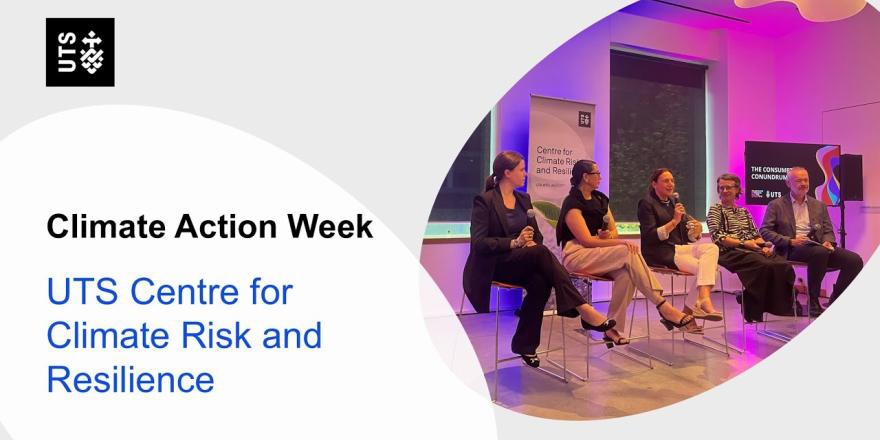
In this Climate Action Week session, hosted by the UTS Centre for Climate Risk and Resilience and UTS Business School, Australia’s leading thinkers, business leaders and researchers explore the ‘Consumption Conundrum’.

29% of Aussies are now doing something called doom spending, where they're looking at how can I inject a sense of meaning, of pleasure, of distraction into the world that is increasingly feeling out of control.

There's 974,000 Aussies that work more than one job, 72% of Aussies feel pessimistic about their financial future and 70% of young Australians don't think home ownership is in within their reach.

I think in business right now, there is a inevitable challenge in how do you do the right thing for the environment, the right thing to contribute to a more socially equitable community and simultaneously deliver the financial and fiduciary obligations that you also need to deliver.

60 to 70% of the incentives go to people who have already decided on the purchase of an EV and would potentially be able to afford this without any type of incentive, right? So it does create a distortion...for people who are not in a category where they can easily afford these types of investments to really join in on the energy transition.

Speakers

  • John Lydon, Co-Chair of Australian Climate Leaders’ Coalition, Chair of Generation Australia and Industry Professor, UTS Business School 

  • Catherine King, Chief Strategy Officer, Leo Burnett

  • Nicky Sparshott is an experienced CEO, Board Director and change agent, most recently as Global Chief of Transformation at Unilever 
  • Siobhan Toohill, leading sustainability advisor, including the first Chief Sustainability Officer at a major Australian bank
  • Professor Martina Linnenluecke, Director, UTS Centre for Climate Risk and Resilience. 

The UTS Centre for Climate Risk and Resilience aims to help businesses address the physical and transition risks bought on by climate change — developing new strategies for value creation and sustainability. Through global research impact, CCRR aims to safeguard the ecosystems and local communities in which businesses operate.

This event was hosted by the UTS Business School. If you are interested in hearing about future events, please contact business.events@uts.edu.au

Share