

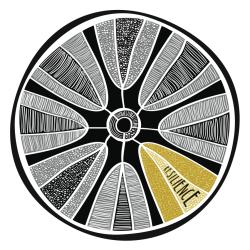
Artwork by Lucy Simpson, Gaawaa Miyay Designs, gaawaamiyay.co .
Strength of Indigenous culture
The Indigenous cultures of Australia are the oldest living cultural history in the world, going back at least 120,000 years (Sherwood, 2011). One of the reasons Indigenous cultures have survived for so long comes from the ability of peoples to adapt and change over time.
"Indigenous worldviews are holistic, integrating the past, present and future through the layering of knowledges and lived experiences; hence they are not static but are ever-changing, shifting from historic/traditional to contemporary."Professor Juanita Sherwood
Resilience of Indigenous Australians, their languages and cultures, is sustained by the family-centred, cooperative and community-focussed values which have been maintained by many generations of peoples [1].
Resisting further erosion
However, the impact upon Aboriginal people of colonisation and dispossession has resulted in the breaking down of many cultural ties, traditional practices and beliefs. Despite this, there is evidence that Indigenous Australians’ connections with their culture and traditional language is resisting further erosion.
Between 2001 and 2006, the Census count of Aboriginal people had doubled: the high level of growth reflects natural increase and non-demographic factors, such as people identifying their Aboriginal origin for the first time.
The 2002 National Aboriginal and Torres Strait Islander Social Survey indicated that more than half of the total Aboriginal population identified with a clan, tribal or language group and that almost 70% of the total Aboriginal population had attended a cultural event during the past 12 months. The 2006 Census also reported that 52,000 people (one in eight, or 12% of Aboriginal Australians, aged 5 years and over) spoke an Aboriginal language at home.
"…we need to include Aboriginal people and Torres Strait Islanders in our communities so that we can all learn from one another and develop a real awareness, understanding, appreciation and respect for the culture and history of Indigenous Australia…Its basis is the inclusion of the Indigenous peoples of Australia, not their exclusion. And that is healing for all of us."
– Flora MacDonald, from the ACT Branch of Australians for Reconciliation
It is also important to support self-determination. For instance, the Aboriginal Community Controlled Health Services (ACCHS) offer a model of Indigenous Australian engagement that many other organisations could usefully follow.
ACCHS are culturally competent services that embody Aboriginal and Torres Strait Islander peoples’ right to self-determination as applied to health services. They have a history of delivering improved health outcomes in communities where other health services have not.
Through their employment of Aboriginal and Torres Strait Islander health professionals they are also best placed to offer traditional and innovative contemporary healing practices.
Acknowledging misdeeds
On the 13th of February 2008, the Prime Minister, Kevin Rudd, tabled a motion in parliament apologising to Australia’s Indigenous peoples, particularly the Stolen Generations and their families and communities, for laws and policies which had “inflicted profound grief, suffering and loss on these our fellow Australians.”
Closing the Gap
The Apology included a proposal for a policy commission to ‘close the gap’ between Indigenous and non-Indigenous Australians in “life expectancy, educational achievement and economic opportunity.”
Summary of progress against the COAG Closing the Gap Targets
- Based on a downward trend in death rates over 1998–2010, at this stage the Northern Territory is the only jurisdiction believed by the COAG Reform Council to be on track to meet the COAG Aboriginal and Torres Strait Islander life expectancy equality target by 2030. While in absolute terms the overall trend is to increasing Aboriginal and Torres Strait Islander longevity, the capacity of these gains to close the gap remains an issue. [2]
- If current trends continue, under-five Aboriginal and Torres Strait Islander mortality rates may fall within the range of the COAG Target to halve the gap in under-five mortality by 2018. However the relative lack of progress in recent years and the widening differential on the critical factor of low birth weight cause concern. [2]
Finding hope and moving forward
To thrive, Indigenous Australians’ – their beliefs and values – need to be understood and respected; past and present misdeeds perpetrated by non-Indigenous peoples must be acknowledged and addressed. There are a lot of positive stories to tell about how this has been done and how non-Indigenous Australians are working in partnership with Indigenous Australians to extend the health benefits enjoyed by the majority of the country to those who are often marginalised.
This Resource Pack is inspired by the examples of those striving to improve the health of Indigenous Australians. It seeks to equip teachers in the Faculty of Health with the tools to foster a learning environment that allows all graduates to develop their “professional cultural competency which contributes to the health and wellbeing of Indigenous Australians, inclusive of physical, social, emotional and spiritual wellness.”
Chapter References
[1] For her PhD, Dr Marion Kickett, from the Curtin Health Innovation Research Institute’s Aboriginal Health and Education Research Unit met with Aboriginal Elders and successful Aboriginal people who had been working or studying for 10 or more years to determine what their definition of resilience was and how they became resilient. “The things that were most important to people were family identity and culture, as well as individual spirituality and a sense of belonging,” she said. “It soon became clear that the people who were the most resilient and able to move on were those who had addressed these issues.”
[2] The Close the Gap Campaign Steering Committee, February 2013.
Artwork
Australian ‘Aboriginal art’ has had a significant impact internationally and is recognised as some of the most unique and contemporary work being done in the world today. Due to its continuing links to country and culture, artwork by Aboriginal artists belongs both in museums and art galleries. Lena Nyadbi’s work entitled ‘Barramundi Scales’ was recently reproduced across the roof of a French museum, visible from the Eiffel Tower. This type of recognition means that many artists and cooperatives are becoming world players in the international art market which has positive connotations for cultural pride and reconciliation. Art remains an arena where Aboriginal Australians are thriving, demonstrating not only resilience and survival but growth and boundary pushing.
UTS ART Education and Outreach Co-ordinator Alice McAuliffe and academic Jennifer Newman have produced a series of videos that explore the cultural and social contexts of Indigenous artwork from the UTS Art collection.
‘Grandfather Gaze’ by Vernon Ah Kee
Grandfather Gaze, rendered in charcoal, is one in a series of portraits by Vernon Ah Kee of his family members. The inspiration for this series came when Ah Kee accessed the resources of the South Australian Museum to view the Tindale Collection, which included photographs of his family members, taken in 1938. Through the process of up-scaling the small photograph to a large image Ah Kee has shifted the subject from scientific document to a portrait of a valued family member.
Additional artwork
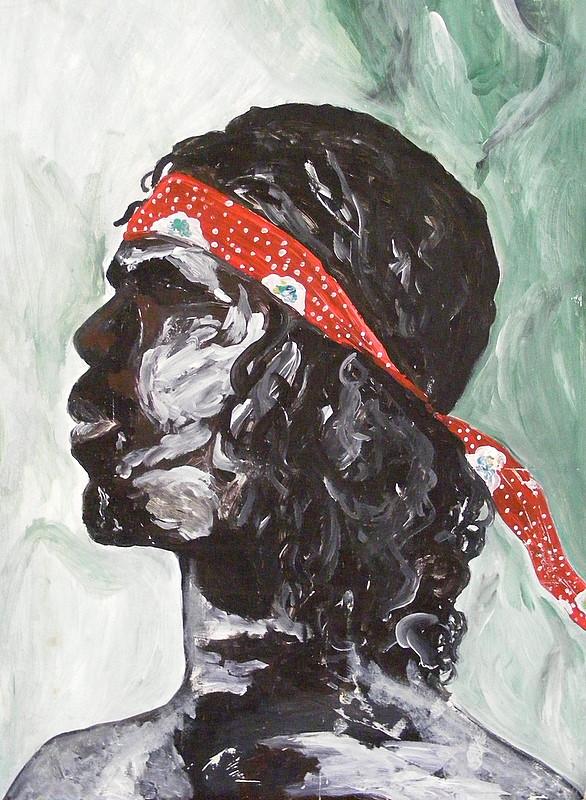
Indigenous Man by Jacqui Stewart. Image provided by the artist. jacquistewart.com.au
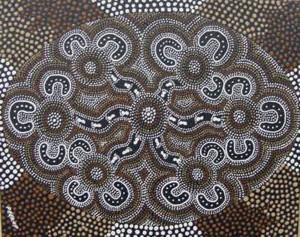
Jeff Roberts : Dreamtime. Image used with permission